The semiotics of clothes, especially royal ones, can be fascinating, sending out powerful messages. Think of the jewel-studded, pearl-strewn portraits of Queen Elizabeth I or Princess Diana’s revenge-chic black dress. As a fashion queen herself (Justine Picardie was editor-in-chief of Harper’s Bazaar for more than seven years and has an acclaimed book on Chanel under her belt), no one is better placed to unpick the subtleties of royal public couture. So, judging by this book’s title, I was expecting a shrewd analysis of diplomacy dressing, with perhaps some behind-the-scenes vignettes. What happens if a royal lady unexpectedly gets a ladder in her tights at a crucial moment? Is there a colour code if three of them are out together? How do hats stay on in a gale? And what happens to all the numerous garments that each wears in her lifetime? In fact, everything a fashion insider might know.
But most of these pages are devoted to a résumé of the events of the first half of the 20th century, covering everything from the late Queen’s childhood to her coronation, where the book ends. There is the wedding of her parents, the Abdication, the rise of Hitler, Kristallnacht, George VI’s speech therapy and so on, with copious quotes from Cecil Beaton and the memoirs of various royal couturiers. Everything is impeccably researched, with sources given – but haven’t we read much of it before?

The book starts promisingly: a history of the House of Windsor is threaded through with accounts of Picardie’s own meetings with royalty, at Balmoral and Windsor Castle (her husband, Philip Astor, was a godson of Prince Philip). Of one sojourn she writes:
The sartorial requirements were stricter than any I had encountered at the Paris couture shows as the editor of Harper’s Bazaar, and despite my long experience of the demanding formalities of French fashion houses, a visit to Windsor Castle was infinitely more nerve-racking.
The late Queen’s clothes are archived in a building near the Castle, which Picardie visited to see the Hardy Amies dresses from the earlier part of her reign, all carefully stored in grey boxes. The first dress shown is a strapless red velvet evening gown with a waist of only 23 inches, worn by the then Princess Elizabeth in the late 1940s.
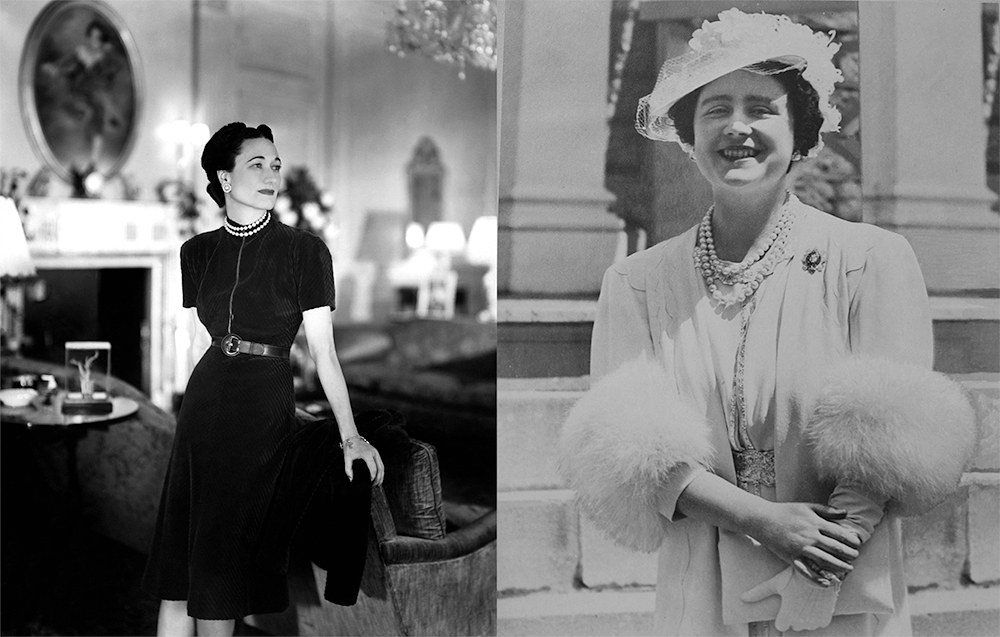
It is not until page 147 that we really get into couture, with descriptions of Wallis Simpson’s wardrobe, much of it from Schiaparelli, and the reactions of Beaton, who photographed her (in black and white) in the designer’s notorious lobster dress, designed in collaboration with Salvador Dali, just before her wedding to the Duke of Windsor in June 1937:
Given that Wallis approached fashion and photography with the utmost dedication, her choice to wear such a provocative dress is significant… Even without being able to see that the lobster is bright red, it is hard to ignore Dali’s insistence on the creature’s sexual connotations, given its suggestive position between Wallis’s thighs.
In July the following year the King and Queen paid the first state visit of their reign to Paris. With war clouds gathering, it was vital to reinforce the alliance between Britain and France. So when, three weeks before their departure, the Queen’s mother, Lady Strathmore, died, there could be no question of cancelling the visit. Fortunately, Norman Hartnell realised that wearing white for mourning rather than the customary black was a royal prerogative; and in three feverish weeks, complicated by intelligence reports of possible assassination attempts (four years earlier, King Alexander of Yugoslavia had been murdered in France) he designed an all-white wardrobe. ‘Thirty grand dresses to be worn from morning to midnight under the most critical eyes in the world,’ wrote Hartnell later. Leaving London in black, the Queen changed in the train, arriving in Paris in a floor-length column of milk-white crepe. The visit was a huge success, its climax a garden party in the Bois de Boulogne, where the Queen wore a frothy, diaphanous dress of cobweb lace and tulle. When she raised her white lace parasol to protect her famous complexion, ‘at a stroke,’ said Hartnell, ‘she resuscitated the art of the parasol-makers of Paris and London’.
Six months later the King and Queen embarked for America, their ship navigating icebergs through a heavy fog for part of the voyage. Here the choice of outfit could be even more demanding: what, for instance, should the Queen wear to greet people when the Royal Train stopped at 4 a.m. at a station in the Rockies? (A simple but flowing negligée dress in nectarine velvet was the answer.)
The Duke of Windsor dashed to Paris in 1940 to collect the Cartier brooch he had commissioned for his wife
Although the context is often in danger of overwhelming the subject, there are fascinating titbits, such as the Duke of Windsor’s dash to Paris to collect Wallis’s 44th birthday present. Just before France surrendered in June 1940, panic-stricken Parisians fled the city in cars, carts, on bicycles or on foot in what became known as l’exode. The Windsors, too, decamped to Biarritz where, once Wallis was installed in a luxury hotel, the Duke, for whom nothing was too much trouble if it pleased his beloved, returned through the throng to Paris. Here he collected the 4in-high brooch in the shape of a flamingo that he had commissioned from Cartier. This jewel, composed of emeralds, rubies, sapphires and diamonds, turned out to depict a national symbol of the Bahamas, to where the Duke and Duchess would soon be despatched.
My favourite story is of the dolls, Marianne and France, given to the two little princesses, Elizabeth and Margaret, during the French state visit. Each doll could have been an advertisement for French haute couture, with a trousseau designed by all the leading Paris houses – Lelong, Lanvin, Maggy Rouff, Paquin, Patou and so on, the only exceptions being Chanel and Schiaparelli – which took more than 20 packing cases to transport to London. There were even tiny matching Hermès handbags.


Comments