
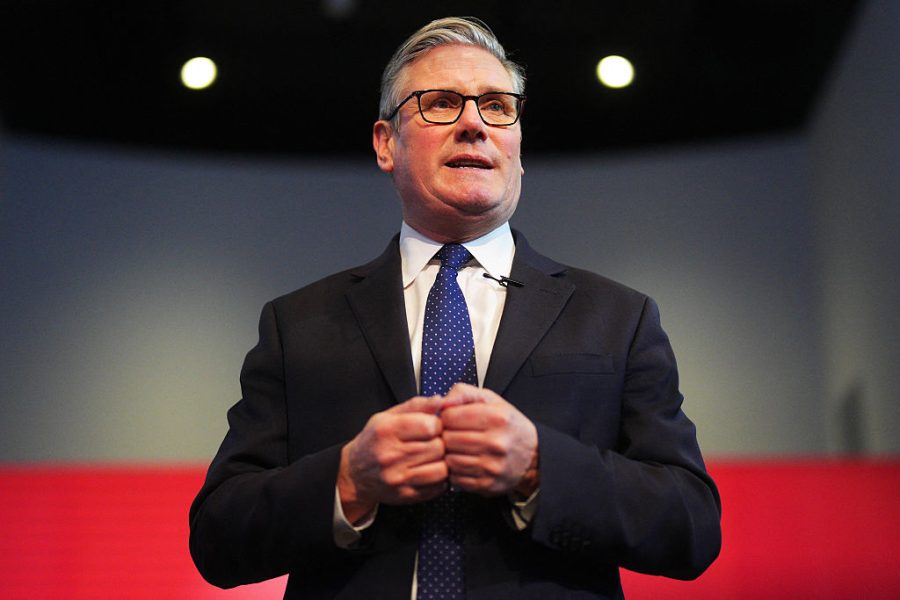
Keir Starmer has been seized by a dogged determination he does not always exhibit and has announced that he is seeking to revisit the UK’s participation in the European Union’s defence fund, SAFE. Established last May, Security Action for Europe (SAFE) is a fund designed to provide €150 billion (£130 billion) in competitively priced, long-maturity loans for urgent, large-scale defence procurement projects. It was primarily intended for the 27 EU member states, but the terms were drawn very carefully: the loans were also open to Norway, Ukraine and third-party countries which had agreed security pacts with the EU, and could be spent with companies meeting the same criteria.
This meant, of course, that the United Kingdom did not fall automatically within the criteria – and nor did Britain’s defence industry, one of the largest in Europe. When the first draft of SAFE was issued in March, there were rumours that some EU members, notably France, were keen to exclude the UK or at least minimise our involvement. This was hardly surprising, since the exclusion of BAE Systems, Babcock International, Rolls Royce and other UK-based manufacturers would hand a dominant position to the French defence sector (much of which is at least partially state-owned).
There is no indication that the EU is willing to scale back its demands for payment into the budget
Back in the autumn, Starmer tried hard to negotiate an agreement with the EU. His minister in charge of EU relations, Nick Thomas-Symonds, put on his best Pollyanna mask and talked about ‘a real shared sense of solidarity in defence across Europe’. But warm words were no match for cold, hard cash: talks broke down last November when the EU was reputed to be demanding that the UK pay contributions and fees of up to £5.7 billion simply for the right to participate in the scheme. This was clearly unacceptable.
What has changed, you might be prompted to wonder? Well, in the real world, absolutely nothing. There is no indication that our EU neighbours are willing to scale back their demands for payment into the Union’s budget. Instead, Starmer is relying on inspiring appeals to the better angels of their natures, in his own perennially humdrum way.
Europe, including the UK, needs to do more on security and defence. That’s an argument I’ve been making for many months now with European leaders… I do think on spend, capability and co-operation we need to do more together. I’ve made the argument and that should require us to look at schemes like Safe and others to see whether there is a way in which we can work more closely together… it makes good sense for Europe in the widest sense of the word – which is the EU plus other European countries – to work more closely together.
To his credit, the Prime Minister has been making this argument for many months, but no one has listened and it has borne no fruit. It is hard to imagine lawyerly reiteration making the difference and changing minds at this stage. But this is not simply about defence spending.
Since he came to office in July 2024, Starmer has been preoccupied with the need, in the words of his party’s manifesto, to ‘reset the relationship and seek to deepen ties with our European friends, neighbours and allies’. This was the driver behind agreement between the UK and the EU at last May’s summit meeting in London.
Partly, Starmer sees a closer relationship with the EU as a route to the elusive economic growth on which almost every aspect of his government depends. But there is also an impression that he regards cordiality with Brussels and with individual EU governments in the same way that he views obsessive obeisance to a maximalist interpretation of international law: as a sign of being a good global citizen. Witness, for example, the shameful and rapidly unravelling fiasco of his agreement with Mauritius over the British Indian Ocean Territory.
Starmer is entitled to that view, of course. But when British ministers go to Brussels to negotiate in earnest, they are playing with the big boys who know what they want and have decades of experience of how to get it. Since there has been no obvious shift in facts on the ground, any change will presumably have to come in our government’s attitude or negotiating skills.
This brings us to the fundamental question. If the UK is going to find a way to participate more fully in SAFE, we are entitled to interrogate the Prime Minister’s stance. With the defence investment plan now months behind schedule, how will Starmer balance direct investment in and support for the UK’s defence industry against the more diffuse contribution to a Europe-wide scheme? Where will the money come from, given that the Ministry of Defence cannot even finalise a contract for helicopters with the sole bidder – even when that bidder threatens to shut down its entire UK arm and the aircraft are required immediately to fill a capability gap? What does he actually want in the end?
Starmer will have to learn that mere articulation of a desired outcome does nothing to make it a reality. If he will make compromises on SAFE as part of a wider rebalancing of the relationship with the EU, we need to know. This is not secondary school, and the acceptance of the cool kids is not a valid policy objective. What does the UK want to achieve, where is it willing to compromise and what will the overall benefits be? If Starmer cannot answer those questions, it may be because he himself doesn’t know the answers – but he should.




Comments