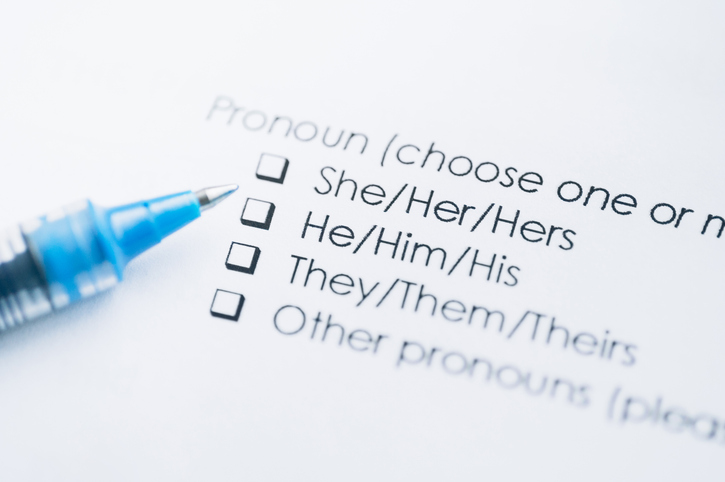
It’s been a cherished belief of progressives over the decades that you change the way we think, and in turn transform society, by changing the kind of language we use. This stretches back to a 1980s strand of feminism determined to jettison default masculine terms such as ‘chairman’ and ‘headmaster’ and replace them with gender-neutral equivalents. Then there are today’s hyper-liberals, who believe they can erase binary thinking on sex by introducing expressions such as ‘pregnant people’ or forgo ‘he’ and ‘she’ altogether and substitute everywhere with ‘they’. Many radicals have imagined that linguistic revolution is essential to actual revolution.
Unfortunately for these idealists, new research suggests that their faith has been misplaced. According to a study by behavioural economists at Exeter university, introducing gender-inclusive language in the workplace has no impact on behaviour and on its own will do nothing to advance women at work. Their findings were based on a study using over 2,000 volunteers in Britain and Austria, in which three groups were given an identical task couched in language ranging from strongly masculine to equally balanced. When it came to substituting gender-inclusive language, it concluded, researchers ‘could not find its use in English and German had an impact on the short-term display of crucial traits to climb the career ladder.’
Thinking precedes – and stands outside – speech or literacy
This is unsurprising. The idea that you can change the way people think by simply changing the language they use has been a resilient fallacy ever since the opening decades of the 20th century. Back then, owing to trends in philosophy, anthropology and linguistics, it became accepted wisdom that thought is determined by language and the particular linguistic concepts we impose upon reality. It was even held by many, and is still held by some, that thought itself was impossible without language. And unfortunately, this is one of George Orwell’s less impressive legacies. By inventing ‘Newspeak’, he entrenched the notion that words can curtail and even determine thought.

This conceit had a great appeal to progressives in the late 20th century, already confident that culture could always trump nurture and that the mind was infinitely malleable. This is why liberals became attracted to the idea of introducing the terms ‘Ms’, ‘s/he’ as a means of asserting equality, or – in a more forceful effort to raise awareness of the sexism inherent in English – consistently replace ‘he’ with ‘she’ when talking of hypothetical people. This custom is still rife in publication houses in the United States.
Wokery – a form of turbo-charged liberalism – has had even greater ambitions: being sure that manipulating language can not only change our perceptions of reality, but reality itself. This is evidenced on the undue weight radical trans activists have placed on individually curated pronouns which deny biological reality, or the belief that one can change or negate one’s sex altogether through mere performative utterance.
Long before these behavioural economists at Exeter stumbled upon the truth that altering language produces ‘absolutely no effects’ (to quote Loukas Balafoutas, lead author of the study), linguists such as Noam Chomsky and Steven Pinker have been telling us that changing language can’t change the way we think.
Sure, they and others who dismiss the shibboleths of linguistic determinism allow that one’s mother tongue colours one’s perception of the world, and that the faculty for language elevates and sharpens abstract thought. But they deny that thought is only possible with it or believe in the omnipotence of language. As Pinker concluded in The Language Instinct (1994): ‘there is no scientific evidence that languages shape their speakers’ ways of thinking.’
Thinking precedes – and stands outside – speech or literacy. Babies evidently think when responding to stimulus. So do adults who live in a world without spoken or written words. Were he a real person, that deaf, dumb and blind boy from The Who rock opera Tommy could still play a mean pinball.
As Bryan Magee remarked in a conversation with Noam Chomsky for his 1978 television series Men of Ideas, it isn’t even obvious that language necessarily enters into all the most highly developed forms of thinking. Stravinsky, when composing The Right of Spring, suggested Magee, ‘is cerebrating in as original, complex and sophisticated a way as anyone doing anything’. To which Chomsky replied:
We don’t have to go to the level of a Stravinsky to find examples of thinking without language. I’m sure that everyone who introspects will know at once that much of his thinking doesn’t involve language. Or, say, the thinking of a cat: that plainly doesn’t involve language.
Neither the gendered title of Magee’s series nor Chomsky’s use of the masculine impersonal pronoun should detract or distract from the substance of their exchange: that language plays second fiddle to thought. It doesn’t dictate the way we think. Tinkering with it is not a panacea and it won’t change the world.






Comments