
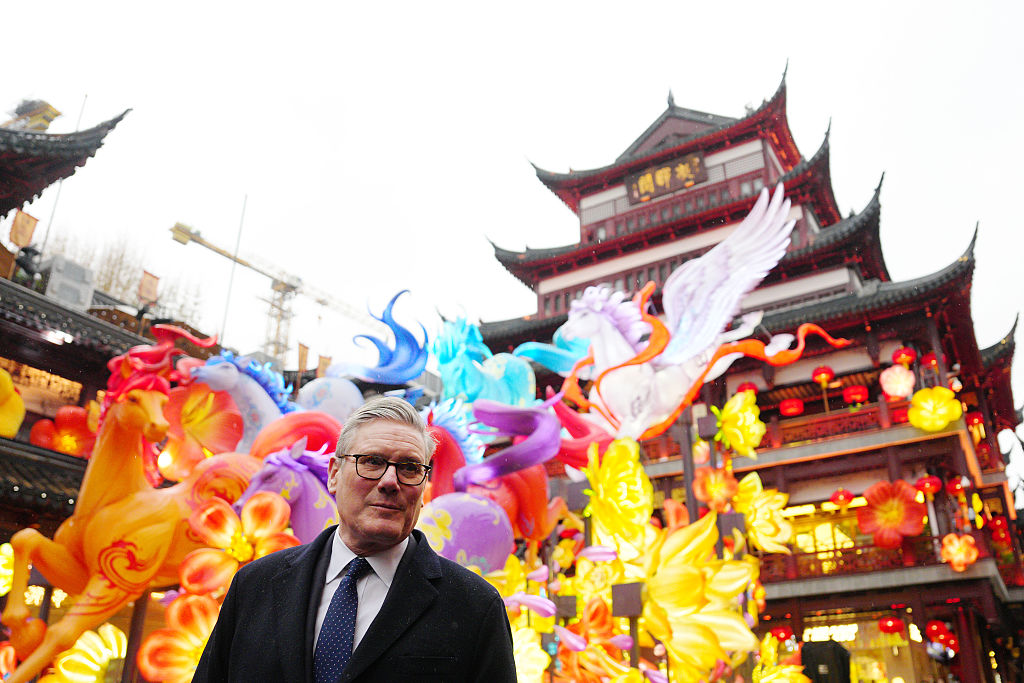
Keir Starmer has this morning arrived in Shanghai after two days in Beijing. He is expected to spend much of today talking up the ‘wins’ he has secured from his China trip. Yet it is striking how much of the briefing from ministers is around future deals to come, rather than actual deals secured to date, with only a ‘feasibility study’ in place for a potential agreement on financial services.
Currently, he is set to return without a single signed deal
So far, Starmer’s main achievements seem to be halving the tariffs on Scotch whisky and 30-days visa-free travel to China. Both are welcome liberalisations – but it is a very different scale to the £9 billion secured by Theresa May, the last British PM to go to Beijing. That is less a reflection on the efforts of HMG this time around and more an indication of the scaling back of Chinese direct investment since the pandemic.
Unsurprisingly, this has failed to impress much of the British press, who give Starmer’s deal both barrels today. ‘Is that it?’ asks the front page of today’s Daily Mail. The argument made by the likes of Emily Thornberry, the chair of the Foreign Affairs Committee, is that rebuilding relations after the Tory era is a long process. A thaw after the so-called ‘ice age’ from 2019 to 2024 will, inevitably, take time.
The trouble is that China has an unfortunate habit of doing things that tend to upend any attempt at dialogue. The jailing of Jimmy Lai, the surge in cyberattacks and the sanctioning of five MPs are just three instances in recent years – alongside much unreported mischief-making and espionage activities. Ahead of his trip, Starmer’s government backed the new Tower Hamlets embassy, which will likely be a long running sore in the months and years that lie ahead.
Two other observations about Starmer’s trip. The first is how Britain’s China policy now fits into the European mainstream. The median Labour MP is much more likely to take the view that, as one diplomat points out, ‘we are a normal European country’. We now have a China policy that is increasingly indistinguishable from France or Germany, straddling Washington as a security partner and China as an economic one.
The second is the capriciousness of America in all this. Donald Trump has attacked Starmer’s trip as ‘very dangerous’ – to the approval of British hawks. But is worth remembering that Trump himself has sold advanced chips to the Chinese, plans to visit Beijing in April and that the US trades far more with China as a share of overall trade.
Such cynicism is a longstanding trait of the DC establishment. In her memoirs, no less a Yankophile than Margaret Thatcher complained of American pressure to cancel business deals – while Washington maintained its own extensive trading ties with the USSR. But at a time of rising tensions, Trump’s unwillingness to stick to a united front against China makes it harder for Starmer’s critics to claim there is an alternative path.
So far, Starmer’s trip has proved to be underwhelming. Currently, he is set to return without a single signed deal – despite Mark Carney, his Canadian counterpart, managing to secure Memorandums of Understanding earlier this month. He just has to hope that his work this week will pay off in the long term.
Listen to the latest of James Heale on Coffee House Shots:





Comments