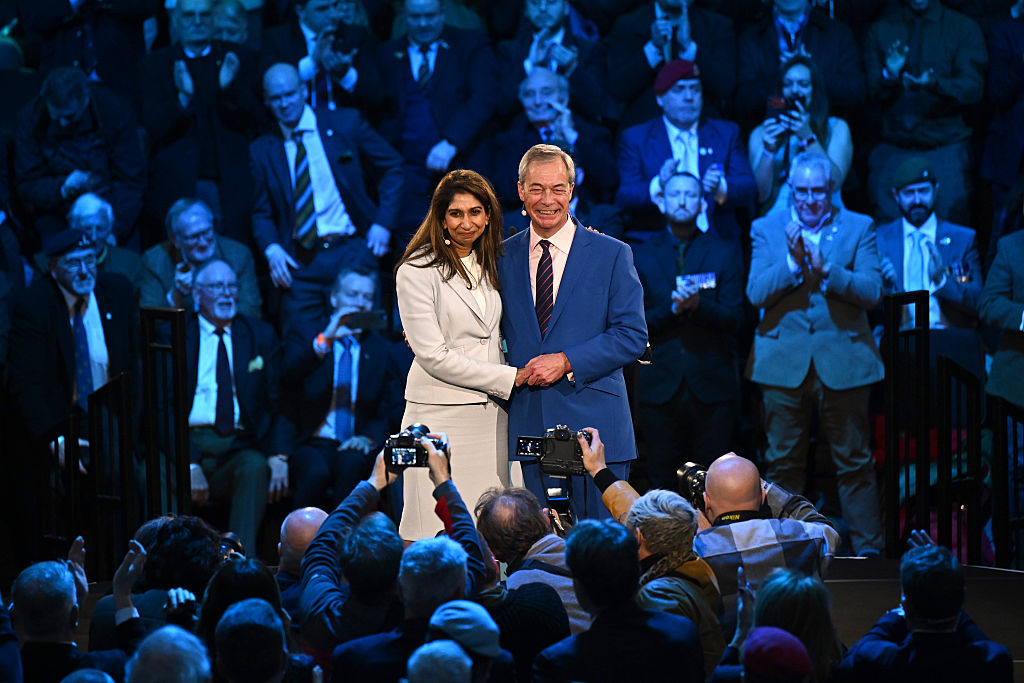
The Tory defections to Reform are continuing to mount up, with former home secretary Suella Braverman the latest to cross the floor this morning. Braverman’s defection has been hailed as a coup by Nigel Farage, who pointed out she is ‘somebody who’s reached high office in the cabinet.’ But there is an important question the Reform leader keeps avoiding: why aren’t these ex-Tories holding by-elections?
Nigel Farage’s superpower is the impression that he’s not like any other politician. That he sticks to his guns, tells it like it is, and acts on principle. And yet on this issue, he is being nakedly hypocritical
As Ukip leader in 2014, Farage rightly insisted both Douglas Carswell and Mark Reckless trigger by-elections after crossing the floor. Both duly won the ensuing contests. On his GB News show in 2022, reacting to the defection of Christian Wakeford to Labour, Farage reiterated his position, saying Wakeford was ‘dishonourable’. ‘It is a complete insult to voters for MPs to have the arrogance to think that it’s them they voted for when the truth is, most of us vote for or against the main party leaders,’ Farage stated.
So what’s changed? Suella Braverman is now the fourth Conservative MP in recent months to have switched to Reform without calling a by-election in her constituency, following Danny Kruger, Robert Jenrick and Andrew Rosindell. The simplest explanation is the most cynical: the Tory defectors are simply worried they’d lose. And yet given Reform’s standing in national opinion polls, it remains perfectly viable that all four could win their seats.
According to the polling website Electoral Calculus, Reform currently has a 46 per cent chance of winning Braverman’s Hampshire constituency of Fareham and Waterlooville, compared to 48 per cent for the Tory candidate. Meanwhile, Robert Jenrick would have a 43 per cent chance of victory in his East Midlands seat of Newark, Andrew Rosindell would have a 49 per cent chance of retaining Romford, and even Danny Kruger would have a 44 per cent chance of success in his leafy East Wiltshire constituency. In other words, there’s all to play for.

By-elections can, of course, be highly unpredictable. Voters could coalesce into powerful ‘stop Reform’ coalitions, risking significant political embarrassment to Farage and deterring future defectors. And yet they also present a huge opportunity. When Carswell and Reckless’s defections to Ukip’s were endorsed by their local electorates, it silenced those who believed the party’s rise was merely a passing phase.
Farage is determined to demonstrate that Reform is replacing the Conservatives as the main party of the right. At present, each defection has diminishing returns, and is fuelling the narrative that Reform is merely a sanctuary for disgruntled Tories. However, if the party were able to pull off a string of headline grabbing by-election victories, the damage to Kemi Badenoch’s leadership could be fatal.
Nigel Farage’s political superpower is the impression that he’s not like any other politician. That he sticks to his guns, tells it like it is, and acts on principle. And yet on this issue, he is being nakedly hypocritical. In his monologue on his GB News show in 2022, he cited Wakeford’s refusal to call a by-election as evidence that ‘nearly all’ career politicians viewed voters as ‘useful idiots’. He is now guilty of the very same crime.
Farage has already issued one condition for future Tory defectors: a deadline of 7 May, when the local elections are held. If the Reform leader wishes to continue to present himself as a man of principle, he should add another: that any future defectors trigger by-elections in their constituency. The potential rewards would justify the risk, but more importantly, doing anything else would – to use Farage’s own word – be ‘dishonourable’.





Comments