There’s a reason why centrists keep failing: their formula of triangulating between two sides of a debate in order to appear balanced, or to hedge against being wrong, won’t win over voters. It suggests a lack of leadership that should have no place in politics, especially when Britain faces such clearly identifiable problems.
The centrists are the real populists because they are chasing what they think the electorate wants to hear
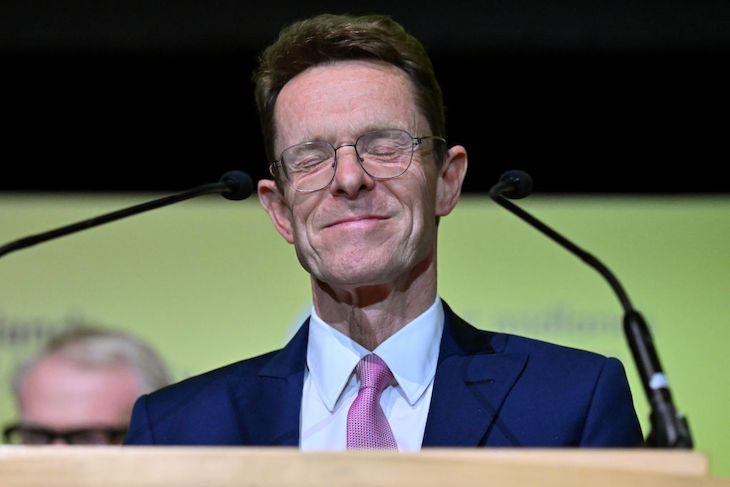
And yet, the centrists never learn. A new ‘movement’ – aimed at reclaiming the centre ground for the Tories – is being launched today by former Scottish Conservative leader Baroness Davidson and ex-West Midlands Conservative Mayor Sir Andy Street.
Street says of this project, dubbed ‘Prosper UK’: ‘The world is fragmenting into populists of the left and populists of the right and the centre ground is being squeezed out. Our argument is that is completely wrong. And actually in Britain, there are still a huge majority of people who have centrist views.’
The implication is that this group will work out what a ‘centrist’ Conservative party would have to do, or say, in order to win back those voters – and win back office, with seemingly little heed taken of what those promises would do to the country should such an empty government be returned. It’ll fail, of course.
This latest centrist initiative calls to mind the old adage attributed to Alexandre Auguste Ledru-Rollin, one of the leaders of the French revolution of 1848: ‘There go my people. I must find out where they are going so I can lead them’. Politicians spend far too much time trying to understand the current views of the electorate just to ape them in order to win support. Instead, leaders ought to lead. This can take one of two forms. There is the ideological; starting from first principles and working out both a vision for what a country can and should be and behave. Think Charles de Gaulle’s ‘une certaine idée de la France’. The second is more pragmatic; diagnosing a country’s material ills, then designing and ruthlessly implementing the solutions come what may. I would broadly call this the Lee Kuan Yew school of thought.

In both cases, the job of the leader is to sell the vision, or at least the plan, to the people and use all the means at their disposal to win over their hearts and minds. Both of these approaches have their strengths and weaknesses, but at least they are based on having a clear strategy and a belief that their proponents are attempting to change things for the better. By contrast, the ‘centrist’ approach has everything the wrong way around. By following the fickle vicissitudes of an electorate who have better things to do than worry about politics leaves one vulnerable to events and changing cultural norms.
One thing that both Britain’s right-of-centre party leaders have in their favour is that they both follow William Buckley’s phrase and ‘stand athwart history, yelling Stop, at a time when no one is inclined to do so, or to have much patience with those who so urge it’.
Nigel Farage was pushing the idea of Brexit for decades before it was cool. The Reform leader has done the same thing recently with net zero and ID cards. And Kemi Badenoch was the one senior politician who saw through the insanity of believing in ‘trans children’ at great personal and reputational risk when that particular social contagion spread across the West. To her credit, Badenoch and her excellent de facto Tory deputy Alex Burghart have resisted this revanchist centrism, with the leader telling Tory MPs last week: ‘We are the party of the right and we will always be a party of the right.’
The centrists, then, are the real populists because they are merely chasing what they think the electorate wants to hear. What centrists need to learn is that a leader owes us, in the immortal words of Edmund Burke: ‘not his industry only, but his judgment; and he betrays, instead of serving you, if he sacrifices it to your opinion.’
Some voters are no doubt put off by ideology, and terms like ‘left’ and ‘right’ mean little to those worried about the cost of living and getting their children to school on time. So if the parties of the right want to appear like unifiers who can represent ‘one nation’ (to steal the Tory wets phrase back) they should turn, as always, to Margaret Thatcher, who understood this mistake decades ago: ‘It is not the centre ground, but the common ground – the shared instincts and traditions of the British people – on which we should pitch our tents. That ground is solid, whereas the centre ground is as slippery as the spin doctors who have colonised it.’






Comments