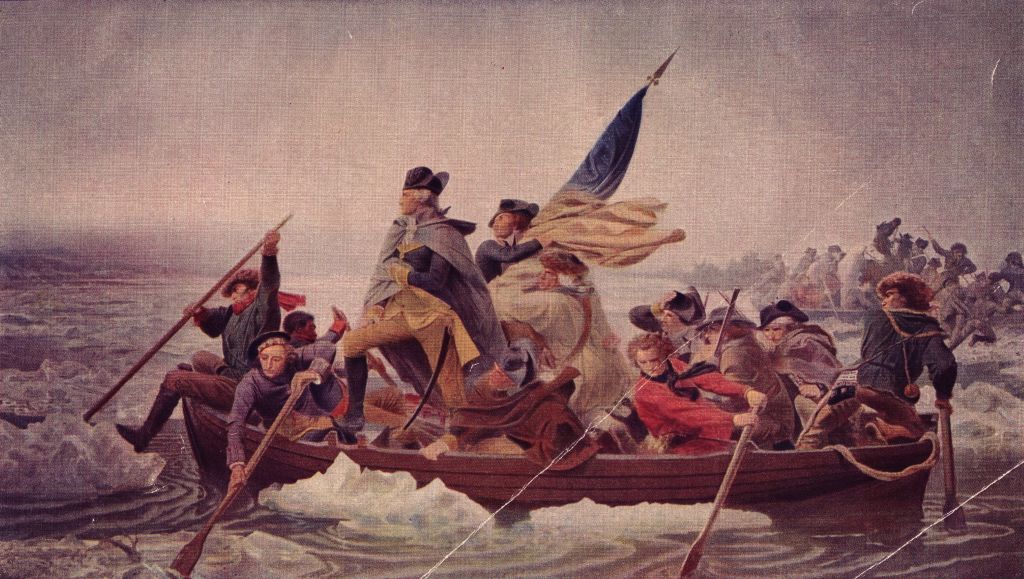


We Americans celebrate July 4, 1776, as our national birthday, and this year, of course, marks our 250th. But the American Revolution began before that. And when did it end? Maybe it never did. In 1812, warhawks in Congress and president James Madison – the man known to posterity as the very father of the Constitution – launched an invasion of Canada in the hopes of completing the American Revolution. Canada was unfinished business. We had invaded Québec in 1775, but that was a disaster. And even though the 13 colonies that became the United States succeeded in winning their independence from Britain, the newborn US was not altogether free. The British still had forts in our territory, British agents were suspected of inciting Indians to harry our western frontier and the British Navy wielded considerable power over our commerce.
And then there was Canada, a vast territorial base from which the British could launch attacks against us, if they ever so chose. So was our war for independence really over? America’s first three presidential administrations didn’t want war. George Washington declared America neutral in the wars between revolutionary France and Britain – despite a mutual defense treaty we had ratified with pre-revolutionary France – and did his utmost to keep us from being dragged into Europe’s superpower conflict.
Isn’t it a rip-off if Denmark can extort security subsidies from us on the threat of Greenland going undefended?
John Adams hewed to the same policy, despite his affinity for the British and deep antipathy to the French Revolution’s ideology. Washington had earlier been disturbed by French meddling in American politics, notably in 1793 when the French ambassador (or minister, as the title then was) Edmond-Charles Genêt enlisted Americans to serve on privateers to harass British shipping and promoted pro-French “democratic societies.” Those societies were aligned with fully homegrown ones that were the nucleus of Thomas Jefferson’s political movement (and, eventually, party). France’s revolutionary regime eventually turned on Genêt, and he was lucky to be accepted by Washington as a refugee. But during the Adams administration, France persisted as a source of mischief, abroad and at home in the US, which led a Federalist Congress to pass the Alien and Sedition Acts, empowering Adams to expel foreigners at will.
Yes, more than 200 years ago, American politics was riven by bitter partisan divides over foreign influence and whether to remain neutral or aid in a foreign war for freedom and democracy (or, on the other side, for the international order and to prevent the spread of radical leftism). During the Whiskey Rebellion – which Washington blamed, somewhat implausibly, on Genêt –Jefferson even questioned whether armed intimidation of judges and federal agents was truly an “insurrection” or just an occasional “riot.” The riotous mobs of Jefferson’s own “democratical societies,” in their pro-French ardor, were not entirely unlike today’s antifa types.
The Alien and Sedition Acts added to Adams’s unpopularity and Jefferson won the 1800 presidential election. He believed some of the Federalists, notably Alexander Hamilton, really did want to undo the American Revolution while the British Empire harbored the same desire. Even so, he tried to keep the country out of the European bloodbath by means of an embargo on trade with the belligerents. But that only imposed more hardship on America’s export industries, including Southern agriculture.
Trade, territorial acquisition, strategic logic and ideology all provided grounds for Madison’s War of 1812, a war that America didn’t exactly win – the British even burned down the original White House, and of course, we didn’t get Canada – but that made us stronger anyway. We fought well enough to dispel any notion, in our own minds as much as those of the British, that our independence was insecure. And Canada became, if not exactly our hostage, a vulnerable asset the British now knew would be expensive to protect.
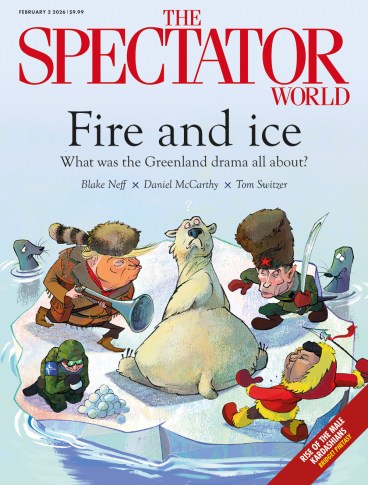
Yet more than 200 years later, Donald Trump likes to speak of Canada as fated to become our 51st state, although if he gets his way, Greenland will become a US territory first. Trump believes Canada depends as much on us today, both strategically and economically, as much as it ever did on the British Empire. So why shouldn’t it be ours, as it was once Britain’s? His thinking about Greenland resembles the way Americans thought about Canada in the lead-up to the War of 1812, too, in one respect: he sees it as a hole in our security fence. To forestall that, the US has already been the guarantor of Greenland’s security since World War Two. Isn’t it a rip-off if Denmark can extort security subsidies from us, forever, on the threat of Greenland going undefended or, worse, falling under the influence of a rival?
Jefferson had some constitutional qualms about purchasing the Louisiana territory from France, yet he found the strategic logic irresistible. “There is on the globe one single spot, the possessor of which is our natural and habitual enemy. It is New Orleans.” Whether or not Trump feels that way about Greenland, he’s doubtless aware, real-estate man that he is, that Greenland’s 836,300 square miles exceeds the size of the Louisiana Purchase. It would be the largest single territorial expansion in American history. Forget the history books – Trump wants to write his legacy on the map.
If it happens, it’ll be negotiated: even before Trump pledged at Davos not to use force, or tariffs, to take over Greenland, there was never any real risk of a War of 2026. But a problem remains. If Greenland is already a protectorate of ours in all but name, the same is true of Europe as a whole. Sooner or later, the price of accepting the American empire’s protection may be accepting that protection implies sovereignty. And Europeans may decide they’d rather lose Greenland than have to provide for their own defense.
This article was originally published in The Spectator’s February 2, 2026 World edition.






Comments