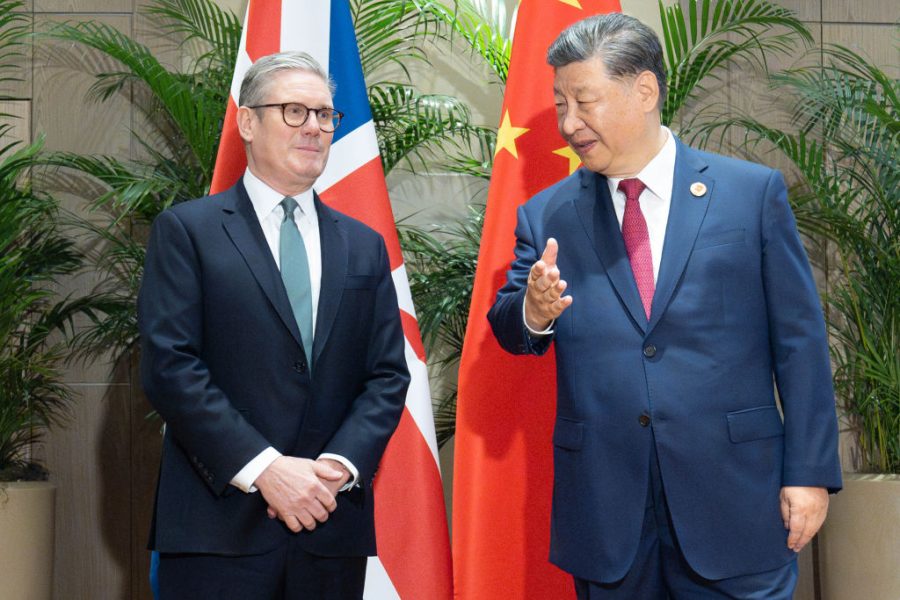
If one is in any doubt as to Great Britain’s decline and fall, look no further than 20 January, when we alienated ourselves from our once-held global status and from our allies and partners. Donald Trump took to social media that morning to declare that Britain’s deal to hand over the Chagos Islands to Mauritius was an ‘act of great stupidity’. The US president followed this up by telling Keir Starmer to ‘fix your country’. Never had truer words been spoken. Several hours later, the British government gave the green light for the construction of a new Chinese super-embassy in London. That decision demonstrated not a care in the world for the deleterious security risks this monstrosity would pose.
Labour’s actions reek of geopolitical and economic illiteracy
Labour’s actions reek of geopolitical and economic illiteracy. Ever since it agreed in May last year to lease the sovereignty of Diego Garcia, the largest of the Chagos islands, to Mauritius for 99 years at an average cost of £101 million per year, the government’s inability to comprehend the security ramifications of this agreement has been nothing short of stupefying.
Read the text of the agreement, and the reason behind this deal is clear: ‘decolonisation’. In this day and age, anything signed in the name of ‘decolonisation’ should be viewed with immense suspicion. In the realm of global security, there is neither room nor time for virtue signalling.
Not only is Mauritius over 1,200 miles from the Chagos islands, thereby nullifying any arguments over the need to give the archipelago to a geographically proximate state, but the country’s links with China are hardly benign. In addition to being a gateway for Xi Jinping’s Belt and Road Initiative, Mauritius has become a core recipient of Chinese financial donations for Mauritian infrastructural projects.

In 2019, Mauritius became the first African country with which China would sign a free trade agreement. For Beijing, Port Louis is a strategic partner, and Port Louis has Beijing to thank for its market access. It is no surprise that after the Chagos deal was signed, China’s ambassador to Mauritius hailed the moment as a ‘massive achievement’ for his host country. More importantly, it was a ‘massive achievement’ for China, for which the Diego Garcia base will become a perfect location to stymie British and US operations in an increasingly volatile Indo-Pacific region.
Meanwhile, the establishment of a Chinese ‘super-embassy’ in London, plans for which were approved earlier this week, is yet another stain on Britain’s global and domestic reputation. One of the most urgent questions which the Labour government shows no interest in answering is just who benefits from this colossus’s construction. The government’s arrogance is palpable. Were national security the government’s ‘first concern’, would the unnecessary building of the unnecessary establishment a stone’s throw away from London’s Square Mile not elicit concern? Beijing’s rapid outpacing of the West in using its technological prowess to gain access to sensitive data is hardly news. The super-embassy is just one more box ticked in Beijing’s ambitions for technological infiltration.
It is all well to speak of a crumbling international order in these uncertain times. But the hypocrisy of Starmer’s government could not be clearer. Labour may speak of the need to protect the people of Greenland from US ownership, but what about the Chagossian people, who openly oppose the handing of the archipelago to China?
It is also naïve simply to place blame solely on Washington for today’s fraying Western alliances. Britain must also take responsibility. Starmer may assert that the British government is in fact stabilising international order. He’s right – such stability is in China’s favour.
London’s decisions are not arbitrary. They, together with an unwillingness to call China a ‘threat’, form a choreographed act of appeasement ahead of the Prime Minister’s imminent state visit to Beijing. Over 5,000 miles away from our shores, Beijing’s neighbours of Seoul and Tokyo will seriously be questioning the motivations and actions of their Western partner. South Korea and Japan have long yearned for a reliable European economic and security partner in addition to their American alliance.
The UK is the only European country to share a reciprocal access agreement with Japan, with which it formed diplomatic relations in 1858. UK-Korea relations date as far back as 1883, with an alliance with South Korea formalised in 1949. When North Korea invaded the South in 1950, starting three years of protracted conflict, Britain deployed over 50,000 troops to liberate Seoul. Yet were Britain to ask South Korea to reciprocate in the future, in the event of any global conflict, it is possible that South Korea would say no, given London’s cosying up to Beijing.
Donald Trump is completely correct. More than being an act of great stupidity, the Chagos deal is an act of colossal geopolitical asininity. For all Washington’s rhetoric over a potential American takeover of Greenland, this is no Venezuela. The longer-term effects of future Sino-Western competition, in which Britain will now be wholly complicit, will be far more severe. Perhaps Russia’s foreign minister, Sergey Lavrov, was correct when he suggested that the adjective ‘great’ be dropped from ‘Great Britain’. If the United States does not intervene and kill this deal, Britain will move away from being ‘great’ in the eyes of the world. Instead, we will become a colony of China.




Comments