In 1969, Charles de Gaulle told his friend André Malraux that America’s “desire – and one day it will satisfy it – is to desert Europe. You will see.” It has taken nearly six decades, but de Gaulle’s prophecy now looks uncomfortably close to fulfillment.
After years of diplomatic effort to manage, placate and charm successive American presidents – and Donald Trump in particular – European leaders are coming to a grim realization: the United States is, at best, indifferent to their interests and sensibilities and, at worst, openly hostile to them.
Some, such as Italy’s Giorgia Meloni, still believe Trump can be cajoled, that the transatlantic relationship can somehow be salvaged. Even Sir Keir Starmer was at pains this week to play down the widening rifts with Washington.
Yet among EU officials, a harsher conclusion is taking hold: this time, with Trump’s bullying of Europe over Greenland, the rupture feels real. NATO, they fear, may exist in name only, and any attempt to rationalize or excuse Trump’s conduct risks self-deception.
This is NATO’s Suez moment. Just as Britain’s withdrawal from east of Suez in the late 1960s marked the effective end of imperial pretensions, the Greenland drama may signal the unraveling of America’s post-war security compact with Europe. If Suez revealed that Britain could no longer act as a global power, Greenland may reveal that the United States no longer sees itself as Europe’s guarantor.
At first glance, none of this is surprising. Long before his Greenland gambit, Trump was a hate figure across much of Europe. His narcissism, vulgarity and bombast seemed to confirm every suspicion about America at its worst: nativist, isolationist, crudely self-interested – a fortress America led by a man with little patience for allies or alliances. His recent foreign-policy maneuvers, from Venezuela to Greenland, appear only to reinforce that caricature.

But there is a more intriguing possibility. What if Trump’s noisy blundering is not merely the product of personal crudity, but an overdue recognition of a deeper truth – that the United States and its transatlantic allies are not natural partners?
What is usually called “the West” has never been a permanent community of shared interests. Western nations share a common history, culture and political inheritance. But a shared civilization does not automatically translate into enduring political unity.
As the Welsh-Australian foreign-policy realist Owen Harries argued in Foreign Affairs, back in 1993, relations among western nations have long been marked by rivalry, division, and even bloody internecine conflict. In retrospect, the periods 1917-18, 1941-45 and the Cold War were the only moments when a united “West” possessed any real political legitimacy. Even then, the term is something of a misnomer, since the principal enemies – Germany and Austria-Hungary in the first instance, Germany and Italy in the second – were themselves core western powers.
As Harries observed, the idea of a political “West” has appealed to Europeans mainly in moments of imminent danger. “Desperation and fear,” he wrote, “have been its parents, not affinities.” Remove the sense of threat, and Europe’s instinct has historically been not solidarity with Washington, but distance from it. The feeling has often been mutual. Even before final victory in World War Two was secured in 1945, the prevailing global model was not a unified West but the “Big Three,” with Franklin D. Roosevelt frequently more suspicious of Britain than of Stalin. After the war, FDR’s successor Harry Truman abruptly terminated Lend-Lease with little apparent concern for Britain or Europe. George Orwell imagined a tripartite world, with Europe standing apart from American capitalism and Soviet communism.
As it was at the beginning of the Cold War, so it was at the end. After the collapse of the Soviet empire, Europe was again treated as a separate pole, with Asia as the third. Far from clinging to Atlantic unity, many Europeans anticipated that a post-Maastricht Europe, led by a reunified Germany, would rival – or even surpass – American power.
When fighting broke out in Yugoslavia in 1991, the European Commission president Jacques Delors captured this reflex perfectly: “We do not interfere in American affairs. We hope they will have enough respect not to interfere in ours.” That the United States had liberated Monsieur Delors’s country from one totalitarian regime and then shielded western Europe from another for four decades was, apparently, beside the point.
The United States and its transatlantic allies are not natural partners
Soon enough, Europe proved incapable of managing the Bosnian crisis and has since become heavily reliant on Uncle Sam for its security. Yet the Soviet empire that justified NATO’s creation collapsed more than three decades ago, and the claim that today’s Russia represents a threat sufficient to sustain a revived West is strained.
Russia is a declining power: demographically weak, economically dependent on commodities and outside the world’s top economic tier. It is bogged down in the Donbas and lacks the military and economic capacity to conquer all of Ukraine, let alone the countries of the former Warsaw Pact. Russia poses little serious threat to western Europe, still less to the United States, even if military strategists share Trump’s concerns about Moscow’s ambitions in the Arctic.
Vladimir Putin is a thug and an autocrat whose regime inspires no admiration. But his ambitions are more limited than the revival of empire. The Kremlin seeks to wreck Ukraine so that it cannot join NATO and become, in political scientist John Mearsheimer’s phrase, “a western bulwark on Russia’s doorstep.”
More importantly, from Washington’s perspective, Russia is not the principal strategic challenger. China is – and Beijing is bent on overturning the status quo across East Asia. Moscow and Beijing may cooperate tactically, but they are not natural allies. They are historic rivals, divided by geography and long-standing suspicion, as the Sino-Soviet split during the Cold War amply demonstrated. What, then, is so staggering about Trump’s instinct to accommodate Russia by entering into dialogue with the Kremlin over Eastern Europe and even inviting Vladimir Putin to join his new “board of peace”? It reflects classic balance-of-power logic: an effort to prevent a durable Sino-Russian alignment against Washington.
Too many politicians in Britain and across the continent take comfort in the belief that Trump is an aberration: that America’s foreign-policy establishment remains instinctively committed to Europe. Normal service, we are assured, will resume once Trump leaves office on January 20, 2029 – if, indeed, he does.
But if a week is a long time in politics, as Harold Wilson once observed, three years is an eternity. More troubling still, history suggests that America’s commitment to Europe has surfaced only when core US interests were directly imperiled: German submarine warfare in 1917; Pearl Harbor in 1941, followed by Hitler’s reckless declaration of war; and Soviet expansionism in the late 1940s. The communist threat bound America and Europe together for four decades. Putin’s Russia does not meet that threshold.
Meanwhile, the global balance of power has shifted decisively. Washington must now reconcile its ambitions with its resources in a multipolar world. The United States is overstretched, and even American power has limits – not least when it now spends more servicing its debt than on defense.
Which brings us back to Suez. In 1956, the Eisenhower administration pulled the financial rug from beneath Britain to force Anthony Eden’s government to halt its ill-fated invasion of Egypt. Suez compelled Britain to abandon the comforting illusion that it remained a genuine global power. A decade later, Harold Wilson’s government announced the withdrawal of British forces from “east of Suez.” The Pax Britannica was over.
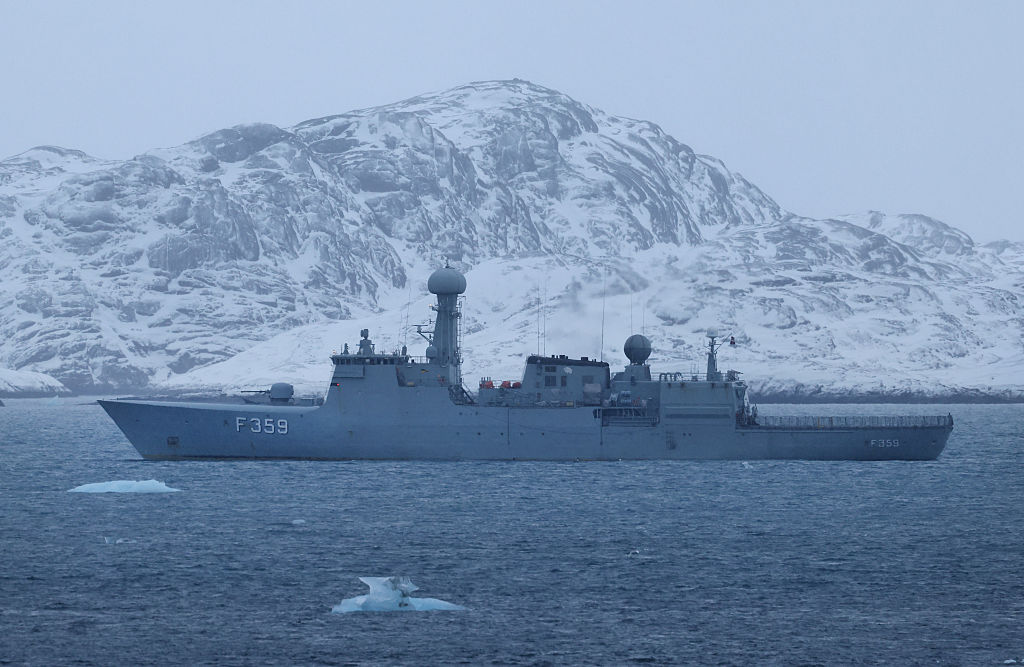
Seventy years on, Donald Trump appears intent on ending the Pax Americana. This does not imply American retreat, but strategic reordering: away from Europe, towards East Asia and back to the defense of the western Hemisphere. Trump’s emphasis on protecting America’s “near abroad” is not novel. The defense of the hemisphere has been Washington’s paramount priority since the 1820s. The principles underpinning the Monroe Doctrine have long gone unstated because they were assumed. And let’s remember that Greenland, the world’s largest island, is geographically North American. It is also at the centre of strategically contested Arctic sea lanes and home to rare earths.
The more pertinent question today is how Washington now views the world beyond its so-called backyard – above all Europe, East Asia and the Persian Gulf. During the Cold War, Europe occupied pride of place in American grand strategy for the simple reason that the Soviet Union posed an existential threat. In recent times, Europe has ceased to be of vital interest to the United States – not just because, as the Trump administration’s National Security Statement recently warned, it is undergoing a form of “civilizational erasure,” but because it is simply no longer a major strategic or economic theatre of global power.
Given Trump’s indifference to Europe, his bluster over Latin America and the Arctic and Washington’s pivot towards East Asia, it is little wonder that commentators on both sides of the Atlantic are being “mugged by reality,” to borrow the old neoconservative phrase. Trump is less the author of transatlantic estrangement than its accelerant and exposer. He has stripped away comforting illusions about a permanent political West and forced Europeans to confront a truth long deferred: western unity was always conditional, contingent and driven by threat.
Trump’s bluntness, to put things mildly and politely, is jarring and destabilizing. He is certainly a lout, whose conduct has shocked many old friends. Yet the more shocking truth is not that America has changed. It is that so many in Britain’s and Europe’s foreign-policy classes assumed it never would.






Comments