
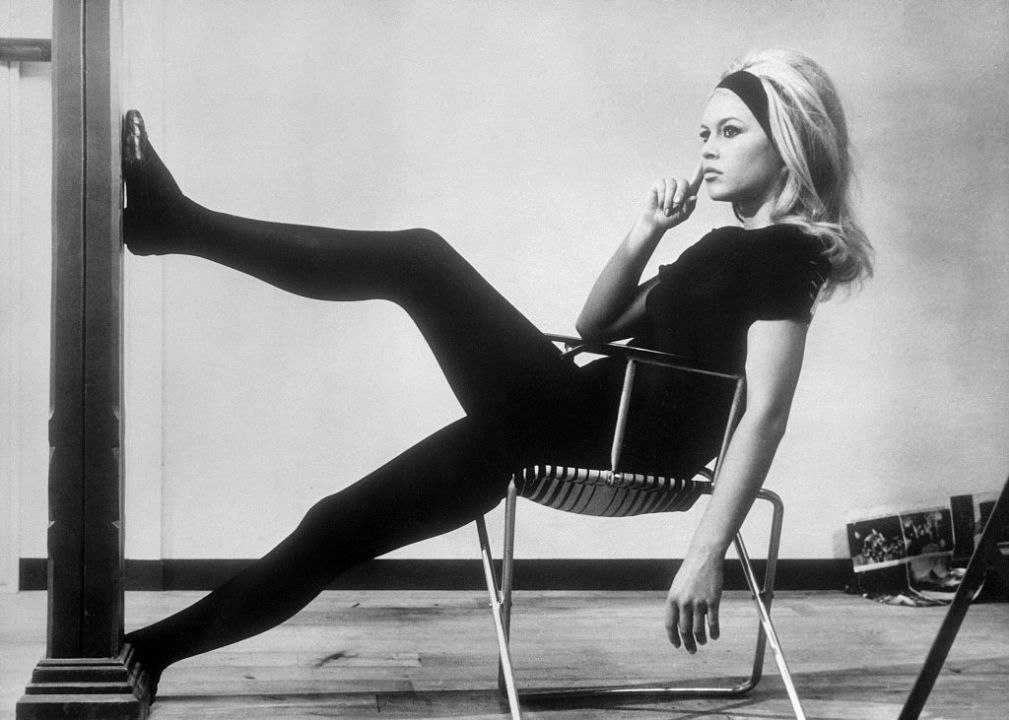
My teenage self was right. Brigitte Bardot, who died this weekend, symbolised sex and freedom. It’s why I had a poster of her on my study wall at school in which she was topless in a white cowboy hat and faded blue denims with the zip undone to reveal that she had no knickers. Needless to say it was not long before someone burnt a hole in her crotch with an aerosol can and lighter. But I still kept the poster up.
Such was the impact of Bardot on teenage boys like me that at a certain point I hitch-hiked off to Saint-Tropez where she lived. Once there, I moved about barefoot in faded denims and Breton fisherman’s shirt, just like she used to do. Dreaming.
Bardot personified the sexual revolution of the 1960s which above all meant the unleashing of female sexual desire and all its potentially terrifying consequences
It was in Saint-Tropez in the summer of 1968 – the year that Soviet tanks rolled into Prague and France toyed with revolution – that Bardot had a fling with a famous Italian playboy Gigi Rizzi. ‘While French students burned flags and occupied universities in ’68,’ he would recall, ‘we engaged in our own battle against conformity.’
So huge was the reaction in the Italian press to Rizzi’s ‘capture’ of Bardot – then married to her third husband, Gunter Sachs, an Opel heir – that it was as if Italy had defeated France and Germany combined in a World Cup final. As one Italian journalist wrote: Rizzi had ‘planted the Italian flag on the most delicate and sensitive part of French pride… It was something so stupefying as to obscure for a moment [the revolutionary unrest of] Sixty-Eight.’
But of course it was Bardot who was calling the shots, not Rizzi. For Bardot symbolised not just sex, or freedom in general, but the sexual freedom of women.

Naturally, no one in their right mind would want such a woman as their girlfriend, let alone wife (she was married four times). For a start, the obsessive attention paid to her by other men would have been hard enough to cope with. But worse, she was incapable of fidelity as she herself confessed in her memoir Larmes de Combat (Tears of Battle): ‘I’ve always looked for passion. That’s why I’ve frequently been unfaithful.’
Andy Warhol famously called Bardot the first modern woman. She personified the sexual revolution of the 1960s which above all meant the unleashing of female sexual desire and all its potentially terrifying consequences.
In essence, this meant that men had to accept what they had until then regarded as unacceptable: female promiscuity. They did not, and do not, find it easy.
In the film that launched her career, And God Created Woman, set in Saint-Tropez before it became a tourist resort, she plays a young women who flits thoughtlessly from one man to another. ‘That girl was made to destroy man,’ says one of her victims,
In a 1959 essay ‘Brigitte Bardot and the Lolita Syndrome’ the French feminist and existentialist, Simone de Beauvoir, called her the ‘locomotive of female history’. ‘In the hunting game, she is both hunter and prey,’ De Beauvoir writes. ‘Males are an object for her, as much as she is an object for them. This is precisely what hurts males’ pride.’
She adds: ‘With BB they get nowhere. She corners them and forces them to be honest with themselves. They are obliged to recognise the crudity of their desire, the object of which is very precise – that body, those thighs, that bottom, those breasts. Most people are not bold enough to limit sexuality to itself and to recognise its power. Anyone who challenges their hypocrisy is accused of being cynical.’
Bardot’s sexuality threatened women as well as men. Mothers, especially. Scared that their daughters would grow up to become like her, they bombarded ‘newspaper editors and religious and civil authorities to protest against her existence.’
Nor would you want Bardot as your mother. In a 1996 memoir Initiales B.B., she wrote that when pregnant in 1959 with Nicolas-Jacques, her only child, he felt like a ‘cancerous tumour’ and she would have ‘preferred to give birth to a little dog’. After his birth, she made one of several suicide attempts in her life and soon afterwards divorced the boy’s father, Jacques Charrier, the actor and painter who brought him up. She rarely saw him.
Such a visceral hostility to having children might appeal to a certain type of feminist but Bardot went out of her way to oppose feminism.
‘Feminism isn’t my thing… I like men,’ she told BFM TV in her final TV interview this year. When the interviewer suggested it was possible both to be a feminist and like men, Bardot shouted: ‘No!’
As for MeToo, asked by Paris Match in 2018, what she thought of actresses denouncing men for harassment in the film industry, she replied: ‘In the vast majority of cases they are being hypocritical, ridiculous, uninteresting… There are many actresses who flirt with producers in order to get a role.’
Her decision in 1973 to quit the cinema for good aged 39 probably saved her sanity if not her life, even if she did become batty. Feeling increasingly bored with making films and imprisoned by the media obsession with her as a global sex symbol her last film was The Edifying and Joyous Story of Colinot.
All her life she had suffered from depression and her fame made it worse. At one point, nearly half (47 per cent) of all conversation in France was about Bardot, according to one survey, and only 41 per cent about politics.
But what finally convinced Bardot to take a leap in the dark and quit films to dedicate her life to looking after animals and defending their rights was a goat which was an extra on the film set. Between takes, she told the old woman who owned it: ‘What a lovely goat.’ To which the woman replied: ‘You’d better hurry up and finish your film because it’s going on the spit on Sunday for my grandson’s first communion.’ So Bardot bought the goat and took it back to her hotel where it slept in her bed. ‘I realised the life of an animal was more important than all these singeries,’ she said. ‘And I decided not to do them anymore. I know how animals feel. I was hunted, hunted, hunted.’ Her well-endowed Brigitte Bardot Foundation these days employs 110 staff looking after animals in France and abroad. As she confided to Le Monde in 2018: ‘Without animals, I would have committed suicide.’
Many on social media were quick to brand Bardot a fascist when she died because she had supported Jean-Marie Le Pen’s Front National, and its successor, Rassemblement National, led by his daughter. Bardot’s fourth husband was businessman Bernard d’Ormale, a former adviser to Jean-Marie whom she married in 1992 and remained with until her death. She once called Marine Le Pen, whose party has the most seats in parliament and is well ahead of the others in the polls, the Joan of Arc of our day.
In later years, Bardot was convicted several times of incitement to racial hatred. Many would feel her remarks were certainly not deserving of a criminal prosecution. In December 2006, for instance, Bardot wrote to then Interior Minister Nicolas Sarkozy to object to the Muslim practice of slitting the throats of sheep without first anaesthetising them. France was ‘tired of being led by the nose by this population that is destroying us, destroying our country, by imposing its acts,’ she added. A French court found her guilty of incitement to race hate and fined her €15,000. Elsewhere, in 1999, she wrote that France was ‘invaded by an over-population of foreigners, especially Muslims’ for which a court fined her €30,000.
But such was her allure that few people cared all that much about her strident views on Muslims, especially as many agreed with her more or less anyway.
In 1969, President General Charles de Gaulle, who said she was as important an export as Renault, decided that she should be the model for the first ever real-life model of Marianne, the personification of France. Copies of a sculpture of her head adorned every town hall in France and postage stamps. Bardot, for better or worse, had become the face of France.




Comments