William Skidelsky

William Skidelsky is the author of Federer and Me: A Story of Obsession.

Why Europe riots

From our UK edition

36 min listen

This week: In the magazine we look at the recent protests in France. The Spectator's Douglas Murray argues that racism is not the problem but that a significant chunk of the unintegrated immigrant population is. He is joined by Dr Rakib Ehsan, author of Beyond Grievance: What the Left Gets Wrong about Ethnic Minorities, to investigate why Europe riots. (01:16) Also this week: Journalist Ivo Dawnay and The Spectator’s associate editor Toby Young discuss the plight of 'politically exposed persons' in the magazine this week. This is of course in light of the news that Nigel Farage has had his bank account closed, with many speculating he has been 'debanked' simply because of his political views and associations.

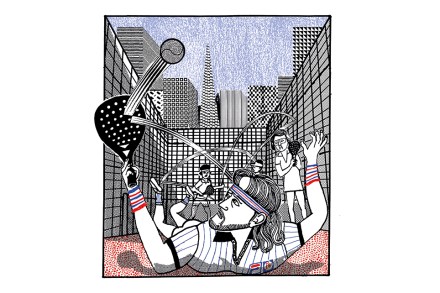
Watch out Wimbledon: padel is taking over

From our UK edition

For the past 15 years, I’ve had an entirely healthy compulsion – my wife, I suspect, would disagree – to play tennis at least twice a week. I assumed this habit was so ingrained that nothing short of a calamitous injury could ever keep me from my fix. Spain is where the craze took hold. Now it’s the country’s second most popular sport, after football I think I may have been mistaken. Recently, I’ve discovered a new sport which is proving, if anything, more addictive. Time will tell if this is a fleeting crush, or the start of something more enduring – but I am beginning to wonder whether my new-found love of padel will lead me to abandon tennis. I hear you ask: what exactly is padel?

Roger Federer is the Shakespeare of tennis

From our UK edition

It was the news we were supposed to be ‘dreading’: the confirmation that Roger Federer was finally hanging up his racket. But when I heard the announcement on Thursday, my feelings were more akin to pained relief. For a long time now, being a Federer fan has felt a bit like being in a relationship which remains officially ‘on’, but which in most meaningful senses has expired. Where once it was replenished by a steady stream of matches (virtually every week, a brand-new tournament, a new opportunity to revel in the powers of the man), it had long since become an expertise in retrospection, a matter of replaying (yet again) those YouTube videos of past glories: that triumph over Nadal in Australia in 2017; that wonder win over Djokovic at Roland Garros in 2011.

Is Serena Williams’s fame as a cultural icon eclipsing her tennis?

From our UK edition

Serena Williams is not exactly an elegant tennis player — her game is based overwhelmingly on raw power — but one of her shots is an exception. Her serve is not only one of the most destructive strokes in tennis, it’s also one of the most beguilingly beautiful. Her action begins slowly, even ponderously — as if her limbs are reluctant to emerge from stillness. But from this heaviness comes a sudden gathering, an explosive acceleration, as racket, arm, trunk and legs are flung up in unison towards the ball. Gerald Marzorati devotes a couple of pages to Williams’s serve in Seeing Serena, and he points out something I’d never noticed, which is how ‘effortlessly smooth’ her ball toss is.

‘How to Get Filthy Rich in Rising Asia’, by Mohsin Hamid – review

From our UK edition

In the classic rags-to-riches narrative, a boy born into poverty attains respectability by dint of hard work, clean living and moral courage. Mohsin Hamid’s third novel — his eagerly awaited follow-up to The Reluctant Fundamentalist — updates the genre for the 21st century, transplanting it to ‘rising Asia’ but stripping it of all sense of uplift. We first encounter Hamid’s unnamed protagonist in his filthy village compound, ‘huddled, shivering on the packed earth’, wracked by hepatitis E.

Rich pickings | 29 November 2012

From our UK edition

Despite its playfully obfuscating title, the rationale behind this anthology is pretty straightforward. A ‘fake’ is a fictional text that purports to be — or, perhaps more accurately, is presented in the guise of — a non-fictional document. Of course, there’s nothing new about stories of this type: the epistolary novel has been around for centuries. However, as the editors point out in their introduction (itself a kind of fake, being presented as a ‘how to’ guide), ours is an age awash with different types of written communication, from texts, blogs and emails to marketing mailshots, application forms and end-of-year-reports. Any writer inclined to fake it, therefore, has a wide variety of formats to choose from.

Wit and wisdom

From our UK edition

‘To enclose the collected works of Cocteau one would need not a bookshelf, but a warehouse,’ W. H. Auden wrote in 1950. The same isn’t quite true of Auden — a warehouse wouldn’t be necessary — but it has to be said that only a bookshelf of substantial proportions would be capable of accommodating the entirety of his work. Auden wrote a lot of poetry; but he wrote an awful lot of other stuff as well. That other stuff included plays (with Christopher Isherwood), opera librettos (with long-term partner Chester Kallman), song lyrics, lectures, radio broadcasts, record-sleeve notes, introductions to other writers’ work, essays, theological tracts and reams of journalism.

A world without frontiers

From our UK edition

Alberto Manguel, the dust jacket informs us, is an ‘anthologist, translator, essayist, novelist, and editor’ who was born in Argentina, moved to Canada in the 1980s and now lives partly in France. A generous gloss on this would be to say that he is an intrepid crosser of boundaries, someone whose identity is too open-ended for him to confine himself to any one profession or place. Less charitably, one might say that he is a man who doesn’t like to be pinned down. I felt a similar ambivalence on reading The City of Words. It is a work of staggering scope and erudition, packed with interesting information and arguments, and often beautifully written. Yet it, too, is hard to pin down.

The critic and the novelist

From our UK edition

Novelists do not always make the best critics, and vice versa. But there are writers — Henry James, Virginia Woolf and John Updike spring to mind — who are similarly gifted in both fields. Such cases are interesting because of the questions they raise about the relationship between the novels and the criticism. How similar are the two stylistically? Can the judgments of the critic ever be independent of the inclinations of the novelist? (Or, to put it another way, are writers likely to favour those novelists who most resemble themselves?) Trickier still is the question of truthfulness: which, out of the fiction or the criticism, can best be said to represent the real author? Fiction’s domain is the imagination, whereas criticism deals with facts.

Shooting the breeze for free

From our UK edition

The Paris Review came into being in 1953, when a group of young Americans living in Paris, among them George Plimpton and William Styron, decided to start a literary magazine. Their intention was to get away from the academic factionalism that then prevailed in literary journals, and simply publish good writing, whether fiction, poetry or plays. In addition, the group came up with an ingenious format — the Q&A — whereby authors would have the chance to discuss the process of writing with a knowledgeable and broadly sympathetic interviewer. Undoubtedly, the format’s appeal was enhanced by the fact that the Paris Review was cash-strapped. Displaying a financial canniness that is rare among literary types, Plimpton and Co.