Tom Ough

Tom Ough is a former commissioning editor and writer at the Telegraph.

Britain needs to join the new space race

From our UK edition

Elon Musk’s Starship is the biggest rocket ever built. Sending it into space is hard; bringing it back to Earth, in a fit state to be reused, is even harder. The rocket booster, having just carried a craft into space, must not be allowed to crash into the Atlantic and sink to the seabed. Instead, in order for it to be swiftly relaunched, it must fall vertically – back onto a launchpad. But as the rocket approaches touchdown, its engines have to fire towards Earth in order to slow its descent. And the colossal heat and force generated by these engines is enough to cause severe damage to the launchpad and surrounding infrastructure.

The high life of stonemason James Preston

From our UK edition

The impact had shattered the churchyard path. Chunks of asphalt and mortar lay in the surrounding grass. Just next to the path, like a broken chess piece, lay the remnants of the church’s 150-year-old spire. A few hours earlier, it had stood at the very top of the church, towering over the churchyard. Mercifully, the Victorian construction had fallen to earth rather than through the church roof. For reasons now lost, St Thomas’ in Wells is one of the very few English churches with a spire to the north-east corner. The list of people one can call for such emergencies is not long. In the event it was 37-year-old James Preston who picked up the phone.

Charlotte Eagar, Lionel Shriver and Tom Ough

From our UK edition

19 min listen

This week we’ll hear Charlotte Eagar on how the arrival of the alpha migrants may be the solution to our labour shortage (00:56), Lionel Shriver on her bewilderment about people still having the Covid app (07:09) and finally Tom Ough's brief history of bidets (15:40).

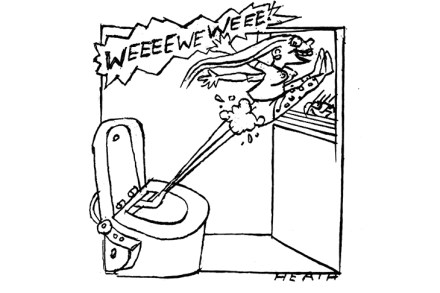
Why are bidets the butt of so many jokes?

From our UK edition

In December 2019, and in keeping with our tradition of perverse birthday gifts, some friends gave me a bidet device. The contraption was a simple one. Fastened on to the back of the lavatory bowl beneath the rim of the seat, it plugged into the flexible hose that filled the cistern, thus enabling the user to administer a cool jet of water, of variable angle and intensity, via the control panel at their right hand. Back then, like most Britons, I saw bidets as a humorous oddity. Then, a few months later, coronavirus reached our shores. Hygiene became a matter of life and death, and supermarkets sold out of loo paper. In these unlikely circumstances, our unwanted plug-and-play bidet became a welcome member of the household.