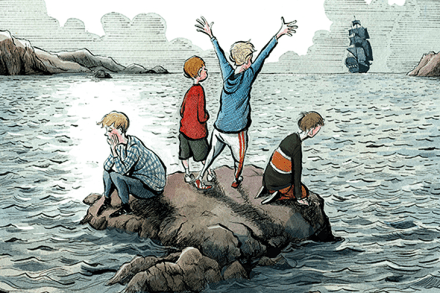
2504: Collectors’ Items – solution
From our UK edition
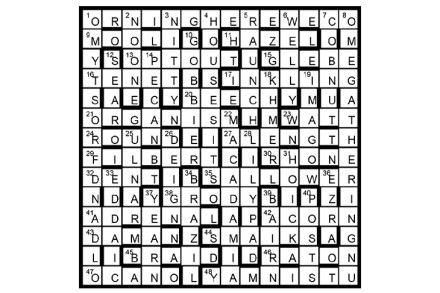
Unclued lights are nuts, as suggested in the perimetrical rhyme.
From our UK edition
Unclued lights are nuts, as suggested in the perimetrical rhyme.
From our UK edition
The Union in peril Sir: Fraser Nelson (‘The great pretender’, 15 May) writes that it has never been easier to make a bold positive case for the Union. He suggests the UK government starts to fight. Perhaps the starting point could be the benefits which flowed from 1707 — joint citizenship, a currency union, a customs union and wealth transfer — both individual and national (the Barnett dividend speaks for itself). Without the Union these would not have happened. Without the Union there is no guarantee any of these will continue. It is not Project Fear to point that out.


From our UK edition
Call to arms Is hugging important to health? A study by Carnegie Mellon University and published in the journal Psychological Science in 2015 claimed so. Psychologists interviewed 404 adults about their social lives, including how often they got into personal conflicts and how often they shared hugs with people they knew and trusted. The volunteers were then exposed to the common cold virus and quarantined to see whether or not they fell ill. The scientists concluded that social contact had a protective effect against the virus — and that hugging accounted for a third of that effect. Job prospects In which sector are you most likely to land a new job over the next three months?
From our UK edition
Home The government made noises about having to delay the lifting of coronavirus restrictions on 21 June in some parts on account of the Indian variant, which appeared more transmissible. ‘The race between our vaccine programme and the virus may be about to become a great deal tighter,’ Boris Johnson, the Prime Minister, said on television. The gap between first and second coronavirus vaccinations would be cut from 12 weeks to eight for over-fifties and the clinically vulnerable. The army was sent to help with testing in Bolton and Blackburn. By the beginning of the week, 37 per cent of the adult population had received both doses of coronavirus vaccination; 60 per cent the first dose.

From our UK edition
The scare over the Indian variant of coronavirus this week is a taste of what to expect over the next few weeks, months or even years. Like all RNA viruses, Covid-19 mutates and has done so thousands of times already. New strains supplant old ones and, for a while, questions will be raised when one mutation comes to dominate. Is it more lethal? Is there a chance it could evade vaccines? Every time so far, there has been no significant reason to doubt the efficacy of the vaccines. So the government’s timetable for lifting Covid restrictions holds firm. How far should Britain go to try to fend off new variants?
From our UK edition
China has peaked Sir: Niall Ferguson makes some good points about the nature of Xi Jinping’s imperial aspirations but misses two important parts of the picture (‘The China model’, 8 May). First, the Chinese Academy of Science predicts that China’s population will peak at 1.4 billion in 2029, drop to 1.36 billion by 2050, and shrink to as few as 1.17 billion people by 2065. They even forecast that China’s population might be reduced by about 50 per cent by the turn of the next century. And second, China’s economic rise is stalling.
From our UK edition
Home A new complexion of British politics was revealed by the capture of Hartlepool by Jill Mortimer for the Conservatives in a by-election, with 15,529 to the Labour candidate’s 8,589. Since its formation in 1974, the constituency had been Labour. Sir Keir Starmer, the Labour leader, said his party had ‘lost the trust of working people, particularly in places like Hartlepool’. The Conservative Ben Houchen was re-elected as mayor of the Tees Valley with 72.8 per cent of the vote. Of 143 English council seats, the Conservatives now control 63, 13 more than before, with 2,345 councillors; Labour lost control of eight councils to end up with 44, and 1,345 councillors. Sir Keir then made a botch of a shadow cabinet shuffle.
From our UK edition
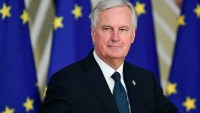
While the EU’s former chief Brexit negotiator Michel Barnier has no formal role in devising the bloc’s immigration policy, his words this week have turned much of the Brexit debate on its head. In an interview on French television, he said that France should suspend non-EU immigration for three to five years — with the exception of students and refugees — and that the EU needed to toughen external borders that have become a ‘sieve’. Had those words come from the mouth of Nigel Farage, he would have been excoriated, not least by Barnier himself. How can any country (let alone a continent) manage in the modern world while shutting itself off to people from, say, India, Australia and America?

From our UK edition
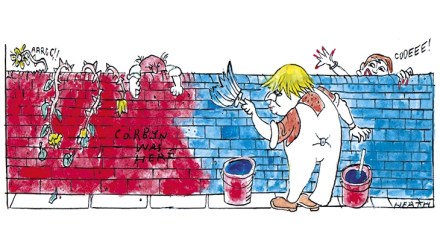
At Redwall Abbey Does fiction provide any guide as to the ultimate fate of Labour’s Red Wall? — Redwall Abbey was the setting for a series of children’s novels written by Brian Jacques between 1986 and his death in 2011. It revolved around the peace-loving creatures of Mossflower Wood who were forced to fight invading vermin. The first of the novels, called Redwall, featured an orphaned mouse who had become a novice monk and was forced to fight off an evil, one-eyed rat. At the end of the final novel, published posthumously, an otter and hedgehog emerged triumphant over the ‘vermin’ — a loose band of creatures which included rats, foxes, wildcats, magpies, rooks and crows. Critics complained that the plots were somewhat repetitive.
From our UK edition
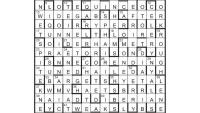
The traditional county towns were Chester (misprinted as CHEATER: 27), Durham (DERHAM: 21), Derby (DERRY: 32), Lewes (LENES: 36), Reading (RENDING: 28) and York (WORK: 8). The correct letters could give SUBWAY (26), examples of which are UNDERGROUND (1A), TUNNEL (17) and METRO (22A). Title: ‘Appleby’ misprinted.
From our UK edition
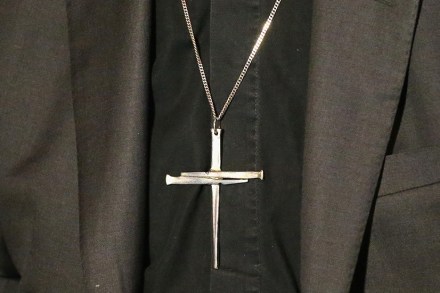
Christian approach Sir: Dr Michael Nazir-Ali’s criticism of our report ‘From Lament to Action’ (‘Bad faith’, 1 May) was wide of the mark in its suggestion that Marxist-inspired critical race theory was the ‘intellectual underpinning’ of our approach. Far from it. The source material for our report was three decades of reports on the issue of racial justice from the General Synod of the Church of England. Doubtless there are valid criticisms which can be made of Synod; however, being a hotbed of radical Marxism is not one of them. Our report explicitly rejects any idea that our work should be viewed as a battle in a culture war.
From our UK edition
A slogan can come back to haunt you. For Boris Johnson, the words ‘data not dates’ sounded powerful at a time when Covid cases were high and hospitals full. The idea was that the government would be guided by scientific reason, would respond to the figures and would not let rigid targets dictate policy. Since the Prime Minister announced his roadmap at the end of February, however, ‘dates’ seem to have become far more important than ‘data’. How can he claim to be following the data when he will not budge from a timeline which now looks like it was designed for a different phase of the pandemic? Why were people braving the cold and rain outside restaurants on a bank holiday when there is every chance it’s safe to go inside?


From our UK edition
So much has been changed by Covid. Science and entrepreneurship have combined brilliantly to mass-produce life-saving vaccines. Working from home, video communication and online retail have become the new normal — perhaps heralding a permanent shift that will leave office towers and city centres searching for new roles. And the responsibility of every business as a corporate citizen as well as a profit generator has come into focus as never before. In 2021 and beyond, innovators have a huge opportunity to make our lives better again. In bioscience and healthcare. In logistics, data analytics and every kind of digital technology. In sustainable housing, transport and agribusiness and all the ways in which entrepreneurs can help address the dangers of climate change.

From our UK edition
Flat spin Which prime minister spent the most on their Downing Street flat, according to figures reported over the years? Margaret Thatcher £0 (Kept 1960s kitchen. Is reputed to have paid for her own ironing board) Tony Blair £127,000 spent on larger flat above No. 11 (including wallpaper reputed to have cost £70 a roll) Gordon Brown £84,000 David Cameron £92,900 (with £64,000 spent on kitchen and bathroom) Theresa May £25,500 Boris Johnson Between £88,000 and £200,000 (according to various reports) But all were eclipsed by the £650,000 of public money spent by former Lord Chancellor Derry Irvine on his flat in the Lords, including £59,000 of wallpaper.

From our UK edition
Home ‘I think we have got a good chance of being able to dispense with the one-metre-plus from 21 June,’ Boris Johnson, the Prime Minister, remarked. By the beginning of the week, 29 per cent of the adult population had received both doses of coronavirus vaccination; 65 per cent the first dose. In the seven days up to the beginning of the week, 107 people had died, bringing the total number of deaths (within 28 days of testing positive for coronavirus) to 127,534. Maldon in Essex reported three cases per 100,000 people, which meant only two people in the whole district. Care home residents in England were allowed to make outdoor visits without having to self-isolate for 14 days on their return.

From our UK edition
The unclued lights are HORSES.
From our UK edition


From our UK edition

From our UK edition
From our UK edition
Levelling up Sir: In making the case for social mobility, Lee Cain unwittingly endorses the classism he hopes to fight (‘Left behind’, 24 April). As the historian Christopher Lasch has argued, the canard of social mobility merely replaces ‘an aristocracy of wealth with an aristocracy of talent’. Far from being egalitarian, the concept is inherently elitist: it implies moving up, out or away from a class, town or profession condemned as undesirable. And by paying lip service to ‘meritocracy’ it becomes a self-serving justification for elites’ power and privilege — if they had the ‘ability and ambition’ to rise to the top, it must only be indolent dullards who are left behind.