2488: Clueless – solution
From our UK edition
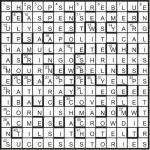
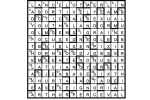
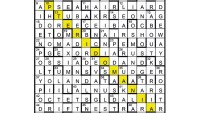
Unclued lights were games played in I’m Sorry I Haven’t a Clue: SOUND CHARADES, SWANEE KAZOO, CHEDDAR GORGE, PICK UP SONG and MORNINGTON CRESCENT.
From our UK edition
Unclued lights were games played in I’m Sorry I Haven’t a Clue: SOUND CHARADES, SWANEE KAZOO, CHEDDAR GORGE, PICK UP SONG and MORNINGTON CRESCENT.
From our UK edition
Paradise lost Sir: After reading Jonathan Beswick (‘Critical mass’, 16 January) I am writing to express the shame I feel as a lifetime member of the Church of England at our Church’s attitude to this pandemic. Here was the greatest opportunity in 70 years to demonstrate care for our fellow people, to advertise our faith and love and to keep the Church in the public eye. I hoped that there would be thousands of Church members flocking to help the lonely and the isolated. But I find my local church locked. This was the chance for the Church to show commitment and sacrifice for the good of the community, to cast aside timidity and get on with normal life, as does the postman, the milkman, the parcel delivery brigade, the health service and many others.
From our UK edition
Home The government undertook to offer a first dose of vaccine to the adult population of the UK by September. More than four million had now been vaccinated. The campaign was on target to vaccinate 15 million by mid-February. A ten-day trial would see some hospitals open for vaccinations 24 hours a day, seven days a week. Racecourses, sports arenas and even cathedrals such as Salisbury, Lichfield and Blackburn became vaccination centres. St Paul’s Cathedral in London suspended public worship because of the danger of coronavirus, as did more than half of Church of England churches. At the beginning of the week, Sunday 17 January, total deaths (within 28 days of testing positive for the coronavirus) had stood at 88,590, including 7,722 in the past week.
From our UK edition
Bad service Economic growth fell by 2.6% in November, the month of the second lockdown, compared with falls of 7.3% in March and 18.8% in April. The pandemic has achieved what has eluded recent governments, in rebalancing the economy away from services. Since February: — Services have contracted 9.9%— Manufacturing has fallen 4.9% — Construction is up 0.6% The most affected sectors of the service economy were: — Hair and beauty: 24.4% of businesses reported zero turnover— Pubs: 27.4% reported zero turnover Source: ONS Unclimbed peaks A team of Sherpas made the first winter ascent of K2, the world’s second-highest mountain. Are there any mountains left to climb?
From our UK edition
At the start of the Covid-19 crisis, Chris Whitty often made the point that a pandemic kills in two ways: directly and indirectly. Locking down society also costs lives — and stymies life chances. Ever since the government moved to embrace lockdown, neither ministers nor the chief medical officer have talked much about the collateral damage it inflicts. This is odd, because it is perfectly defensible to say that lockdown is the least damaging course of action while still acknowledging the harm it causes, particularly for the young. Not since Victorian times have so many children spent so little time in school. As ever, it is the poorest who will be most affected by the lack of education over the past year.
From our UK edition
The winners The first prize of £100, three prizes of £25 and six further prizes of Word Perfect by Susie Dent (John Murray) go to the following. First prize Martin Dey, Hoylandswaine, SheffieldRunners-up Victoria Sturgess, Wimborne, Dorset; David Armitage, Stockport; Elisabeth Hopkin, London SE9Additional runners-up John Boyd, Ashtead, Surrey; Dianne Parker, St Margaret’s at Cliffe, Kent; Hilary Balls, North Berwick, East Lothian; Emma Corke, Abinger Hammer, Surrey; Susan Bell, Reeth, N. Yorks; J.
From our UK edition
Home The government, in the face of overwhelming numbers of people with Covid-19 being admitted to hospital, told everyone to stay at home and threatened them with unspecified harsher measures. The law brought into force on 6 January allowed any amount of exercise and visits to food shops, dry cleaners, takeaway restaurants, banks, pet-food suppliers, off licences, public lavatories, garden centres, bicycle shops and libraries (for collection of books ordered in advance) or anywhere for the purpose of picketing. The Speaker asked MPs to wear masks in the House, except when speaking.
From our UK edition
Parliamentary objections The US Capitol was raided by Donald Trump supporters trying to prevent the confirmation of Joe Biden’s election victory. How close have protestors come to entering our own parliament? — In May 2004, protestors calling for fathers’ access rights to their children threw a condom full of purple flour from the public gallery of the Commons, hitting the then prime minister, Tony Blair. — Four months later, five pro-hunt protestors succeeded in entering the Commons chamber, after getting into parliament by posing as building contractors. — In January 2008, protestors against airport expansion tried to storm parliament but got no further than hammering on St Stephen’s door.
From our UK edition
Lockdown damage Sir: I am sick and tired of people taking the moral high ground and looking down on ‘lockdown sceptics’ like me as if we don’t care. It’s ironic, because while there is no clear evidence to date that national lockdowns actually save more lives (contra the interview with Matt Hancock, 9 January), there is plenty of evidence that lockdowns ruin lives. If anyone should take the moral high ground it is those, like myself, who witness this ‘collateral damage’ on a daily basis. Yes, the health issues are complex. And who would want to govern at this time?
From our UK edition
When lockdown was first proposed in March, one of the many arguments against it was that people would tolerate being deprived of their liberty only for a few weeks. The idea of criminalising basic community behaviour — welcoming a guest into your home, educating children, going to church to pray — was viewed as an extreme measure with a short shelf-life. One of the big surprises of the pandemic is to see that lockdowns, in fact, are popular in large quarters. People have complied for far longer than was ever envisaged. But it’s a careful balance — and examples of overzealous policing risk upsetting that balance. It does not help that the rules change regularly, with even government ministers saying (in private) that they have given up trying to keep track of them.
From our UK edition
When Sir David Barclay, along with his twin brother Sir Frederick, bought The Spectator in 2004, the magazine came as a side dish with their purchase of the Daily Telegraph. Under their ownership, that quickly changed. The Spectator (1828) became a separate company with no financial cross-entanglements. The Barclay method was to apply the three most valuable commodities any publication could ask for: patience, investment and editorial independence. We will leave readers to judge whether the magazine has improved under their ownership. But our sales have almost doubled, in a market that has more than halved, and we have had the resources to embrace the digital age with relish.
From our UK edition
December 12th was the birthday of Gustave FLAUBERT (1D) and Frank SINATRA (15). Examples of their work are MADAME BOVARY (13) and SALAMMBÔ (20), and FLY ME TO THE MOON (1A) and STRANGERS IN THE NIGHT (45/37). Flaubert was born in ROUEN (25), and Sinatra in HOBOKEN (in the ninth column) which was to be shaded. First prize James Woodworth, St Albans, HertsRunners-up J.
From our UK edition
A mob descended on Capitol Hill last night acting on lies and disinformation, but there was no foreign actor to blame. This hostility was homegrown and came from the highest echelon of government. The President of the United States has been stoking fear, division and doubt since his defeat in November’s election, and yesterday it bubbled over into an attack on the very heart of American democracy. Trump had been speaking at a 'Save America' rally where he invited crowds to march on the Capitol. 'You’ll never take back our country with weakness,' he told them, 'you have to show strength'.
From our UK edition
Home Boris Johnson, the Prime Minister, announced harsher coronavirus restrictions in England, resembling those last March, except that bubbles continued. People must work from home if they could; schools were closed and this year’s exams cancelled. Another £4 billion was directed to businesses in retail, hospitality and leisure. At Westminster, parliament was recalled. In Scotland, golf courses remained open and churches were closed. In England, churches remained open and golf courses closed. The actions came in response to a sharp rise in Covid infections, many from a variant virus. One in 50 were estimated to have the disease. At first, 44 million in England were put under newly-invented Tier 4 restrictions, but hospitalisations increased.
From our UK edition
A ferry tale Gerry Marsden, who died aged 78, was credited with making the ferry across the River Mersey world-famous. But it has another claim to fame: as possibly the oldest continuously operated ferry service in the world. The earliest record of a regular ferry was in 1150, when monks at the then newly built Benedictine Priory in Birkenhead set up a ferry service. It was not, however, reliable; bad weather frequently caused delays, so that in 1317 a licence was granted to build lodging houses for people waiting to cross the river. Those who didn’t want to wait, or wanted to avoid the fare, could try their luck wading across: until the river was made navigable for large boats the Mersey was fordable at low tide.
From our UK edition
Veritas vincit Sir: Professor Dawkins eloquently and engagingly defines true truth for us (‘Matters of fact’, 19 December). It seems to me that ‘true’ is a poor little four-letter word with a heavier workload than is reasonable. Historic truth may include ascertainable facts, which I suppose he would pass, but combined with conclusions based on available evidence or ‘true-to-life’ conjecture. Theological truth combines historic fact with unassailable moral principle and a journey of imagination beyond the reach of experience. It cannot be called untrue — only unproven. Perhaps we need to find a word with more gravitas than ‘truth’ for the scientists. I suggest ‘veritas’ — as found in vino.
From our UK edition
So great have been the government’s failures over Covid that it would be easy to forget to give credit where it is due. The fact that Britain was the first country to begin a public vaccination programme — and this week became the first to have two vaccines in use — did not come about by chance. It happened because the government had the foresight to pre-order large quantities of promising vaccines and because Britain’s medicines regulator, the MHRA, worked fast and effectively to assess the data from the trials of those vaccines. The vaccines from Pfizer and AstraZeneca underline the lifesaving role played by an often-maligned pharmaceutical industry. But Britain’s head start will count for little if the momentum cannot be sustained.
From our UK edition
Unclued lights are nicknames of works by Beethoven, born 250 years ago. The title referred to the Ghost piano trio, Op. 70/1. First prize Carlos de Pommes, Walton on Thames, SurreyRunners-up R.P. Wright, Loughton, Essex; Damian Hassan, Bishop Auckland, Co.
From our UK edition
There have been extraordinary scenes at the United States Capitol this evening, after a pro-Trump mob stormed Capitol Hill and gained access to the Senate Chamber. There have been reports of violent clashes with police and it has been confirmed that one person has been shot. The violence follows a pro-Trump rally which took place in Washington, DC on Wednesday to protest the confirmation of Joe Biden’s victory in the presidential election. Members of the US Senate were forced to evacuate the Chamber after the mob managed to break into the building. The National Guard have been called in to restore order.
From our UK edition
Boris Johnson has announced a third national lockdown to last until at least the middle of February. But there are more stated exemptions than in the first lockdown. The new laws are expected to follow shortly, while the formal advice is below: ● You must not leave home without a ‘reasonable excuse’. This will be put in law with fines for non-compliance ranging from £200 (for a first offence) to £6,400. ● Work — You can go to work 'where it is unreasonable for you to do your job from home'. The examples given are 'critical national infrastructure, construction or manufacturing' but the advice says it’s 'not limited to' those jobs. Workers such as cleaners will still be able to go to work.