The Spectator

Portrait of the week: Europe’s vaccine wars, a beached walrus and Sturgeon survives

From our UK edition

Home The nation was surprised to learn that from 29 March there would be a dearth of vaccine for a month. More than half the adult population had been vaccinated once, and more than 4 per cent twice. In one day 589,675 people received their first vaccine, including Boris Johnson, the Prime Minister, and the next day 752,308 first doses were given. But five million doses of the AstraZeneca vaccine from India were delayed and the EU was making hostile noises about banning exports to Britain. The government considered making vaccination compulsory for people working in care homes, a quarter of whom had not been vaccinated.

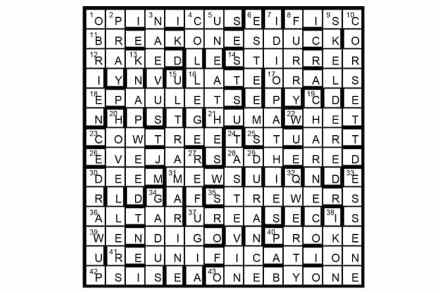
2496: Depart Paddington – solution

From our UK edition

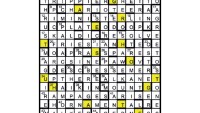
The play was The Winter’s Tale by Shakespeare. The perimetric dramatis personae are MAMILLIUS, LEONTES, FLORIZEL, DORCAS, MOPSA, HERMIONE and ANTIGONUS; NODI (23) and DIPTERA (17) are anagrams of Dion and Perdita. THE WINTERS TALE (in the third row) was to be shaded. Title: ref. ‘Exit, pursued by a bear.

Does the UK really have the highest Covid death rate?

From our UK edition

A long way from home A walrus turned up off the Pembrokeshire coast, thousands of miles south of its normal habitat. Some other lonely visitors: — In July 2020 an albatross, a native of the southern hemisphere, was spotted near Flamborough on the Yorkshire coast. It was one of 30 sightings over the past few decades.— In September 2018 a beluga whale, normally resident near Svalbard, Norway, was found swimming off Gravesend.— In May 2016 a 25ft bowhead whale, more usually seen off Greenland, was spotted in Mount’s Bay, Cornwall.— In August 1999 a great white shark, common to South African, Californian and Australian coasts, and rarely found north of Spanish waters, was seen off Cornwall.

Has Neil Ferguson been proved right about Covid?

From our UK edition

Calculated risk It is a year since Neil Ferguson’s Imperial College team published the paper that inspired the government to call the first lockdown. How good were its scenarios? — It modelled four Covid-suppression measures: isolating cases for seven days, their household contacts for 14 days, social distancing to reduce household contacts by 75 per cent and the closure of schools and hospitals. It assumed these measures would be repeated for 12-18 months before a vaccine became available. — The model was run with different values for the basic reproduction number, which it estimated to lie within the range 2 to 2.6. If the government introduced none of these measures it estimated there would be between 410,000 and 550,000 deaths.

Letters: What really irritates Meghan’s critics

From our UK edition

Meghan’s adroitness Sir: Tanya Gold suggests that people criticise Meghan Markle because she is mixed race and a woman, and states it is because she has dared to attack the royal family (‘In defence of Meghan’, 13 March). I think that misses the point. For a great number of people, her narrative simply does not ring true. Over the past few decades, thousands of media articles have accused the royal household of being claustrophobic, pedantic and antiquated. But unlike the young and naive Diana, Meghan was a thirtysomething TV star with agents and PR people when she met Prince Harry. It’s hard to believe she didn’t know what she was letting herself in for.

Portrait of the week: Tributes to Sarah Everard, rows over AstraZeneca and Nokia cuts jobs

From our UK edition

Home A Metropolitan Police officer, Wayne Couzens, 48, was charged with the kidnap and murder of 33-year-old Sarah Everard, who was last seen on 3 March as she walked home from Clapham to Brixton. A mass vigil on Clapham Common was called off after the High Court declined to interfere with a police ban on the event in accord with coronavirus regulations. The Duchess of Cambridge came alone and left some daffodils at the bandstand. Women who stayed in their hundreds saw police struggle with women who refused to leave the bandstand. There were four arrests and pictures of policemen subduing one of them, Patsy Stevenson, on the floor fed a widespread anger against the police.

2495: Contrary – solution

From our UK edition

Four unclued lights are places in Britain with MARY in their name. The remaining unclued lights can be linked with MARY (see Brewer). (Peter, Paul and Mary have been the theme words of Doc’s puzzles numbered 2489, 2492 and 2495.

The Oxbridge files: which schools get the most offers?

From our UK edition

Oxford and Cambridge have released figures showing how many offers they gave to pupils from various schools last year. We have combined the figures in this table below. It shows how well state grammars and sixth-form colleges now compete with Britain’s finest independent schools. Over the years, both universities have roughly doubled the proportion of pupils from state schools: it now stands at 60 per cent, up from 50 per cent in 2000. This is reflective of which schools get the best A-level results. Of the 100 schools below, 48 are independent, 23 are grammar, 19 are sixth-form colleges, 7 are comprehensives or academies and 3 are further education colleges.

The policing of lockdown is failing

From our UK edition

The scenes in Clapham Common have brutally exposed the problem with lockdown rules. People had gathered to mourn Sarah Everard and protest in defence of the right to walk the streets safely. The Metropolitan Police had been asked by the government to stop people going outside for anything other than a handful of allowed reasons: protest is not one of them. Given how many anti-lockdown protesters were arrested at Clapham Common earlier this year, the Met decided it could not be seen to pick and choose causes. Protesters were told it was 'unsafe' for them to be there due to Covid-19. Officers swooped. Chaos ensured. Footage from the protests showed a row of women being dragged away from the bandstand on the common, which has been filled with flowers for Ms Everard.

Letters: What happens if interest rates rise?

From our UK edition

Spinning plates Sir: Kate Andrews is right to highlight the looming risk of inflation (‘Rishi’s nightmare’, 6 March), but to say that the UK has known barely any inflation for almost a generation misses a very painful point. It may be true for consumer prices. Low interest rates and quantitative easing, along with other ill-advised stimuli, have caused huge inflation over the past two decades in the single greatest expense throughout most working people’s lives: the cost of housing.

Which TV interviews have attracted bigger audiences than Harry and Meghan’s?

From our UK edition

Good for the goose The government indicated that it will ban foie gras, out of animal welfare concerns. While it is often thought of as a French product, its origins have been traced back to Egypt in 2500 bc — thanks to a bas-relief at the Necropolis of Saqqara outside the ancient city of Memphis. The painting depicts workers holding geese around the necks and feeding them — although there is no great sign of force being used. Viewer discretion ITV reported an audience of 11 million for Harry and Meghan’s interview with Oprah Winfrey. In the US 17 million were said to have watched. What are the previously most-viewed TV interviews (combined US and UK audiences)?

What did Spectator writers really get up to at school?

From our UK edition

Rod Liddle If you leave a Bunsen burner on for about ten minutes, then quickly put the rubber pipe over a water tap and turn it on full, you get a small explosion and a scalding stream of water to be directed at a boy called Harris. Similarly, if you attach crocodile clips to Harris’s jacket and then wire it up to a power source, it makes him jump about a lot. I loved physics lessons. Jeremy Clarke Snow in the playground. The tall caped figure of the headmaster appeared on a short outside staircase — a rare balcony appearance of a benign, reclusive demigod. One long-distance snowball among the flying hundreds, arcing higher than the rest, travelling through the air in slow time, apparently laser guided, is fixed in the memory of all who saw it.

Which instrument should I play?

From our UK edition

Thinking about taking up a musical instrument, but unsure where to start? Whether you have amazing musical abilities or not one iota, try our handy quiz to find out what’s right for you, from tissue paper and comb to saxophone.

School portraits: a snapshot of four notable schools

From our UK edition

St Edward’s School, Oxford St Edward’s School has featured in these pages before, because of its North Wall performing arts centre which attracts (in ‘normal’ times) more than 20,000 public visitors a year to its exhibitions and performances. St Edward’s sets great store by being part of Oxford as a whole. ‘Beyond Teddies’ is the school’s community outreach programme, encompassing a community farm on school grounds where young people with learning disabilities and autism explore basic outdoor skills, marshalling the Oxford Half Marathon and visiting local care homes. Academically, the co-ed boarding and day school also thinks outside the box, with its pioneering ‘Pathways and Perspectives’ courses.

The Sturgeon case exposes the fatal flaw in Scottish devolution

From our UK edition

The campaign for a Scottish parliament was rooted in the notion of a ‘democratic deficit’. Scotland kept voting Labour but the UK kept getting Conservative governments. Devolution, so the logic ran, would give Scotland a more responsive government. Two decades on, a new democratic deficit is emerging: the chasm between the minimum accountability demanded by the parliament and the maximum Nicola Sturgeon’s government is prepared to give. A new establishment has taken root in Edinburgh, more powerful and less accountable than the old one. The Alex Salmond inquiry, which began as a recondite tale about a failed attempt by Sturgeon’s government to probe sexual misconduct claims against the former Scottish National party leader, has narrowed to three stark questions.

Letters: The key to Scotland’s future

From our UK edition

The key to the Union Sir: ‘Love-bombing’ the Scottish electorate with supplemental spending in devolved areas (‘The break-up’, 27 February) is unlikely to prove a decisive tactic in the ongoing battle over Scottish independence. It will never be enough, and the average voter will not distinguish Westminster spend from Holyrood’s. Neither should opposition to an independence referendum be the Scottish Conservative and Unionist party’s primary policy in the upcoming Holyrood election. Falling into the SNP trap of focusing on this issue allows the party to pursue its agenda of confected grievance and division. Secession is the SNP’s preferred battleground, not least because it permits deflection of their record in government.