The Spectator

Letters: The uncivil service

From our UK edition

Uncivil service Sir: The elephant in the room in the handling of the pandemic (‘A tragedy of errors’, 29 May) is the civil service, which has become the problem in government rather than the solution. Repeated disasters of problem management — from the blood transfusion scandal to Hillsborough to the failures illuminated by Dominic Cummings — reveal an inability to make precise decisions, accept errors and move on. This is especially illustrated by the Home Office which is no longer fit for any purpose. The difficulties encountered by the Windrush people are a case in point. The incompetence and sheer nastiness is breathtaking.

Have tennis players always been expected to give interviews?

From our UK edition

Game, set, chat Japanese tennis player Naomi Osaka withdrew from the French Open after being fined $15,000 for failing to appear for a post-match press conference. Have players always been expected to give interviews? — Wimbledon was first televised live in 1937, the year of Fred Perry’s third and final victory against Gottfried von Cramm. A photo from 1938, when Bunny Austin was beaten by the US player Donald Budge in the final, shows that the post-match interview was already part of the coverage. Vaccine clots How many people in the UK have died from blood clots related to the AstraZeneca vaccine? Up to 27 May the Medical and Healthcare Products Regulatory Agency has recorded 332 serious cases and 58 deaths.

Portrait of the week: Boris Johnson’s wedding, bitcoin blackouts and a £140m tomato ketchup factory

From our UK edition

Home Freelance scientists urged the government not to end coronavirus regulations on 21 June, for fear of a third wave. Fewer than 900 people remained in hospital with Covid, compared with 39,249 in January. Chris Hopson, the head of NHS Providers, said ‘very, very few’ Covid patients in hospital had received two coronavirus vaccinations, and usually had additional conditions. Heathrow got round to using a separate terminal for passengers arriving from countries with a high risk of Covid. The government considered compulsory Covid vaccination for NHS staff. The Johnson & Johnson single-dose vaccine was approved for use. By the start of the week, 47.3 per cent of the adult population had received two doses of vaccine; 74.2 per cent the first dose.

2506: Summer’s voice – solution

From our UK edition

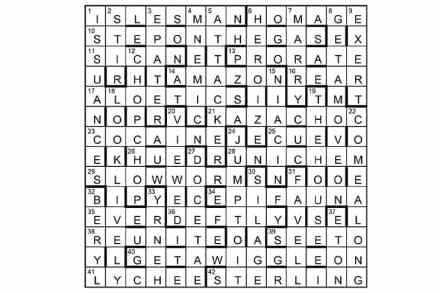
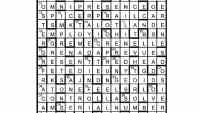
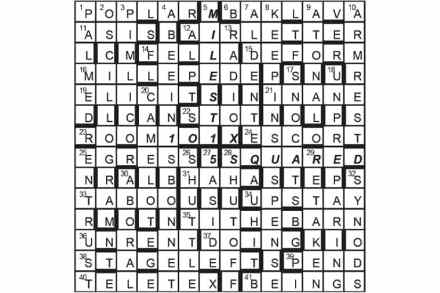
The unclued lights are ferns: RUSTY-BACK (26/5A), WALL RUE (48/7A), MAIDENHAIR (1D/11), OSMUNDA (18), BIRD’S-NEST (20/45) and POLYPODY (24). PTERIDOMANIA (diagonally from 10) could have induced this puzzle and was to be shaded. Title: cf. Adder’s-tongue.

Has No. 10 really solved the problem of Covid groupthink?

From our UK edition

It is hard to deny the importance of the issues raised this week by Dominic Cummings. His decision to identify the many mistakes made at the start of the pandemic is not about seeking vengeance; it is a vital process to ensure that errors are identified and not repeated. A vaccine-evading variant or a new virus could come along at any time. Should this happen, ministers must be ready. Some of the world’s finest minds worked on pandemic planning, in Britain and throughout the western world. The UK was once ranked as more prepared for a new virus than any country in Europe. But the failure to provide adequate PPE equipment was the most visible sign of implosion.

Letters: The unfairness of ‘free care for all’

From our UK edition

Taking care Sir: I agree completely with Leo McKinstry that care for parents should be paid out of their estate (‘Home economics’, 15 May). The costs of care are what people effectively work for, not for the passing on of wealth paid for by the taxpayer. My mother lived until she was 100, and was in care for almost 14 years. Although she had a property and shares, we funded her care until her cash/share balance was £15,000. After this time she was means-tested and between her pension and the rent from her flat, we were able to pay for some of the care, with the rest paid for by the local council. On her death the property was sold and the effective loan from the local authority was paid out of the proceeds of the sale.

Portrait of the week: Bashir’s reckoning, Dominic Cummings’s evidence and ‘secret’ local lockdowns

From our UK edition

Home The BBC was engulfed in doubts after a report by Lord Dyson blamed Martin Bashir for deceiving the late Diana, Princess of Wales, before interviewing her on television in 1995 — and the BBC for failing to investigate properly. The Duke of Cambridge said: ‘It brings indescribable sadness to know that the BBC’s failures contributed significantly to her fear, paranoia and isolation that I remember from those final years with her.’ He said that had the BBC properly investigated complaints, ‘my mother would have known that she had been deceived’ before her death in 1997. The former chairman of the BBC, Lord Hall of Birkenhead, resigned as chairman of the National Gallery.

Cummings, Covid and groupthink – a cautionary tale

From our UK edition

It is hard to deny the importance of the issues raised this week by Dominic Cummings. His decision to identify the many mistakes made at the start of the pandemic is not about seeking vengeance; it is a vital process to ensure that errors are identified and not repeated. A vaccine-evading variant or a new virus could come along at any time. Should this happen, ministers must be ready. Some of the world’s finest minds worked on pandemic planning, in Britain and throughout the western world. The UK was once ranked as more prepared for a new virus than any country in Europe. But the failure to provide adequate PPE equipment was the most visible sign of implosion.

Is hugging healthy?

From our UK edition

Call to arms Is hugging important to health? A study by Carnegie Mellon University and published in the journal Psychological Science in 2015 claimed so. Psychologists interviewed 404 adults about their social lives, including how often they got into personal conflicts and how often they shared hugs with people they knew and trusted. The volunteers were then exposed to the common cold virus and quarantined to see whether or not they fell ill. The scientists concluded that social contact had a protective effect against the virus — and that hugging accounted for a third of that effect. Job prospects In which sector are you most likely to land a new job over the next three months?

Portrait of the week: Indian variant goes up, Santander goes down and pubs reopen

From our UK edition

Home The government made noises about having to delay the lifting of coronavirus restrictions on 21 June in some parts on account of the Indian variant, which appeared more transmissible. ‘The race between our vaccine programme and the virus may be about to become a great deal tighter,’ Boris Johnson, the Prime Minister, said on television. The gap between first and second coronavirus vaccinations would be cut from 12 weeks to eight for over-fifties and the clinically vulnerable. The army was sent to help with testing in Bolton and Blackburn. By the beginning of the week, 37 per cent of the adult population had received both doses of coronavirus vaccination; 60 per cent the first dose.

Why Britain must unlock on 21 June

From our UK edition

The scare over the Indian variant of coronavirus this week is a taste of what to expect over the next few weeks, months or even years. Like all RNA viruses, Covid-19 mutates and has done so thousands of times already. New strains supplant old ones and, for a while, questions will be raised when one mutation comes to dominate. Is it more lethal? Is there a chance it could evade vaccines? Every time so far, there has been no significant reason to doubt the efficacy of the vaccines. So the government’s timetable for lifting Covid restrictions holds firm. How far should Britain go to try to fend off new variants?

Letters: China has peaked

From our UK edition

China has peaked Sir: Niall Ferguson makes some good points about the nature of Xi Jinping’s imperial aspirations but misses two important parts of the picture (‘The China model’, 8 May). First, the Chinese Academy of Science predicts that China’s population will peak at 1.4 billion in 2029, drop to 1.36 billion by 2050, and shrink to as few as 1.17 billion people by 2065. They even forecast that China’s population might be reduced by about 50 per cent by the turn of the next century. And second, China’s economic rise is stalling.

What Europe could learn from Britain’s new migration system

From our UK edition

While the EU’s former chief Brexit negotiator Michel Barnier has no formal role in devising the bloc’s immigration policy, his words this week have turned much of the Brexit debate on its head. In an interview on French television, he said that France should suspend non-EU immigration for three to five years — with the exception of students and refugees — and that the EU needed to toughen external borders that have become a ‘sieve’. Had those words come from the mouth of Nigel Farage, he would have been excoriated, not least by Barnier himself. How can any country (let alone a continent) manage in the modern world while shutting itself off to people from, say, India, Australia and America?

How does the ‘red wall’ story end?

From our UK edition

At Redwall Abbey Does fiction provide any guide as to the ultimate fate of Labour’s Red Wall? — Redwall Abbey was the setting for a series of children’s novels written by Brian Jacques between 1986 and his death in 2011. It revolved around the peace-loving creatures of Mossflower Wood who were forced to fight invading vermin. The first of the novels, called Redwall, featured an orphaned mouse who had become a novice monk and was forced to fight off an evil, one-eyed rat. At the end of the final novel, published posthumously, an otter and hedgehog emerged triumphant over the ‘vermin’ — a loose band of creatures which included rats, foxes, wildcats, magpies, rooks and crows. Critics complained that the plots were somewhat repetitive.

2503: Applery – solution

From our UK edition

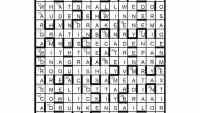
The traditional county towns were Chester (misprinted as CHEATER: 27), Durham (DERHAM: 21), Derby (DERRY: 32), Lewes (LENES: 36), Reading (RENDING: 28) and York (WORK: 8). The correct letters could give SUBWAY (26), examples of which are UNDERGROUND (1A), TUNNEL (17) and METRO (22A). Title: ‘Appleby’ misprinted.