The Spectator

Portrait of the week: Boris’s shambolic CBI speech, more Covid protests and Kyle Rittenhouse is cleared

From our UK edition

Home Boris Johnson, the Prime Minister, praised Peppa Pig in a speech to the Confederation of British Industry: ‘Who would’ve believed that a pig that looks like a hairdryer... has now been exported to 180 countries?’ Then he lost his place and said: ‘Forgive me. Forgive me. Forgive me.’ Nineteen Conservative MPs voted against the government on a clause excluding means-tested council support payments from a new £86,000 lifetime limit on social care costs; it would mean a lost inheritance for heirs of people with assets worth no more than the limit. The writer J.K. Rowling was hounded by militant trans campaigners. ‘I’ve now received so many death threats I could paper the house with them,’ she said.

Books of the Year 2021

Matt Labash I read a lot of books. Probably well over sixty in the last year. I’m not saying that in some little-kid braggadocious way. After all, I’m fifty-one years old. Though some have said I read on a fifty-two-year-old level. In addition to the couple of books I have open at any time, a good deal of my book consumption comes via audio: I have an audiobook going in my car or on my MP3 player at all times. And at my advanced age, if I don’t dog-ear and underline a book, it’s lost down the memory hole forever, no matter how much I liked it. But one I do remember liking so much that it bears mentioning, is John Green’s The Anthropocene Reviewed: Essays on a Human-Centered Planet (Penguin, $28).

books

Emad Al Swealmeen should not have been in Britain

From our UK edition

Emad Al Swealmeen, who blew himself up in a taxi outside the Liverpool Women’s Hospital, is not believed to have been identified by security services as a terror suspect. Nevertheless, he should not have been in Britain. He lied about where he had come from, which ought to have been a red flag, enough in and of itself to warrant his return to his home country. Indeed, his application for asylum was rejected in 2014, but he was never removed. Instead, he reinvented himself as a Christian convert, gaining himself time and grounds for appeal and last Sunday, on Remembrance Day, he attempted to commit what could easily have been a devastating attack. Only a closed road, the fact that the bomb partially detonated and the bravery of the taxi driver prevented a dramatic death toll.

Books of the year II — a further selection of the books chosen by our regular reviewers

From our UK edition

Jonathan Sumption The reputation of Sir Edward Grey, Britain’s foreign secretary from 1905 to 1916, has never recovered from the pasting he received in Lloyd George’s war memoirs. Lloyd George thought that his deliberate ambiguity about Britain’s intentions led us into the first world war. If you read just one book of history this Christmas, it should be T.G. Otte’s re-evaluation in Statesman of Europe: A Life of Sir Edward Grey (Allen Lane, £35). This beautifully written biography of one of the most humane, perceptive and intelligent diplomats is a wistful reminder of what Britain might have been like if Lloyd George had not destroyed the Liberal party. If one is not enough, try Ambrogio A.

Letters: it isn’t climate change scientists who are the hysterics

From our UK edition

Balance of power Sir: Ross Clark sums up the problem with wind power (‘Storing up trouble’, 13 November). It is often inadequate or alternatively excessive, leading in the latter case to the ludicrous position of making payments to operators for producing nothing. A solution to the question of storing electricity to even out the peaks and troughs of wind power would clearly be of great benefit in our quest for net zero. Mr Clark does not appear to be keen on batteries, which make demands on our finite sources of rare metals and can be dangerously volatile. Pumped water storage has limited application. What he did not mention was hydrogen.

Portrait of the week: a Liverpool terror attack, the end of COP26 and the Belarus migrant crisis

From our UK edition

Home The UK terror threat level was raised to severe after a taxi exploded and burst into flames just before 11 a.m. on Remembrance Sunday outside Liverpool Women’s Hospital, killing the passenger. He was Emad Al Swealmeen, 32, a failed asylum-seeker from the Middle East, who had converted from Islam, and was confirmed in 2017 at Liverpool Anglican Cathedral nearby. He had previously been sectioned for six months under the Mental Health Act because of his behaviour with a knife. The detonator seemed to have gone off but not the bomb. The taxi driver, whose wounds required hospital treatment, was praised for his courage. The Countess of Avon, widow of the former prime minister Anthony Eden, died aged 101.

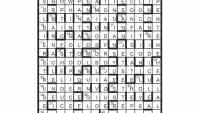
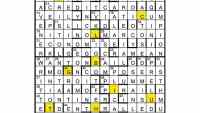
2530: Ups and downs – solution

From our UK edition

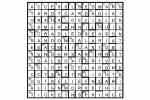
The quotation is ‘LAUGH, AND THE WORLD LAUGHS WITH YOU; WEEP, AND YOU WEEP ALONE’ from Solitude by Ella Wheeler Wilcox. Her two unclued novels are SWEET DANGER (34/24) and A DOUBLE LIFE (3/29). ELLA (on the perimeter), WHEELER (12) and WILCOX (diagonally from 12) were to be shaded.

It’s not too late to scrap HS2

From our UK edition

There are government projects gone haywire – and then there’s HS2. The High Speed rail project should never have been given the nod in the first place. Costs spiralled out of control from the very beginning: it was estimated to cost £32.7 billion in 2012, now this is set to surpass £100 billion. The technology will be out of date before it even comes online. The government is right to ditch plans for an easterly arm of HS2 from Leeds to Birmingham. In contrast to the London to Birmingham section, no buildings have yet been flattened, no earth has been moved. Now is the chance to abandon it, before any more money and effort is spent.

Books of the Year I — chosen by our regular reviewers

From our UK edition

Anna Aslanyan A decade after Londoners, we have another wonderful work of oral history from Craig Taylor. New Yorkers: A City and its People in Our Time (John Murray, £16.99) is a collection of monologues that makes you feel as if you are there, listening to these people. A nurse, an activist, a nanny, a car thief, a personal injury lawyer, a lice consultant, a philanthropic foundation officer, a meditation teacher and dozens of others tell their stories of a place that ‘meant more of everything’ to them and to their interlocutor. Even before finishing the book, I began imagining what Taylor’s next destination might be. I also kept wondering how he infallibly manages to draw so much from his urban encounters.

Is there any evidence climate change is making hurricanes worse?

From our UK edition

Horror shows Eight people were killed when fans of rapper Travis Scott rushed the stage at a concert in Houston, Texas. Some previous deadly concerts: — 11 were killed at a Who gig in Cincinnati on 3 December 1979, after a crush sparked off by concert-goers outside the entry doors mistakenly thinking the band had started playing when they were only tuning up. — Nine were killed at a concert by Pearl Jam at Roskilde, Denmark on 30 June 2000. — 11 people were killed during a festival in Rabat, Morocco on 23 May 2009. Stevie Wonder and Kylie Minogue were on the bill, although not on stage at the time. Third time’s the charm How many people are likely to have a booster Covid jab? By 6 November, 10.

Letters: climate protestors would do better to boycott China

From our UK edition

Heat Sir: May I place some of Nigel Lawson’s comments in a sensible historical context (‘Stupid fuels’, 6 November)? First, he notes that the difference between the average annual temperature in Finland and in Singapore is at present 22°C. However, he is wrong to suggest that we should therefore not be concerned about a predicted rise in the average global temperature of a few degrees. The average global temperature during ice ages was only about 6°C colder than today, but that difference was enough to make the planet unrecognisable: much of the northern hemisphere’s land was covered in glaciers several thousand feet thick, and the sea level was 100 metres lower.

Portrait of the week: Tory sleaze, NHS jabs and Elon Musk’s shares

From our UK edition

Home NHS staff in England will have to be fully vaccinated against Covid by the spring. Britain had ordered 250,000 courses of a Pfizer antiviral pill available from early 2022 shown to cut the risk of hospitalisation or death from Covid by 89 per cent. Britain approved another antiviral pill, developed by Merck, and ordered 480,000 courses. In the seven days up to the beginning of this week, 1,185 people had died with coronavirus, bringing the total of deaths (within 28 days of testing positive) to 141,743. (In the previous week deaths had numbered 1,097.) Numbers remaining in hospital stayed at about 9,000. Rolls-Royce gained the backing of private investors and the government to develop small modular reactors to produce nuclear energy.

Letters: Why net zero is impossible

From our UK edition

Carbon deceit Sir: At this week’s climate change conference, countries will be urged to follow the UK’s ‘lead’ in setting the goal of net-zero carbon emissions by 2050 (‘Cop out’, 30 October). This goal is impossible for any advanced economy based on mass consumption. The majority of British manufacturing has shifted abroad, where labour is cheap and items are mostly produced with electricity supplied by coal and other fossil fuels. For a real figure for Britain’s emissions, the consumption of goods produced overseas must be included. As our consumption has increased enormously over the past 30 years, this carbon addition will be substantial. It is a dangerous nonsense for rich countries, therefore, to pretend they are cutting carbon emissions.