The Spectator

Books of the Year I — chosen by our regular reviewers

From our UK edition

Anna Aslanyan A decade after Londoners, we have another wonderful work of oral history from Craig Taylor. New Yorkers: A City and its People in Our Time (John Murray, £16.99) is a collection of monologues that makes you feel as if you are there, listening to these people. A nurse, an activist, a nanny, a car thief, a personal injury lawyer, a lice consultant, a philanthropic foundation officer, a meditation teacher and dozens of others tell their stories of a place that ‘meant more of everything’ to them and to their interlocutor. Even before finishing the book, I began imagining what Taylor’s next destination might be. I also kept wondering how he infallibly manages to draw so much from his urban encounters.

Letters: climate protestors would do better to boycott China

From our UK edition

Heat Sir: May I place some of Nigel Lawson’s comments in a sensible historical context (‘Stupid fuels’, 6 November)? First, he notes that the difference between the average annual temperature in Finland and in Singapore is at present 22°C. However, he is wrong to suggest that we should therefore not be concerned about a predicted rise in the average global temperature of a few degrees. The average global temperature during ice ages was only about 6°C colder than today, but that difference was enough to make the planet unrecognisable: much of the northern hemisphere’s land was covered in glaciers several thousand feet thick, and the sea level was 100 metres lower.

Portrait of the week: Tory sleaze, NHS jabs and Elon Musk’s shares

From our UK edition

Home NHS staff in England will have to be fully vaccinated against Covid by the spring. Britain had ordered 250,000 courses of a Pfizer antiviral pill available from early 2022 shown to cut the risk of hospitalisation or death from Covid by 89 per cent. Britain approved another antiviral pill, developed by Merck, and ordered 480,000 courses. In the seven days up to the beginning of this week, 1,185 people had died with coronavirus, bringing the total of deaths (within 28 days of testing positive) to 141,743. (In the previous week deaths had numbered 1,097.) Numbers remaining in hospital stayed at about 9,000. Rolls-Royce gained the backing of private investors and the government to develop small modular reactors to produce nuclear energy.

From the archive: the nature of Japan

From our UK edition

From ‘The rule of taste’, Anthony Thwaite, 6 March 1959: The society of aristocrats, connoisseurs, wise men and heroes which was the Japan of Yeats’s imagination did exist. It was capable of moments which combine, in the true spirit of Zen, extraordinary aesthetic perception with what looks like plain flippancy. This is revealed, for example, in the anecdote which Sir George [Sansom] tells about the Emperor Shirakawa, who had summoned a stricken old campaigner to the Palace to tell the story of his campaigns. ‘The old soldier began, “Once when Yoshiiye had left the Defence Headquarters for the fortress at Akita, a light snow was falling and the men…” at which point His Majesty broke in and said: “Stop there!

Portrait of the week: Fishing friction, Greta’s singalong and terror in Tokyo

From our UK edition

Home Boris Johnson, the Prime Minister, told delegates to the 26th Conference of the Parties to the United Nations Framework Convention on Climate Change (COP26) in Glasgow: ‘It’s one minute to midnight on that doomsday clock and we need to act now.’ He left the conference the next day. British companies would have to publish plans on reaching net zero by 2050. India said it would reach net zero by 2070. Greta Thunberg, aged 18, stood in Govan Festival Park leading a chorus of ‘You can shove your climate crisis up your arse’ to the tune of ‘Ye cannae shove yer grannie aff a bus’.

The flaw in Britain’s net-zero plan

From our UK edition

The COP26 summit is unlikely to be an outright flop. There has been no shortage of drama, with speakers seeming to compete with each other to see who could use the most histrionic language. Justin Welby, the Archbishop of Canterbury, went so far as to compare the attending leaders to Nazi appeasers. He later apologised. Some progress, albeit small, is being made. A hundred countries have been persuaded, some on the promise of sweeteners worth £14 billion, to sign a pledge to end deforestation by 2030. Brazil, the most important of all, is among them. India has agreed, for the first time, to set itself a date for achieving net-zero greenhouse gas emissions — although its target, 2070, is two decades beyond what the United Nations would have liked.

Where is the climate plan B?

From our UK edition

The COP26 summit is unlikely to be an outright flop. There has been no shortage of drama, with speakers seeming to compete with each other to see who could use the most histrionic language. Justin Welby, the Archbishop of Canterbury, went so far as to compare the attending leaders to Nazi appeasers. He later apologised.  Some progress, albeit small, is being made. A hundred countries have been persuaded, some on the promise of sweeteners worth £14 billion, to sign a pledge to end deforestation by 2030. Brazil, the most important of all, is among them. India has agreed, for the first time, to set itself a date for achieving net-zero greenhouse gas emissions — although its target, 2070, is two decades beyond what the United Nations would have liked.

Letters: The contentious issues of religious conversion

From our UK edition

Hard to reconcile Sir: Although not an Anglican, I appreciate Michael Nazir-Ali’s dilemma (‘A change of mind and heart’, 23 October) and know many Anglicans whose loyalty to the C of E is being severely tested. But insofar as his theology is classically Protestant and evangelical, it is difficult to see how the former bishop can reconcile it with the teaching of the Roman Catholic Church on the sacraments, the office of the Pope, the role of Mary, purgatory and justification, to name but a few contentious issues. He speaks of how ‘what Anglicanism in its classical form has held most dear is being fulfilled in the progression of the Ordinariate’.

Rishi Sunak’s change of direction

From our UK edition

The Conservative party has always sold itself to voters as the party of low taxation, but it has now pushed taxes higher than any post-war Labour government dared. High spending was the tool the Prime Minister reached for at every turn in the pandemic, leaving Britain with one of the biggest post-Covid bills in Europe. His recovery plan was to part-nationalise care homes, taxing the working poor to protect the assets of the wealthy. Taxes are now heading to a 70-year high. Not Conservatism, it seems, but its inversion. Rishi Sunak’s Budget this week marks a potential turning point in this narrative.

What’s more expensive – petrol or fizzy drinks?

From our UK edition

Filming fatalities The actor Alec Baldwin accidentally shot a cinematographer on set when mistakenly given a gun loaded with real bullets. Others who have died on set: — Martha Mansfield was resting in her car during the filming of a romance set in the US civil war in 1923 when someone flung a match which set her dress alight. — John Jordan fell out of a plane while filming Catch-22 in 1969. — Vic Morrow was decapitated by a low-flying helicopter while filming Twilight Zone: the Movie in 1982. — Jon-Erik Hexum shot himself while fooling around with a gun on the set of the CBS series Cover Up in 1984. — Roy Kinnear succumbed to injuries after he fell from a horse during the filming of The Return of the Three Musketeers in 1988.

2527: The main dilemma – solution

From our UK edition

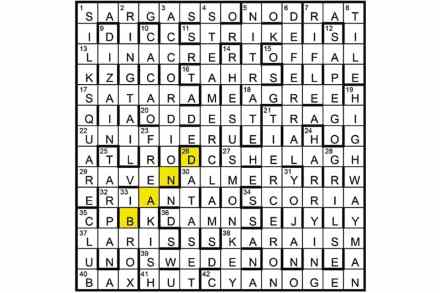
The question posed by the song is 11A/ 22A/37A. Suggested by 37A, other unclued lights were anagrams of words meaning sailor: 17A – rating; 26A – mariner; 39A – shipmate; 10D – sea dog; 27D – lascar.

Rishi Sunak’s surprise tax cut

From our UK edition

The Conservative party has always sold itself to voters as the party of low taxation, but it has now pushed taxes higher than any post-war Labour government dared. High spending was the tool the Prime Minister reached for at every turn in the pandemic, leaving Britain with one of the biggest post-Covid bills in Europe. His recovery plan was to part-nationalise care homes, taxing the working poor to protect the assets of the wealthy. Taxes are now heading to a 70-year high. Not Conservatism, it seems, but its inversion. Rishi Sunak’s Budget this week marks a potential turning point in this narrative.

Letters: How to feed the world

From our UK edition

Doom and gloom Sir: The depressing article by Tom Woodman (‘You must be kidding’, 16 October) confirms my growing fears about the damage being wrought by the promoters of apocalyptic climate change, which has become a dangerous cult with alarming echoes of millenarian doom which has stretched through many previous centuries. While sensible care for the environment is a good thing, the descriptions of a frightening future of the imminent end of the world through drought, flood and fire now imbues every aspect of education and politics. Constantly bombarding young people with the news that the end of the world is nigh has led many of them into completely unnecessary visions of death and disaster.