The Spectator

Did Storm Eunice really break records?

From our UK edition

Blow by blow Did Storm Eunice really set a new record for wind speed in England? A 122 mph gust measured at the Needles on the Isle of Wight is, according to the Met Office, provisionally the fastest ever recorded in England. Greater speeds have been measured in Scotland: 173 mph on Cairngorm summit on 20 March 1986 and 142 mph at Fraserburgh on 13 February 1989. Northern Ireland, too, has recorded a faster gust, of 124 mph at Kilkeel, County Down on 12 January 1974. Last week’s record is only provisional. One suspect detail is that it is more than 30 mph faster than any gusts recorded elsewhere.

Letters: It’s time for the common cup to return to communion

From our UK edition

The Bull of Oman Sir: There was one significant omission in the cast of characters mentioned by Charles Moore in his notes on the Sultan of Oman’s armed forces (Notes, 19 February): General Sir Timothy Creasey KCB . The omission is all the more surprising given the key role Margaret Thatcher played in getting General Tim to take up the Sultan’s invitation to go back out to Oman as deputy commander in chief and chief of defence staff. Having been instrumental in achieving a satisfactory resolution of the insurrection in Dhofar as a senior loan service officer, General Tim was highly regarded by the Sultan but he was not keen to take up the offer of direct employment.

Portrait of the week: Storms rage, Covid curbs end and Russia’s ‘renewed invasion’

From our UK edition

Home Boris Johnson, the Prime Minister, announced, in the House of Commons, sanctions against Russia after its ‘renewed invasion’ of Ukraine. These included the freezing of five banks’ assets and those of three Russian billionaires (Gennady Timchenko, Boris Rotenberg and his nephew Igor Rotenberg). The price of Brent crude oil reached a seven-year high of $99.38. A day earlier, the Prime Minister had told parliament that all coronavirus restrictions in England were to end on 24 February. People who tested positive for Covid would no longer be required by law to self-isolate, but would still be advised to stay at home.

2541: Beastly – solution

From our UK edition

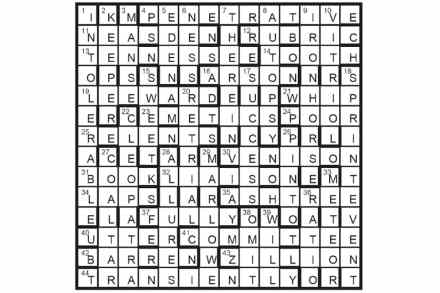
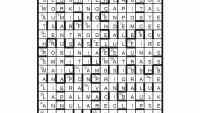
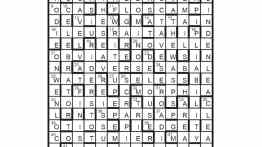
The unclued lights form a quartet of three-word terms, each of which has the letter count of (6,6,6) which is the ‘number of the Beast’: 21/45/35, 22/1A/23, 39/16/33 and 46/7/17.

Full text: Putin’s declaration of war on Ukraine

From our UK edition

Dear citizens of Russia! Dear friends! Today, I again consider it necessary to return to the tragic events taking place in the Donbass and the key issues of ensuring the security of Russia itself. Let me start with what I said in my address of 21 February this year. We are talking about what causes us particular concern and anxiety, about those fundamental threats that year after year, step by step, are rudely and unceremoniously created by irresponsible politicians in the West in relation to our country. I mean the expansion of the Nato bloc to the east, bringing its military infrastructure closer to Russian borders.

Sales of The Spectator surge 16 per cent to (another) all-time high

From our UK edition

The UK magazine industry releases figures today and we're delighted to announce that The Spectator sold a weekly average of 106,905 copies last year, up 16 per cent on 2020 and — yet again — our best year ever. The Spectator has now almost doubled our sales over a decade where sales of consumer magazines fell by two-thirds. We can also announce: Our actual (print) magazine, which has the longest run of any weekly in the world, hit an all-time sales high averaging 77,564 sales last year. Just under a quarter of our subscribers are digital-only Our recently-launched Spectator TV has broken through 150,000 subscribers Coffee House Shots, our flagship daily podcast, exceeded a million listens in January Our website spectator.co.

How do Russian and Ukrainian military forces measure up?

From our UK edition

Facing the music Police in New Zealand played Barry Manilow records to truck drivers in an attempt to persuade them to break up their protests. One of the first uses of music as a weapon was by US forces attempting to force Panamanian military leader and drug dealer General Manuel Noriega to leave the Vatican embassy, where he had sought sanctuary in December 1989. For three days over Christmas they played an eclectic mixture of music including ‘Too Old to Rock’n’Roll, Too Young to Die’ by Jethro Tull, ‘Judgment Day’ by Van Halen, ‘Born to Run’ by Bruce Springsteen, ‘Give It Up’ by KC and the Sunshine Band, ‘We Gotta Get Out Of This Place’ by the Animals and ‘Never Gonna Give You Up’ by Rick Astley.

Letters: In defence of the police

From our UK edition

A health-care disaster Sir: Kate Andrews’s piece on who really controls the NHS (‘Waiting game’, 12 February) gives us a flavour of how things have come to this: an unaccountable health service with a government attached. We are about to enter a new phase, with additional taxation in the form of increased NI based on promises which are already looking hollow — waiting lists will continue to rise. There is no sign that the 100,000 key workers who are needed are going to be found any time soon.

Portrait of the week: Inflation hits 30-year high, Andrew settles out of court and Turkey changes its name

From our UK edition

Home Boris Johnson, the Prime Minister, made ready for a Russian invasion of Ukraine by cutting short a planned visit to northern England for a Cobra meeting. ‘We are on the edge of a precipice,’ he said. He said Britain was prepared to target Russian banks and companies, and stop them raising money on London’s financial markets. Sir Keir Starmer, the Labour leader, condemned an online rally called No War in Ukraine: Stop Nato Expansion, organised by the Stop the War coalition, of which Jeremy Corbyn is the deputy president. Petrol prices reached a new high of 148.02p a litre. Inflation rose to 5.5 per cent, its highest for 30 years. Unemployment fell to 4.1 per cent and job vacancies reached a record of 1.3 million; wages fell by 0.

P.J. O’Rourke 1947–2022

From our UK edition

The great American journalist and satirist P J O’Rourke has died. He contributed a number of articles to The Spectator over the years. This diary from December 2010 was the last piece he wrote for our London edition. RIP. — New Hampshire Just back from London, 40 years to the week since my first visit. It was a wonderful city then, in a cold- rooms, dark-streets, early-pub-closing, single-TV-channel way. And the food… I ordered a steak, it arrived boiled. But London was more polite and intelligent than America. The language was full of manners. If one didn’t like a person, one could say, ‘One quite likes him.’ One could use the politely impersonal ‘one’. No dialogue began with the rude Americanism ‘What do you do?

Job vacancy: social media editor

From our UK edition

The Spectator is looking to hire a new social media editor to oversee our channels and to drive engagement online. Responsibilities Posting and scheduling stories on all major social media platforms. Writing social posts quickly and accurately after articles are published. Repurposing written content from online into creative posts for social media platforms. Giving feedback to staff about performance data from social media posts. Job requirements Experience of creating engaging social posts and managing social accounts.A sensitivity to controversy and an ability to drive engagement without resorting to clickbait or lowering our intelligent tone online. A proven track record of building communities online.

Why Putin wins

From our UK edition

Does Vladimir Putin intend to invade Ukraine? Or are his troop manoeuvres just a game — another test of the West’s resolve? If the former, he will win: British troops (and citizens) have been told to leave Ukraine in the event of conflict and no one doubts that the estimated 130,000 Russian forces could succeed in their objective. So the first major land war in Europe since World War II would end in an easy victory for Russia.  “My guess is he will move in,” Joe Biden said last week, as if he were a casual observer. Families of US diplomats in Ukraine have been ordered to leave the country But even if it's a bluff, Putin can count the past few weeks a success.

Portrait of the week: Queen Camilla, a cabinet rejig and NHS waiting list warning

From our UK edition

Home In a message for the 70th anniversary of her accession, the Queen said it was her sincere wish that ‘when that time comes, Camilla will be known as Queen Consort’. She signed the message: ‘Your servant, Elizabeth R.’ Rishi Sunak, Chancellor of the Exchequer, said that the government would pay energy suppliers to discount bills by £200 in October, but customers would then have to pay back £40 a year for five years. People living in houses of the A-D council tax bands would receive a £150 rebate. The regular Ofgem energy price cap adjustment meant that a typical household would pay £693 extra a year, a 54 per cent rise.

Are the Winter Olympics suffering the effects of climate change?

From our UK edition

No snow The pistes are covered with artificial snow and the hillsides are bare. Are the Winter Olympics a victim of climate change? — Skiing events at the games are at Yanqing and Zhangjiakou, north-west of central Beijing. Both have arid climates where a remarkable proportion of rain falls in the summer. Yanqing averages just 10mm of rain between December and February, Zhangjiakou just 11mm. London averages 160mm in the same months. Temperatures in the Chinese resorts have been well below freezing this week. The real snow has not melted — it never fell in the first place. Source: meteoblue.com Jab done What was your risk of dying of Covid, vaccinated or unvaccinated, between July and December last year?

2539: Wider – solution

From our UK edition

The six unclued lights and PLAYWRIGHTS (35/26) are FETCHER/Fletcher (13), CHILLER/Schiller (22), WESTER/Webster (34), MEANDER/Menander (38), PRIESTLY/Priestley (6) and COTEAU/Cocteau (12). Title: cf. Thornton WILDER.

What’s the point of Boris?

From our UK edition

The anger against the Prime Minister for failing to observe the rules which he imposed upon the rest of us is justified. Even so, there will come a point at which the public starts to ask: aren’t we spending too much time obsessing about the parties? Johnson’s electoral mandate gives him the chance to redeem himself; to show that he has the ideas to get Britain out of this mess and that although he may make mistakes over more trivial matters, he gets the big decisions right. In defying Sage’s advice in December, Johnson saved Britain from a needless lockdown. He could and should have done this at a far earlier stage last year, but he nonetheless deserves credit.