The Spectator

Wanted: senior digital marketing executive

From our UK edition

How would you describe The Spectator? And how would you sell it to someone who had never read us before? Some of the most important words we write never appear in the magazine: they’re from our ten-strong marketing department. They’re now looking for a senior digital marketing exec: it’s a mid-level job to learn from and get stuck into the world’s greatest publication and join the team here in 22 Old Queen Street. You will be … Looking at the emails we send to readers who don’t (yet) subscribe. How to best persuade them to sign up? Which emails work the best? Which ones to send out and when? Technology gives us a pretty good idea, and you’ll be using it to keep score.How to make the case for The Spectator in social media.

Job offer: Product Owner

From our UK edition

Over the last decade, The Spectator — the world’s oldest weekly — has almost doubled its sales in a market that has fallen by two thirds. In an era where publications are judged by the quality of the digital product as much as they are the magazine, the role of product owner is crucial to our continued success. We are looking for someone to manage and oversee our digital products — including primarily our website and app, but also our podcast and video platforms. You will act as a bridge between the digital, editorial and marketing departments. So you’ll be not just technically proficient, but also a meticulous organiser, communicator and project manager with a keen eye for detail who can juggle several mission-critical projects all at once.

What’s the hottest it’s ever been in the UK?

From our UK edition

Hot hot hot The Met Office said temperatures may hit 40˚C on Sunday, which would be the highest ever recorded in the UK. The current record of 38.7˚C was in Cambridge Botanic Garden on 25 July 2019. The lowest ever temperature of -27.2˚C was recorded in Braemar, Aberdeenshire twice: once on 11 February 1895 and on 10 January 1982. Source: Met Office Cutting remarks Former chancellor Lord Lamont warned Tory leadership candidates not to enter a ‘Dutch auction’ over promising tax cuts. Here are the cuts they have proposed so far: Nadhim Zahawi £43.4bn Jeremy Hunt £39bn Liz Truss £38.

Portrait of the week: Mo Farah’s secret, hot weather warnings and hot competition for the Tory leadership

From our UK edition

Home The Conservatives began the process of finding a new leader, which involves balloting MPs and then sending two names for party members to choose between. Eight candidates initially qualified for the process set out by the 1922 Committee, by gaining nominations from 20 MPs: Kemi Badenoch, Suella Braverman, Jeremy Hunt, Penny Mordaunt, Rishi Sunak, Liz Truss, Tom Tugendhat and Nadhim Zahawi. Grant Shapps, Rehman Chishti and Sajid Javid withdrew before the off. Ben Wallace, the Defence Secretary, a fancied contender, had decided not to stand, as had Steve Baker, who was not widely fancied. Michael Gove (whom Downing Street had denounced a week earlier as a ‘snake’ when the Prime Minister, attempting to hold on to power, sacked him) did not stand, and nor did Priti Patel.

The Uber scandal highlights big tech’s big failure

From our UK edition

A few years ago the Conservatives were excited about the march of the tech giants. Uber was offering an alternative to black cabs at a far lower cost, and Airbnb enabled homeowners to rent out a spare room to tourists at a fraction of the rate charged by hotels. Politicians were no longer dependent on traditional media but could reach the public via social networks, and there seemed to be an explosion of entrepreneurs, empowered by the new tech, taking on vested interests. The Tories intended to be part of this revolution. Their enthusiasm for people power was not to last. The government now plans to give regional mayors the power to curb Airbnb to protect the hotel industry (and the government tax base).

2561: Ports – solution

From our UK edition

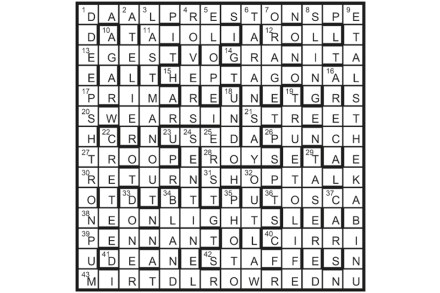
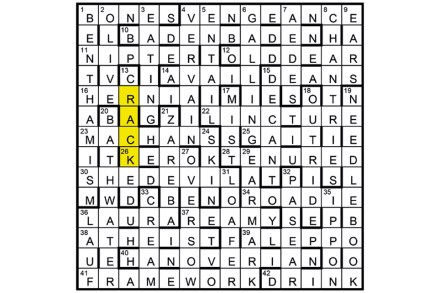
The unclued entry RECYCLING thematically links six unclued cyclic non-word permutations that appear in the systematic order GCYCLIN, NGCYCLI, INGCYCL, LINGCYC, CLINGCY and YCLINGC. The title alluded cryptically to SPORT/CYCLING. First prize Richard Andrews, Ashford, Middlesex Runners-up Sara MacIntosh, Darlington, Co. Durham; Roderick Rhodes, Goldsborough, N.

Letters: What Sturgeon has got wrong

From our UK edition

Sturgeon’s single issue Sir: Nicola Sturgeon needs to be careful what she wishes for. Declaring that the next general election will be concerned solely with the issue of Scottish independence is, as you say, ‘a constitutional absurdity’ (‘Sturgeon’s bluff’, 2 July). Heads of government who stipulate single-issue elections are on a hiding to nothing, and rightly so. Theresa May’s ‘Brexit’ election in 2017 turned out badly for her, although at least she kept her job (just). Ted Heath wasn’t so lucky in 1974 (‘Who rules Britain?’), ditto Churchill in 1945 (‘Who won the war?’) or Stanley Baldwin in 1923 (‘Free trade or protection?’).

A Tory implosion

From our UK edition

What is the purpose of a Conservative government? It’s a reasonable question for voters to ask. In 2019 Boris Johnson gave us a clear answer: he was a different type of politician. He would get Brexit done, then protect the public from the rising costs of government by freezing taxes. The public, he said, had had enough of weasel words and broken politics. He stood as an unconventional prime minister who would sweep away Westminster’s failing conventions. Instead, he is in danger of sweeping away the conventions that actually worked. The country is now being deprived of a functional government: one that is capable of planning longer than a fortnight ahead. For Johnson, survival is victory.

2560: Obit VI – solution

From our UK edition

The perimetric names are NIJINSKY, NEVER SAY DIE, CREPELLO, THE MINSTREL, ROBERTO and TEENOSO, six of the nine Derby winners ridden by Lester Piggott who died on the 29th of May, the other three being ST PADDY (22), SIR IVOR (33) and EMPERY (4). DERBY (15) and LESTER (35) were to be shaded.

How has the Wimbledon prize money changed over time?

From our UK edition

Blooming huge Botanists discovered the largest species of giant water lily at the Royal Botanic Gardens, Kew, with leaves more than 10ft wide. The plant with the largest leaves is the Raffia regalis, a palm whose foliage can grow up to 82ft long and 10ft wide. The largest living organism is a colony of identical aspen named Pando (‘I spread’ in Latin) in Utah which covers 108 acres. A wild fig tree in Mpumalanga, South Africa has the longest roots on record at 400ft. Net profits Wimbledon comes to an end this weekend with the men’s and ladies’ finals. How has the total prize money for the singles championship changed over time?

2559: Platinum upgrade – solution

From our UK edition

The perimeter, starting at square 38, yields six of the CITIES created to commemorate the Platinum Jubilee: DONCASTER, MILTON KEYNES, BANGOR, WREXHAM, DUNFERMLINE and DOUGLAS. STANLEY and COLCHESTER are the unclued lights. PORT (Stanley) had to be highlighted at 23 Across.

Portrait of the week: Scottish independence, striking lawyers and the end of Roe vs Wade

From our UK edition

Home Ben Wallace, the Defence Secretary, said that military spending had to increase. Boris Johnson, the Prime Minister, reacted to the loss of two by-elections by saying ‘I’ve got to listen to what people are saying’, but did not resign. Oliver Dowden said ‘Somebody must take responsibility’, and resigned as a co-chairman of the Conservative party. Later Mr Johnson joked to reporters in Kigali, Rwanda, at the Commonwealth Heads of Government meeting: ‘I’m thinking actively about the third term.’ The Liberal Democrats won Tiverton and Honiton with a swing of 29.9 per cent from the Conservatives; the Conservative majority of 24,239 from the 2019 general election was the largest ever overturned in a by-election.

Nicola Sturgeon’s referendum stunt

From our UK edition

Nicola Sturgeon presents Scotland as a country outraged by Brexit and straining at the leash of the United Kingdom. She said she wants a second referendum on 19 October next year. But she has no powers to call one and has already referred herself to the Supreme Court, which is likely to confirm that only the UK parliament can bring into being a referendum on the future of the UK. So her call for a referendum date is, to all intents and purposes, a stunt. The SNP and their Green allies stood on pro-referendum manifestos last year and between them captured a majority of Holyrood seats. Sturgeon feels that justifies another vote. But that logic has already been rejected by the UK government, which says that now is not the time.

Letters: Why do we bully PMs’ wives?

From our UK edition

Strong leaders Sir: Freddy Gray states that ‘voters seemed most enthusiastic about the leaders who removed their liberties’ (‘Leaderless’, 18 June). I believe people just like to see their government take strong measures. People like to see the effect of a government policy straight away, especially in a crisis. This is probably the reason so many Americans like the idea of Trump’s wall. It is an immediate and physical solution to a large problem that can be seen and felt, even if it is not necessarily the best solution.

Letters: How to face death

From our UK edition

Be prepared Sir: The advice of Jeremy Clarke’s Aunty Margaret that he ‘must “get right with the Lord” as a matter of the gravest urgency’ in the light of his cancer diagnosis is spot on. I say that not just because I’m a vicar, but because I have sat at innumerable bedsides of people in the last days of their lives and have often found myself thinking: ‘You really should have prepared for this a long time ago.’ But by then they were too sick, too tired or too drugged up to think straight about spiritual matters and I have always felt that I would be intruding if I forced the issue. Deathbed conversions such as Lord Marchmain’s in Brideshead Revisited are, in my experience, almost nonexistent.

Who’s still buying Russia’s fossil fuels?

From our UK edition

Striking differences This summer’s strikes are unlikely to erupt as badly as the Great Railroad Strike of 1877 in the US, which still stands out as one of the most violent in history. It began when workers on the Baltimore and Ohio Railroad refused to accept a 10% pay cut, their second in a year. On 14 July they uncoupled locomotives and stranded 600 trains around the town of Martinsburg, West Virginia. The strike spread throughout the north-eastern states. In Cumberland, Maryland, ten people were killed when the militia were dispatched to deal with the strikers. In Pittsburgh, a riot led to 40 deaths. In Lebanon Valley, Pennsylvania, a viaduct was burned down. Federal troops restored order by the end of the month.

Portrait of the week: Rail strikes, rates rise and a record-breaking stingray

From our UK edition

Home A rail strike on three alternate days, bringing the system to a standstill for a week, was organised by the Rail, Maritime and Transport workers’ union. On the first day, the London Underground came out too. Tram drivers in south London arranged a strike of their own. Sir Keir Starmer, the Labour leader, instructed his frontbenchers not to join strikers’ picket lines, but some did. EasyJet announced plans to cut 7 per cent of its 160,000 flights scheduled between July and September after Gatwick, easyJet’s main airport, said it would reduce the number of flights taking off. Flights carrying up to 5,000 passengers were cancelled at Heathrow airport on one day because of trouble with baggage-handling.

Cutting the cost of government is the only solution to this crisis

From our UK edition

A little over a year ago, The Spectator printed a cover story about the risk of inflation. Britain, we argued, was hugely vulnerable: the national debt was structured in such a way that even a small uptick in inflation followed by a rise in interest rates would inflict immense damage on public finances. The conventional wisdom was that there was no such risk, that rates would be ‘low for long’. But what if this consensus was wrong? The Financial Times took the unusual step of writing a story about our story. ‘The Spectator joins the inflation doom-mongers,’ it announced. ‘Doom’ was pushing it a bit: we simply sought to underline the complacency with which governments, central banks and many analysts viewed the economic horizon.