The Spectator

Portrait of the week: Prince Harry heads to court, Waitrose says sorry and Rishi goes to Washington

From our UK edition

Home The government was acquiring two barges to house 1,000 migrants in addition to one at Portland for 500. Rishi Sunak, the Prime Minister, said that small-boat crossings of the Channel were down 20 per cent, and ‘our plan is starting to work’. A group of asylum-seekers, transferred to a Comfort Inn in Pimlico and told they would have to share four to a room, refused to enter and stayed on the pavement. The scandal-hit CBI said that 93 per cent of the 371 members who voted backed its plans to reform; the British Chambers of Commerce launched a rival group called the Business Council.

Who sat on the first TV sofa?

From our UK edition

Sofa so good Phillip Schofield has said that his career on the TV sofa is over. Who first sat on one?  – BBC Breakfast, first broadcast on 17 January 1983, famously featured a red leather sofa which presenter Frank Bough told his audience was the ideal way to present a news programme. But the history of the TV sofa goes back a lot further. The Tonight Show, first broadcast on NBC in 1954, featured one from 1964 onwards – a surviving clip from that year shows presenter Johnny Carson standing in front of a blue cloth-upholstered sofa. Death and taxes How much does inheritance tax raise, and how many people pay it? – In 2021/22 the tax raised £6.1bn. This is double what it raised a decade earlier.

Letters: we don’t need a Covid inquiry

From our UK edition

Toothless inquiries Sir: You rightly say that inquiries in Britain have become a form of cover-up (‘The politics of panic’, June 3). This is clear as we contemplate the delay in reporting on the Grenfell Tower fire of 2017, the £200 million spent on the Bloody Sunday report published 38 years after the event, the seven-year delay in concluding the Chilcot inquiry, and the shaming fact that Sweden has reported on its handling of Covid before our inquiry has even begun.

Portrait of the week: Rishi Sunak defends Kathleen Stock, food prices rise and AI extinction warning

From our UK edition

Home Rishi Sunak, the Prime Minister, supported a visit to the Oxford Union by Professor Kathleen Stock, who believes that there are such things as women: ‘University should be an environment where debate is supported, not stifled,’ he said. He said in a separate announcement that he would ban companies from giving out free samples of vaping supplies to people under 18. He then packed his bags for a visit to Washington, DC, in the coming week for talks with President Joe Biden. Delaney Irving, aged 19, from Vancouver Island, won the women’s race at the Cooper’s Hill cheese-rolling event near Gloucester. Food prices continued to rise rapidly, according to the British Retail Consortium, by an annual rate of 15.4 per cent in May, compared with the even steeper rate of 15.

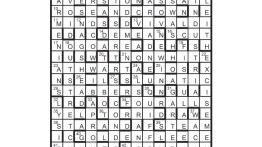
2604: Snap – solution

From our UK edition

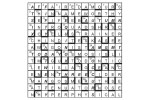
The unclued lights are card games, as is the puzzle’s title, SNAP. The pair is 15A/29. First prize Mark Rowntree, Greenwich, London SE10 Runners-up Frances Whitehead, Harrogate, N. Yorks; Alan Pink, Crowhurst, E.

Who was the original Terf?

From our UK edition

Terf wars Who was the original Terf (trans-exclusionary radical feminist)? – The practice of some women’s groups in excluding trans women began almost with the advent of trans women themselves. In 1978, the Lesbian Organisation of Toronto refused membership to a trans woman who identified as a lesbian – saying it would only accept ‘womyn born womyn’. – The term ‘Terf’, however, dates only from 2008, when it was used in a blog post by feminist writer Viv Smythe in response to a ban on trans women attending the Michigan Womyn’s Music Festival (a ban which had been in place since 1991). – The festival, which had been going since 1976, was boycotted by some and was last held in 2015.

Letters: Jeremy Clarke was an example to us all

From our UK edition

Goodbye, Jeremy Each week I opened The Spectator at Low Life in part to read that brilliant column and, more recently, to see how Jeremy Clarke was coping with his deteriorating health. Always hoping the column would be there; that he had, despite excruciating pain, penned us another. Like very many of his regular admiring readers, I had found the last two weeks disturbingly sad and last week we learned that he has died and is free at last from his suffering. As an oncologist, during a career treating thousands of patients, at first ones with prostate and other urological cancers, and later ones with breast cancer, I have seen the ravages of metastatic cancer in its many and varied forms and observed how people cope in their individual ways.

Portrait of the week: Rioting in Cardiff, rising migration and falling inflation

From our UK edition

Home A crash in which a 15- and a 16-year-old boy riding on an electric bike were killed led to rioting, the burning of cars and attacks on police in the Ely estate in Cardiff; social media had said the deaths followed a police chase, which the police denied. But video evidence seemed to show a chase. During the riot, one of the boys’ mothers posted a Facebook message: ‘Please I beg you all to stop and let my son be moved to hospital so I can see him.’ A woman hit on 10 May by a police motorcycle escorting the Duchess of Edinburgh died.

How Rishi Sunak should react to the Ely riot

From our UK edition

‘There’s a lot of societal issues in Ely,’ said an anonymous caller to BBC Radio Wales the morning after the recent riots in that Cardiff suburb. ‘Motorbikes going up and down constantly. Open drug-dealing going on in broad daylight, that the police are aware of, and nothing gets done about it. Children in Ely – dare I say it? – probably don’t have aspirations. They only see what’s around them. There are young children going to school wearing Rolexes and rolling around on £6,000 e-bikes that their parents haven’t bought for them. So where’s the money coming from? There’s so many things at play that it’s shocking... things will start coming to the surface that would make a lot of people on both sides of the fence hang their heads in shame.

Do speeding fines work?

From our UK edition

Fine lines Would Suella Braverman be more likely to stick to the speed limit had she chosen to go on a speed awareness course instead of being fined? A government-commissioned study in 2018 looked at the reoffending rate among 1.4 million drivers who had accepted the offer of a speed awareness course and compared it with that of drivers who opted to take three points and pay a fine instead. Within two years of taking the course, around a quarter of drivers had reoffended. However, the rate was lower than it was for motorists who had chosen to pay the fine. The relative reduction of reoffending was put at 12-23% after six months, 9-17% after one year, 9-11% after two years and 6-13% after three years.

Jeremy Clarke remembered: by Boris Johnson, Sophie Winkleman, Eric Idle and more

From our UK edition

Boris Johnson    When Jeffrey Bernard died in 1997, it seemed possible that we would never again have a regular Low Life columnist in The Spectator – or no one half as good. We needed someone who could match Taki for appalling frankness, for saying the unsayable; but not about the denizens of Gstaad or New York nightclubs. Low Life meant the opposite milieu. We needed our man with the half-eaten packet of prawn cocktail flavour crisps and the monster hangover, our man in the pub lock-in, the ferret show, the debtors’ court, the A&E at 3 a.m. with the drunk guy going crackers. It had to be someone who knew how to argue with social workers. We needed a new literary Hogarth.

Letters: Britain’s net-zero ambition problem

From our UK edition

Zero ambition Sir: How extraordinary that Ross Clark (‘Carbon fixation’, 20 May) can look at the cut-throat competition to capture the economic gains of the future and conclude that Britain’s problem is an excess of ambition. The USA stands alone as the only G7 nation not to have a net-zero target in law, but is nonetheless spending billions to achieve it. The country’s Inflation Reduction Act has proved so popular with the market that it is leveraging trillions more of private investment than previously expected, the majority in Republican-led states. Likewise China may lack a legally binding target, but enjoys a comfortable lead in core technologies following decades of investment.

Why Britain is falling behind in the global universities race

From our UK edition

Our country still excels when it comes to higher education. Britain has seven of the world’s top 50 universities. In spite of many claims that Brexit would lead to a reduction in the number of foreign students, the intake has never been higher. In 2021-22, there were 680,000 overseas students in higher education in Britain, an increase of 123,000 in just two years. That’s good news for the British economy. A report by London Economics estimated that one year’s intake of students would, by the time their courses had finished, bring in £29 billion in revenue from tuition fees and other income. Importantly, the benefits are spread all over the country: the University of Manchester and the University of Edinburgh each have around 18,000 overseas students.

Who else has come after Percy Pig’s crown?

From our UK edition

Pig out Marks & Spencer wrote to an ice cream parlour in Hertfordshire demanding that it stop calling one of its products ‘Perky Pig’ on the grounds that it infringed the chain’s copyright of Percy Pigs, which it has been selling since 1992. Some more onomatopoeic porcines: – Pierre Pig: collectible plastic figurines introduced by Fabuland in 1984. The characters in the series also included Pat Pig, Peter Pig and Patricia Piglet. – Peppa Pig: children’s TV series first broadcast on Channel 5 in 2004, and favourite of former PM Boris Johnson. – Percival Pig Finds His Manners: children’s book published in the US in 2014. – Percival, the Performing Pig: children’s play by Dilys Owen. – Perry Pig Jump: Nintendo game brought out in 2019.

Letters: What Millennial Millie needs

From our UK edition

Lion of London Bridge Sir: Douglas Murray’s well-presented essay (‘Don’t be a hero’, 13 May) brings to mind the bravery of the Millwall fan Roy Larner, who fought off three knife-wielding religious fanatics in a terror attack, saving the lives of many others in the process. Stabbed eight times and in a critical condition, the ‘Lion of London Bridge’ managed to drive his attackers off. This was five years ago and yet, despite meeting all criteria for courage of the highest order, Mr Larner has yet to receive any public citation, let alone the George Cross he so obviously deserves. One wonders what is delaying this long overdue recognition. John B.