The Spectator

Reading Wagner

From our UK edition

I've been having a Wagnerian time of it lately, organizing a festival of events to coincide with the Royal Opera's performances of the Ring cycle in October. On Wednesday I was deep in the Nibelheim-like bowels of the Royal Opera House, recording extracts from Wagner's letters with Simon Callow. He read with the most spine-tingling concentration and a vivid fluency that made me unnervingly feel as if I was sitting next to the composer himself. Wagner was undeniably a monster but the energy and passion of the man was astounding. One minute he's writing exaltedly to Franz Liszt - 'I now consider my powers to be immeasurable: everything seethes within me and makes music'; the next he is in a rage of despair at the 'cruelly difficult task of creating in my mind a non-existent world.

Time for Elgar to go global

From our UK edition

One of the guests at our third Elgar concert at The Spectator's offices in Old Queen Street last night shrewdly pointed out the oddity that the great composer does not seem to travel as well as, say, Vaughan Williams. Listening to Madeleine Mitchell (violin) and Nigel Clayton (piano) perform the sublime Violin Sonata (Op. 82) one could only agree that, on his 150th birthday, "E.E." deserves to go global. There's an excellent piece which makes the same point in today's Guardian.

More abuse to come

From our UK edition

Why does David Cameron keep insulting his party? It’s a question plenty of Tories are asking and the answer is buried on p33 of The Times today. Its new chief political correspondent, Francis Elliot (he of the indispensable Cameron biography) has disclosed that the party’s research shows its voters are suspicious of “the same old Conservative Party”. This squares with my information. Cameron's behaviour is explained by his belief that there's a gulf between Tory activists and Tory voters - and he will keep pitching his message to the latter, even if it infuriates the former. “We’re still in Phase One, persuading the country that we have changed” a senior Cameroon said to me recently.

Who needs Iowa?

From our UK edition

Thirteen of the last fourteen nominees from the two major US parties have won the first primary  state of Iowa. The odd one out? A certain Bill Clinton in 1992, who only won 3% of the Iowa vote, to Iowa local Tom Harkin's 76%. The Hillary campaign have now officially rejected  the strategy of "skipping" Iowa, and she is headed there this weekend to do damage repairs. But let's not say the strategy shows panic - a Clinton did it without Iowa before, and they could do it again. (As it happens Barack Obama appears to be considering skipping the state, having missed some crucial Iowa events and spending a lot of time in California and New Hampshire.) The whole nomination process is different this year.

Is Hillary’s camp in a panic?

From our UK edition

If you want to know how much the race for the Democratic presidential nomination has changed since people thought that Hillary just had to turn up to win, read this story about how Team Clinton is contemplating skipping the first contest of the season in Iowa. The strategy actually makes some sense given Hillary’s relative weakness there compared to other states. But the fact her campaign is thinking of roundabout ways to win the nomination shows that the inevitability myth has been well and truly punctured.

Reading aloud

From our UK edition

A hot, hot night in a Portobello Road boookshop for a poetry reading (see my earlier post) hosted by the excellent Pass on a Poem and Oxfam, in aid of Darfur and Chad. As I stand up to read "The Day He Died" by Ted Hughes, I notice Saffron Burrows sitting in the back row of the audience. Just another night in Notting Hill, I guess. I manage to get through without fluffing my lines, I think. Then it's over to the real talent. Our own Rachel Johnson reveals that (in addition to all her other talents) she has a beautiful speaking voice, reading Auden's Epitaph on a Tyrant with great poise and power. And speaking of that poet, the great Alex James, Blur bassist and man of letters, reveals that his own haircut  is "centenary Auden", to mark the 100th anniversary of Wystan's birth.

Why Rocky rocks

From our UK edition

DVD release of the week is Rocky Balboa, the sixth and final instalment of the boxing saga. Yes, I know the idea of the 60-year-old Sylvester Stallone climbing into the ring again is innately absurd, but all of the Rocky movies, including the first which won the Oscar for Best Picture in 1976, have been completely ridiculous. That has been their popcorn magic, a classic example of the American Dream told in comic book idiom. Any film that includes lines like “what we'll be calling on is good ol’ fashion blunt force trauma” and “let's start building some hurtin' bombs!” has my vote. Rocky Balboa has the added attraction of declaring that the Saga generation are not above giving young upstarts a serious pasting when the fancy takes them.

Groups of New York?

From our UK edition

According to the Youth Justice Board, most teenage “gangs” should be referred to less abrasively as “groups”. Which makes me think how very different Martin Scorsese’s movie would have been if it had been called Groups of New York. I doubt Goodfellas would have made such an impact if it had begun with the line: “As far back as I can remember, I've always wanted to be a group member.” And, somehow, “group rap” – or perhaps “group rhyming partnership initiatives” – doesn’t sound quite as snappy as “gangsta rap”. Still, next time you see a bunch of hoodies menacingly huddled on your street corner, you can rest assured: they’re really only a “group”.

Our rotten taste in tomatoes

From our UK edition

Some people think that the only tomato worth eating is the one you’ve grown yourself but this isn’t actually true. I can think of loads of tomatoes – eg the cherry ones grown at the foot of Mt Etna and sold at I Camisa in Old Compton Street, Soho – that are much nicer than most people’s rubbishy, watery, tasteless home grown ones. With home grown tomatoes there’s only one thing that really matters: they have to be the yellow-skinned cherry type called Sungold. Every other variety sucks. Gardeners Delight? Sucks. Moneymaker? Sucks.

Remembering Sheridan Morley

From our UK edition

What a wonderful afternoon it was! Who can imagine a theatre jammed full of the most famous thespians in London honouring that despised creature, a theatre critic? But they — Miriam Margolyes, Corin Redgrave, Patricia Hodge, Simon Callow and many others — all came. Actors loved the late Sheridan Morley, for they realised that Sherry not only loved but also had huge understanding of the theatre. And they — actors, directors, producers, friends — came in their hundreds to show their affection for him. And as they read from Sherry's reviews, reminisced, sang and recited, they made us laugh and cry.

Will he or won’t he?

From our UK edition

If you want a quick guide to whether Al Gore will end up running for president or not read this piece by Ben Smith, one of the savviest US political reporters. The thing with Gore, as one politics watcher from his home state of Tennessee told me, is that he’d like to be president but he doesn’t want to run for it—think Michael Portillo in the Tory leadership contest in 2001. So Gore is putting all his least popular positions up front, as Portillo did, to make it clear that he only wants it on his terms.  One scenario for Gore jumping in which does the rounds in Washington is that Obama makes a rookie error, Edwards doesn’t catch on and then at the last minute some scandal engulfs the Clinton campaign which reawakens all the old doubts about the couple.

The fight on the right

From our UK edition

The issue that ends up rendering asunder the American right will not be Iraq but the other i-word, immigration. George W. Bush and Karl Rove have long believed that the future of the Republican Party depends on appealing to Hispanics, the fastest growing minority group in the US. They argue that with their strong family values, work ethic and small business mind-set this group are just waiting for the Republicans to court them. Indeed, Bush and Rove received some vindication for this theory when a sharp increase in the Hispanic vote helped win Bush a second term.

Hollywood, friend of cheap dates everywhere

From our UK edition

Leonardo di-Caprio and Blood Diamond gave men an excuse not to buy their wives and girlfriends diamonds on the grounds that they were ethically tainted. Now Julia Roberts is going to star in a movie that will do the same for flowers, reports New York Magazine. The film, based on the Vanity Fair essay ‘A Flowering Evil’, will tell the tale of the conservationist Joan Root who struggled to save Lake Naivasha in Kenya from the flower farm industry before being murdered earlier this year. All Hollywood needs to do now is to make a good thriller about the evils of the chocolate industry and tight-wads the world over will be able to say, "I'm not cheap, I'm ethical.

The political web

From our UK edition

Fascinating piece in today’s Washington Post about Republican’s fears that they are “losing the Web.” What was once a side-show for political geeks is becoming core electoral terrain. Actually the best thing about Gordon Brown’s “listen and learn” campaign is his website.

A good idea from Don Rumsfeld–no really

From our UK edition

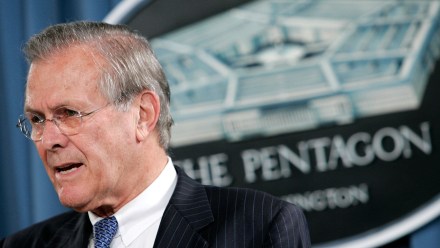
Few people have a good word to say about Don Rumsfeld right now and there is little doubt that he was an absolute disaster in his second stint at the Pentagon. The Rumsfeld doctrine—just enough troops to lose, as one Washington wag dubbed it—is largely responsible for the Coalition’s inability to bring order to Iraq after the fall of Saddam. Having said all that, his latest wheeze does seem like a good idea. He is planning to set up a foundation to provide fellowships for those in the private sector who want to do a stint in public service.

Heated debate

From our UK edition

If man-made global warming is killing Africans, as the climate change alarmists suggest, shouldn't we reduce our carbon footprint?  Tesco did just that, says Dominic Lawson, and reduced by two-thirds their fruit and veg imports from East Africa. The result: poorer Africans. "All it does is make Tesco look better in North London. I find it repulsive," Lawson said on 18 Doughty Street television . This clip shows a 15-minute discussion which you're unlikely to see from mainstream British broadcasters who seem to view their role as 'raising awareness' rather than debating. The success of Channel Four's Great Global Warming Swindle documentary was largely due to relief that a broadcaster did not treat audiences like kids, unable to decide facts for themselves.

Brown goes nuclear

From our UK edition

Today’s news that Gordon Brown will back the next generation of nuclear power plants is further proof of his desire to put the Tories on the back foot. Nuclear power is one of the issues that divide the opposition with Alan Duncan declaring himself “instinctively opposed” to it while many others see it as the only form of energy that offers security of supply at a sufficient quantity. If Cameron backs nuclear power he’ll alienate Zac Goldsmith and many of his green chums who Cameron has so assiduously cultivated. He’ll also hand the Lib Dems a distinctive issue with which to attack the Tories in the south. Yet if he refuses to back nuclear power, Brown will be able to ridicule him for being incapable of taking tough decisions.

Letters to the Editor | 19 May 2007

More power to Kazakhstan Sir: Elliot Wilson rails against the alleged bureaucracy, corruption and nepotism that he argues are strangling business opportunities for foreign investors in Kazakhstan (Business, 28 April). But his three examples of Western companies who have ‘decided to leave’ are misleading. PetroKazakhstan, which emerged from nowhere as Canadian-based Hurricane Oil, was very happy to sell its Kazakh assets to the Chinese national oil corporation in 2005 for more than $4 billion. The same is true of Nations Energy, which in 2006 was sold by the owners for almost $2 billion.

What Brown should say

From our UK edition

Frank Luntz, the US polling guru whose Newsnight focus group gave David Cameron a crucial boost in the Tory leadership election, has an interesting piece in today’s Guardian. He argues that Brown is getting it all wrong and that people won’t be persuaded by his protestations that he wants to hear their thoughts. Instead, Luntz thinks that Brown needs to embrace who he is and persuade the public that these are serious times that call for a serious leader. Here’s the opener for the speech Luntz thinks Brown needs to give: "Some people say I'm boring. Well, they're right. In challenging times such as these, Britain doesn't need an entertainer. We need a leader.