The Spectator

Letters: Hollywood owners have ruined Wrexham FC

From our UK edition

Wild abandon Sir: As upsetting and pointless as is the National Trust’s cancelling of the fishing lease on the River Test at Mottisfont Abbey (Letters, 19 August), it is all of a piece with the way the National Trust is going. On the 13,000-acre Wallington Estate in Northumberland, the Trust has recently spent a small fortune elaborately fencing off 50 acres to release beavers on one of the two farms they have recently taken out of agricultural production. They trumpet their intention to create ‘Wild Wallington’ by abandoning it to nature and planting trees on as much of the estate’s farmland as they can.

Portrait of the Week: Inflation falls, Hawaii burns and Oxford Street is raided

From our UK edition

Home The annual rate of inflation fell to 6.8 per cent in July, from 7.9 per cent in June. Wages in the period of April to June were 7.8 per cent higher than a year earlier, according to the Office for National Statistics. GDP grew by 0.2 per cent in the second quarter, after growth of 0.1 per cent in the first quarter. The number of people inactive because of long-term sickness rose to more than 2.5 million, 400,000 more than at the start of the Covid-19 pandemic. Unemployment rose from 3.9 per cent to 4.2 per cent. Food prices were 12.7 per cent higher in the four weeks to 6 August than a year earlier, according to Kantar, a research company. Wilko, the homeware chain with 400 outlets, was for sale after going into administration.

2615: Bronze pile – solution

From our UK edition

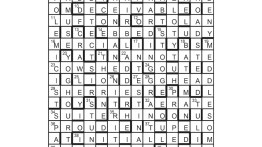
Unclued lights are some laureates of the Nobel Prize in Physics. There were two CURIEs (35). The clued name was Max BORN (8). The title is an anagram of NOBEL PRIZE. First prize Sid Field, Stockton on Tees Runners-up David Carpenter, Sutton Coldfield G.

Where were the longest A&E waits?

From our UK edition

The bare platform A 112-space car park built to serve the railway station in the Cambridgeshire village of Manea was used by just three cars in its first week. — The station, formerly a ghost station with one train a week, has been revived but even so is only served by two trains every hour. — Yet had it not been for the Civil War, it could have been the capital of England. Charles I planned an English Versailles there, surrounded by a great city called Charlemont – all built on land reclaimed from the fens. Thanks to the war, however, nothing ever got built. — The name Charlemont lives on as a cul-de-sac in the village (population 2,000) where you can buy a modest four-bedroom detached house for £400,000.

View from a Window

From our UK edition

1979 Break time. Out of the staff room window through             The fug of pipes and cigarettes The landscape of industrial decline             Has empty smokeless chimneys signal debts To history that never will be paid             Except by demolition. Cleanliness Of plate glass far prefers the playing fields             Whose straight white lines mean to impress. But as exhaust-filled smog rolls in, it seems             The goalposts move. What do we hear? ‘She’s right, the country needs...’ What, modernise?

Portrait of the Week: The Crooked House fire, Liz Truss’s honours and a Commonwealth Games flop

From our UK edition

Home The first of about 500 asylum seekers were taken to live on the Bibby Stockholm barge on the Isle of Portland, north of the prison and linked to the mainland by one road. The arrival of 339 migrants by small boat across the Channel at the weekend brought the year’s total to 15,071. The government declared it would increase enforcement action against lawyers who ‘coach illegal migrants to lie’ in making claims. Fines were to be tripled for employers and landlords who allow illegal migrants to work for them (up to £45,000 per illegal worker for a first breach) or rent their properties, the Home Secretary announced. The 18th-century Crooked House pub, near Dudley, was gutted by fire a fortnight after being sold, and the next day reduced to rubble by a mechanical digger.

2614: Monkey Business – solution

From our UK edition

The key word is GIBBON (highlighted). 1A, 1D and 28D are types of gibbon; 16D is by 18A 29A Gibbon; 32D Gibbon wrote The History of the 13A 38A of the Roman Empire. First prize Anne Clements, Bromley, Kent Runners-up Janet Baines, Winchester, Hants; L.

Letters: ‘supercops’ won’t save us from rising crime

From our UK edition

Crime stoppers Sir: If the Tories’ reputation on crime lies in the hands of these innovative supercops, then it will be sadly doomed, no matter how enterprising they may be (‘Rise of the supercops’, 5 August). Whether we like to believe it or dismiss it as woolly liberalism, the police and courts have a limited impact upon crime. The reality is that crime is driven by powerful social and economic forces, not the effectiveness of the local constabulary. In a liberal democracy, leaving the police to deal with any complex social problem, particularly one as diverse and intractable as crime, is fraught with danger. The police do have an important role to play but so do many others.

Is the rest of the world still working from home?

From our UK edition

Scout’s honour Thousands of teenagers were evacuated from the World Scout Jamboree in South Korea as flooding, a heatwave and then the threat of a typhoon affected the event. What exactly is a ‘jamboree’? – Lord Baden-Powell adopted the word for the first gathering of scouts at Kensington Olympia in 1920. But the word itself can be traced back to the mid-19th-century American West, when it was used for a drunken revel – presumably not what Baden-Powell nor subsequent heads of the scouting movement would encourage. – The first documentary evidence for use of the word is in the report of a murder trial in the New York Herald in 1868, when two of the accused were described as indulging in a  jamboree before the crime was committed.

Trump’s indictment and the trouble with the law

From our UK edition

The latest charges against Donald Trump will do nothing to deter his many supporters within the Republican party. On the contrary, his indictment by a grand jury set up by special counsel Jack Smith plays into the former president’s narrative of victimhood and makes it even more likely that he will be chosen as a candidate. And that, curiously, is exactly what many senior Democrats want. To his electoral opponents, Trump seems reliably toxic – millions of Americans will turn out to vote against him.  It is a depressing development when legal processes are used as a political tool Even if he is convicted of the latest four charges – which include conspiracy to defraud the US and conspiracy against the rights of citizens – Trump might not be debarred from office.

How much do students drink?

From our UK edition

Union booze Several universities have renamed freshers’ week ‘welcome week’ in an attempt to dissociate it from heavy drinking. How much do students drink? – A survey last year by the group Students Organising for Sustainability found that 81% regard drinking and getting drunk as part of university culture. – 53% reported drinking more than once a week. – 61% said they drink in their rooms or with other students before going out for the night to a pub or club. – 51% said that they thought getting drunk would ensure they had a good night out. – 13% said they took illegal drugs. Round the houses Councils are to be allowed to charge more council tax for second homes. How many second homes are there in England? – There are 3.

Letters: why AI may be a force for good

From our UK edition

Parris review Sir: Matthew Parris (‘Coutts, Farage and the trouble with choice’, 29 July) omitted to mention the initial, fundamental and obvious matter of the breach of client confidentiality committed by Dame Alison Rose, who he says should not have resigned. This is surely the gravest offence any bank official – let alone the head of NatWest – can commit. Yet he puts her resignation down to a ‘silly media storm’, which was actually started by the BBC, to whom the client information was given. Further, his article relates mostly to the discretion which institutions such as banks have in choosing who to admit. But this issue wasn’t about a client’s admission to the bank, it was about expelling one for his ‘views’.

Rehearsing Noye’s Fludde

From our UK edition

We were all in it an opera in a church my youngest brother going into the Ark in the mask of a blue tit Raven Boy twirling to a clarinet Dove Girl with ballet shoes and a bunch of green leaves and Mrs Noah who did not want to go dragged up the gangplank waving a goblet shouting I will stay with my gossips.

The political battle for net zero is only just beginning

From our UK edition

This may come to be remembered as the year where the global warming debate became serious. Until now, there has been a shrill quality to the discussion with emotive language used in place of reason. Yes, there’s a serious problem facing the planet – but to what extent would the proposed solutions address this problem? What are the trade offs involved? How does decarbonisation rub up against other obligations, like alleviating cost-of-living pressures and protecting the elderly from the cold? Deadlines that once seemed far away – like the 2030 ban on new petrol cars – are now getting rather close and focusing minds. The public certainly are concerned about the environment, as evidenced by consumer choices and behaviours, but they are unwilling to be taken for fools.

NatWest’s attack on Nigel Farage was a political hitjob

From our UK edition

The Coutts scandal can be traced back to the day, two years ago, when the bank proudly announced that it had achieved ‘B Corp’ status. B Corp is a little-known non-profit which operates a scheme a bit like Stonewall’s Diversity Champions Programme. Companies that sign up and jump through the necessary hoops will receive a certificate declaring that they’re ethical and inclusive. Business and politics should be kept separate, yet woke capitalism wants to fuse them together B Corp’s website declares: ‘Certified B Corporations are leaders in the global movement for an inclusive, equitable and regenerative economy.’ It adds that its scheme seeks to measure ‘a company’s entire social and environmental impact’.

Edinburgh Marathon, What I Remember

From our UK edition

(after Tracey Herd) most, is not the goal, the finish-line, but the start, (do any of us know where we are heading), the assortment of people, the runners I mean, stretching, going for last minute pees, doing their weird warm-up routines, and the straggle of loved ones congregating in Holyrood Park. I barely remember the first five miles down Edinburgh’s deep streets, I remember hitting the coast, the exposure at Portobello beach, the surprise of space, the sudden release of the sea’s shore.

Portrait of the Week: NatWest, fires in Greece and Twitter’s new look 

From our UK edition

Home Dame Alison Rose resigned as the chief executive of the NatWest group, which owns Coutts bank. She had been the source of a BBC report that Nigel Farage’s account at Coutts had been closed because it no longer met the bank’s financial requirements. Dame Alison also apologised to Mr Farage for ‘deeply inappropriate’ comments in a Coutts dossier on him which showed his account had been closed because of his political views. Her resignation came only after No. 10 had expressed ‘significant concerns’ about her remaining as the board wanted. The volume of goods sold by Unilever fell by 2.5 per cent in the first half of the year, but sales measured by price grew by 9.4 per cent. A fire destroyed more than 40 businesses on an industrial estate at Baldock, Herts.