Captions Please
From our UK edition
Leave them in the comments below.
From our UK edition
Leave them in the comments below.
From our UK edition
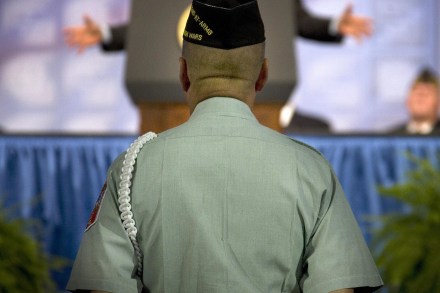
At first glance it seems bizarre that Bush invoked Vietnam in defence of his Iraq policy. After all, for years the Bush administration has argued that any parallel to Vietnam is nonsense. But there’s logic to what Bush is doing. By mentioning Vietnam and Iraq in the same breath, Bush has guaranteed that his speech is getting plenty of attention. The hope is that this coverage will allow the message that the surge is making military progress to be communicated to the public. The other thing he is doing is more subtle, he's trying to evoke the consequences of defeat not only in Iraq but at home. Americans, whatever their opinion of either Iraq or Vietnam, have no desire to experience the kind of funk that the country went into after its defeat in south east Asia.
From our UK edition
This brief Time magazine article is as good a summation as any of the current situation in Iraq and how the US feels about it. Essentially, the surge has made military progress—something that an increasing number of Democrats are prepared to recognise—but the Maliki government has yet to take advantage of this window of opportunity, much to the frustration of the Bush administration. Overall, the situation in Iraq is more hopeful than it was before the surge started but the Iraqis need to start making political progress soon if this momentum is not to be squandered.
From our UK edition
In his speech on youth crime today, David Cameron suggested that those who commit minor offences should have their driving licences delayed. This is a more sensible idea than marching yobs to cash-points and in theory one can see it being quite an effective deterrent against the kind of bad behaviour that can make life so unpleasant. However, the obvious downside is that it could lead to a whole bunch of young people driving without a licence or insurance—after all, these people are having their licences delayed precisely because of their lack of respect for the law and consideration for others.

From our UK edition
David Davis's op-ed in the Telegraph today on immigration makes an absolutely crucial point about the Learco Chindamo case. As Davis writes, “On the Today programme yesterday, Jack Straw blamed EU law. But the relevant 2004 EU directive was negotiated on his watch as foreign secretary.” Politicians have a habit of doing this. They sign onto something from Brussels and then when faced with the consequences of their actions announce “don’t blame us, Europe made us do it.” If this government is going to push through the new EU treaty without the referendum that they promised the public, then they should be made to carry the can for every decision that is taken under the powers that they have signed away without a democratic mandate.

From our UK edition
The Pandora column in today’s Independent report on just how much the Department of Health spent on transport last year, and the sums are quite staggering: £310,754 on taxis £463,723 on business-class plane fares £3.1 million on first-class train tickets As Pandora notes that’s, “£1,195 a working day on taxis and almost £12,000 a day on first-class train travel.” Or to put it another way, the Department of Health spends on taxis and first-class train tickets each day what it would cost to give 5,000 patients the daily Alzheimer's drugs that they need.
From our UK edition
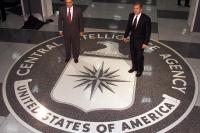
Perhaps, the most damning thing about the CIA Inspector General’s report into the Agency’s performance into the run up to 9/11 is that even after George Tent concluded that the United States was at war with terrorist organisations petty turf wars between the intelligence agencies continued. Take this dispute between the CIA and the National Security Agency, which the Washington Post reports on this morning: “the NSA had long refused to share raw transcripts of intercepted al-Qaeda communications with the CIA but finally relented and allowed one CIA officer to review the intercepts at the NSA for a brief period in 2000.
From our UK edition
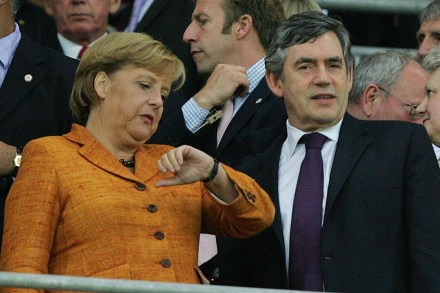
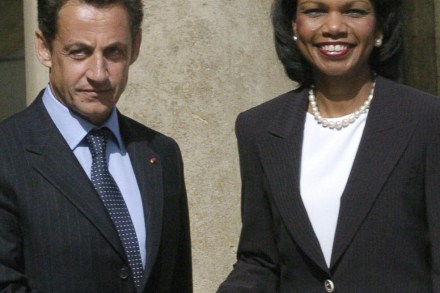
Have we entered a post-American age in Europe? That’s the argument of this Adam Gopnik piece in the New Yorker. It argues that what Gordon Brown, Angela Merkel and Nicolas Sarkozy all have in common is a desire not to be defined by their relationship with the United States. So, Brown is cooling things so as not to be seen as a poodle and Sarkozy is being friendlier to avoid the French president being seen as an anti-American above all else. Gopik goes on to say that, "The Sarkozy-Gordon Brown-Merkel generation is not unsympathetic to America, but America is not so much the primary issue for them, as it was for Blair and Chirac, in the nineties, when America was powerful beyond words.” Yet, when you look at Brown and Sarkozy’s policies the influence of America is clear.
From our UK edition
“Boris Johnson is by far the most right wing candidate ever to be presented by a major party for Mayor of London.” This is how the Compass dossier on Boris starts. But the sentence is actually fairly meaningless as there have only been two elections for Mayor of London and the Tories fielded the same candidate in both of them. So what the Compass report is actually saying is that Boris is more right-wing than Steve Norris; that hardly marks one out as the political love child of Ann Coulter and Genghis Khan. You could equally happily say that “Ken Livingstone is by far the most left wing candidate ever to be presented by a major party for Mayor of London.
From our UK edition
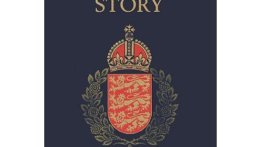
John Lloyd has a typically thoughtful op-ed in the FT today about how we should teach history in schools and how we can create a sense of nationhood that fits this post-devolution, multi-ethnic country. Lloyd argues that the problem with Gordon Brown’s belief that an emphasis on liberty, equity and democracy can unite the country is that they are universal ideals not solely British ones. Lloyd suggests that the way these values could tie the country together is if they are rooted in a sense history. To that end, he thinks we need a new version of the kind of popular, narrative history embodied by Our Island Story.
From our UK edition
Mark Penn is the pollster of choice for those politicians who still believe in the third way. He advised Tony Blair on how to win a third term in 2005, advice that cost Labour £530,372, and is now a key part of Hillary Clinton’s presidential campaign. So his new tome, Microtrends: The Small Forces Behind Tomorrow's Big Changes, is sure to be pored over for hints as to where campaigning is going next. One of the most interesting of Penn’s findings is that in the US a plurality of those who earn under a $100,000, roughly £50,000, vote for a candidates based on the issues while amongst those who earn more than that a majority make their choice based on character and personality. I’d be intrigued to find out if this holds true for the UK too.
From our UK edition
The Guardian reports today that Compass, the leftwing pressure group, has compiled a dossier accusing Boris of being “Norman Tebbit in a clown’s uniform”. Well, now: I admire Norman and hate clowns with equal vigour, and so find this an intrinsically distasteful notion. But the strategy adopted by Compass – namely that Our Candidate is a crypto-fascist – is very good news for his campaign. If this is the best the Left can come up with, he has an even better chance than we thought. There are two reasons why the smear campaign will fail. First, every politically incorrect Boris quotation dredged up from the past can be matched by a much more serious error made by Ken Livingstone.
From our UK edition
The FT’s look at how the British deployment in Basra got to where it is today is well worth reading. As the FT notes, the reason the British force in Iraq was reduced so quickly after the invasion from 45,000 to 26,000 is that the military is simply not big enough to support such a large deployment for any substantial period of time. How small the army has become is illustrated by the fact that: “At just under 100,000 men and women, Britain’s regular army is now smaller than at any time since the early 1840s.
From our UK edition
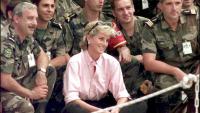
If you’re planning to listen to a Royal Recovery on Radio 4 this morning at nine, repeated this evening at half nine, about how the Royal family came back from the death of Diana do read Matthew d’Ancona’s account of making the programme in this week’s Spectator. Matt concludes that the monarchy has surived because”the public were not rebels at all, but complicit with the monarchy in this process of selective amnesia and quiet restoration.” As Matt says, “The deeper lesson of the past ten years is that our national genius for memory is matched by a genius for forgetting.

From our UK edition
Australian Labor Party leader Kevin Rudd is hardly the first decent Christian family man visiting from out-of-town to find himself in a New York strip club. These things happen when a man is away from his wife and family in a sinful place like New York. Rudd, a devout Anglican who cites Deitrich Bonhoffer as his hero, was outed on Sunday by News Ltd papers as having attended Scores, a Manhattan strip club, while visiting the UN on taxpayer funded business in 2003. If St Kevin, as the press have dubbed him, was perhaps entitled to feel a bit miffed at his treatment by the Murdoch press – accounts of the evening suggest that it was New York Post editor Col Allan’s idea that they go there – he wasn’t showing it.
From our UK edition
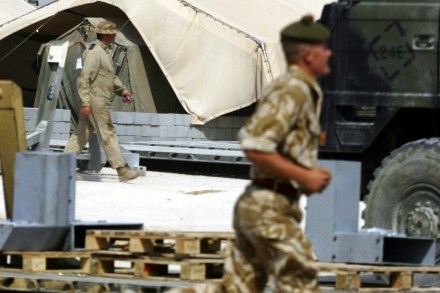
One of the things that has been strained to an intolerable extent since 9/11 is the compact between the British people, represented by their government, and the armed forces. We are now in a situation where the military is fighting two wars on a peacetime budget. When injured servicemen and women return home they are not being treated in military only hospitals but instead forced to share their treatment space with those of us who have not served and thus can not understand what they have experienced. While society seems generally uninterested in the efforts of British troops. One of the more damning condemnations of our culture is that the troops’ welfare has only risen to the top of the agenda in August, the traditional silly season month.
From our UK edition
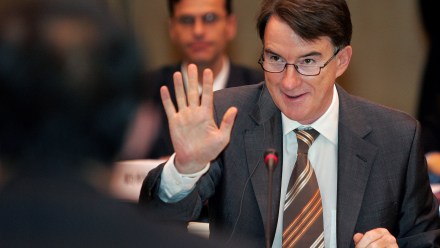
Michael White has a fun post up on which political memoirs really were worth the advances that their publishers paid for them. Which raises the question of which politician’s autobiography would you pay to read? Top of my list would be Peter Mandelson. He is the most psychologically interesting of the New Labour founding fathers. He’s also the one who is probably most aware of how close the project came to failing. Remember that, unlike Blair and Brown, he was shut out after Neil Kinnock’s 1992 defeat. Put alongside that, Northern Ireland where he appears to have seen the flaws in Blair’s approach more clearly than anyone else on the Labour side and his time in Brussels and you’ve got a pretty interesting mix.
From our UK edition
If you want an example of how government comes up with ways to waste our money, just consider the story in The Sun today of ‘The WAG’s Guide to Travel’ penned for the Foreign and Commonwealth Office by Jermain Defoe’s girlfriend Charlotte Meares. A quick call to the FCO confirms that Ms. Meares was paid for putting her name to the guide. The FCO won’t reveal how much but merely say that the money came out of the £1.8 million budget for the ‘Know Before You Go campaign.’ Now, consider that not only was Ms. Meares paid for her work but that a bunch of people were paid for coming up with the idea and you begin to see how the costs begin to spiral.
From our UK edition
Of all the characters in the cash for honours scandal, only one was unfairly maligned: John McTernan, Blair's last political secretary. He was in No 10 but not of No 10: a disarmingly honest and straightforward chap in a rogue's gallery. I gather he is now back in government, and will tomorrow be named special adviser at the Scotland Office. With Scottish Labour having gone for the vacuous Wendy Alexander as its new leader as of today (it failed to find anyone to challenge her) and Salmond riding high in the polls, Scotland has perhaps never been closer to making the calamitous error of choosing independence. (If only because Salmond is one of the few MSPs who does not make Scots cringe.) So McTernan is off to save the Union.
From our UK edition
If you want an example of how government comes up with ways to waste our money, just consider the story in The Sun today of ‘The WAG’s Guide to Travel’ penned for the Foreign and Commonwealth Office by Jermain Defoe’s girlfriend Charlotte Meares. A quick call to the FCO confirms that Ms. Meares was paid for putting her name to the guide. The FCO won’t reveal how much but merely say that the money came out of the £1.8 million budget for the ‘Know Before You Go campaign.’ Now, consider that not only was Ms. Meares paid for her work but that a bunch of people were paid for coming up with the idea and you begin to see how the costs begin to spiral.