The Spectator

Barometer | 4 December 2010

Happy talk David Cameron wants to measure our happiness alongside GDP. The first measure of happiness — the Gross National Happiness index — was instigated by the former king of Bhutan, Jigme Singye Wangchuck, in 1972. — Heavily influenced by Buddhist teachings, it contained questions which might not strike many Britons as being important to their happiness. One asked:  ‘Do you know the names of species and plants and animals in the local area?’ Another asked:  ‘How would you rate your knowledge of the mask and other dances performed during national/local tshechu?
Letters | 4 December 2010

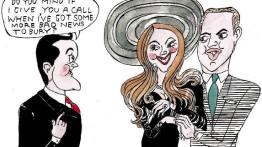
Pecksniffian bureaucrats Sir: I bought your 27 November issue purely on the promising cover illustration and was not disappointed. Josie Appleton’s masterly article (‘A common sense revolution’) held up to deserved ridicule the Criminal Records Bureau, a classic example of a very worthwhile idea hijacked by as big a bunch of Pecksniffian bureaucrats as ever wrung their hands. Of the many howling idiocies dragged whining and wailing into light, the crowning example was that of the cathedral flower guild who might have ‘paedophiles infiltrating’ their group because of a toilet-sharing arrangement with choirboys.

Leader: Less heat, more light

We have heard surprisingly little about the climate change jamboree currently underway in Cancun. Before last year’s Copenhagen summit, there was much hullaballoo. Gordon Brown told us that we had ‘fewer than 50 days to set the course of the next 50 years’. Yet he and 100 of his political counterparts could not stop the conference from collapsing under the weight of its contradictions. This year, only two dozen world leaders are likely to make the carbon-consuming trek to the Mexican coast. David Cameron, to his credit, will not be one of them. He will not miss much. One paper prepared for the Cancun summit, by Prof Kevin Anderson of the Tyndall Centre for Climate Change Research, proposes halting economic growth in the developed world for the next 20 years.

The Spectator’s Notes | 4 December 2010

From our UK edition

Part of the pleasure of the WikiLeaks revelations is that they confirm the view now universally reviled as ‘neocon’. Part of the pleasure of the WikiLeaks revelations is that they confirm the view now universally reviled as ‘neocon’. It emerges that whereas the public pronouncements of the Arab world all concentrate on Israel as the villain of everything, what really worries the Arabs is Iran. The Arab regimes share Israel’s view that Iran is an ‘existential threat’. They also turn instinctively to America to sort out the problem. While President Obama has tried unsuccessfully to pursue a doveish policy, real, live Muslims want Ahmedinejad’s nuclear ambitions stopped, if necessary by violence.

The week that was | 3 December 2010

From our UK edition

Here are some of the posts made on Spectator.co.uk over the past week: Fraser Nelson argues that David Cameron can be proud of his World Cup bid, and reveals Sweden's recession remedy. James Forsyth says that England's defeated World Cup bid was a national embarrassment, and says that the Lib Dems need to get their act together over tuition fees. Peter Hoskin digs out a leaked embassy memo about Margaret Thatcher, and observes a grim turning point for Ed Miliband. David Blackburn outlines what the statist left thinks of the liberal right, and watches the government take the fight to students. Daniel Korski highlights the Guardians Wiki-spin. Martin Bright reveals the ultimate Jewish conspiracy theory.

CoffeeHousers’ Wall, 29 November – 5 December

From our UK edition

Welcome to the latest CoffeeHousers' Wall. For those who haven't come across the Wall before, it's a post we put up each Monday, on which - providing your writing isn't libellous, crammed with swearing, or offensive to common decency - you'll be able to say whatever you like in the comments section. There is no topic, so there's no need to stay 'on topic' - which means you'll be able to debate with each other more freely and extensively. There's also no constraint on the length of what you write - so, in effect, you can become Coffee House bloggers. Anything's fair game - from political stories in your local paper, to chat about the latest football results.

Just in case you missed them… | 29 November 2010

From our UK edition

...here are some of the posts made at Spectator.co.uk over the weekend. James Forsyth introduces the ANTIs, and explains what we learn from Wikileaks. David Blackburn finds some more statistical support for IDS' welfare reform, and notes that Ed Miliband's latest relaunch went the same way as the last. Daniel Korski wonders if Europe is about to become more German, and argues that tuition fees work and are fair. And Jerry Hayes reviews The Real PM?

Now for the real examination

From our UK edition

If William Beveridge were commissioned to write another report into Britain’s social ills, he would find that two of his ‘giant evils’ — ignorance and idleness — still stalk and shame Britain. If William Beveridge were commissioned to write another report into Britain’s social ills, he would find that two of his ‘giant evils’ — ignorance and idleness — still stalk and shame Britain. At the time, one might have argued that this was because schools lacked enough money or because the economy was a ruin. But today, when schools enjoy record funding and immigrants occupy one in seven jobs, only one conclusion can be drawn: that the welfare state has been incubating the very evils it was designed to eradicate.

Barometer | 27 November 2010

From our UK edition

Having it so good Lord Young was forced to resign as an adviser to David Cameron after claiming that people in Britain ‘had never had it so good’. The phrase is associated with Harold Macmillan, who used it in 1957, but he was echoing the 1952 US presidential election slogan of the Democrat Adlai Stevenson: ‘You never had it so good.’ —The Republican, Dwight Eisenhower, attacked Stevenson’s claim in a powerful TV commercial: ‘Can that be true, when America’s billions in debt, when prices have doubled, when taxes break our backs and when we’re still fighting in Korea?’ —Stevenson lost the popular vote 45 per cent to 55 per cent.

Letters | 27 November 2010

From our UK edition

Royally remote Sir: Perhaps Charles Moore’s concerns that the university education of Prince William and his future queen (The Spectator’s Notes, 20 November) could undermine national morale are unfounded. Reflection on my time as a St Andrews undergraduate 30 years ago has jogged memories of a surreal existence in a beautiful, remote seaside town, full of history, golf shops and bizarre traditions. Combined with the more normal student activities of non-stop partying and occasional bursts of frantic study, I would say that St Andrews University encapsulated a way of life very removed from the real world. Prince William and Kate Middleton’s time at St Andrews should prove to be the ideal preparation for their royal duties.

Mohammad Sawalha: Apology

From our UK edition

On 2 July 2008 we published an article entitled “Just look what came crawling out” which alleged that at a protest at the celebration in London of the 60th anniversary of the founding of the state of Israel, Mohammad Sawalha had referred to Jews in Britian as “evil/noxious”. We now accept that Mr Sawalha made no such anti-Semitic statement and that the article was based on a mistranslation elsewhere of an earlier report. We and Melanie Phillips apologise for the error.

The week that was | 26 November 2010

From our UK edition

Here are some of the posts made at Spectator.co.uk over the past week The Spectator welcomes Nick Cohen as its latest guest blogger. The Spectator Book Blog congratulates 2 old friends of the magazine on their appointment to the Booker Prize judging panel. Fraser Nelson praises Michael Gove’s education white paper, and analyses the political precedents of Howard Flight’s loose talk. James Forsyth explains why Spain matters. David Blackburn watches the coalition forge another impressive compromise, and thinks that Ed Miliband must begin to define himself and his party. Mark Littlewood reports on the centre right’s changing conception of society and why Jon Cruddas is exercised by it. Martin Bright is asking questions about Bangladeshi war criminals.

Introducing Nick Cohen

From our UK edition

The Spectator is delighted to welcome Nick Cohen as our new guest blogger. You can read Nick’s first post here and his blog can be found at new.spectator.co.uk/nickcohen. He needs no introduction, but Cohen is a columnist of both the Observer and Standpoint magazine. He has also written numerous books, including What’s Left?, which was shortlisted for the Orwell Prize in 2008. It's a pleasure to have him on board.

CoffeeHousers’ Wall, 22 November – 28 November 

From our UK edition

Welcome to the latest CoffeeHousers' Wall. For those who haven't come across the Wall before, it's a post we put up each Monday, on which - providing your writing isn't libellous, crammed with swearing, or offensive to common decency - you'll be able to say whatever you like in the comments section. There is no topic, so there's no need to stay 'on topic' - which means you'll be able to debate with each other more freely and extensively. There's also no constraint on the length of what you write - so, in effect, you can become Coffee House bloggers. Anything's fair game - from political stories in your local paper, to chat about the latest football results.

Just in case you missed them… | 22 November 2010

From our UK edition

…here are some of the posts made at Spectator.co.uk over the weekend. Fraser Nelson heralds the death knell of the Euro. James Forsyth notes that Pakistan has rejected US pleas to extend the drone attacks, and draws comparison between Sarah Palin and Gordon Brown. David Blackburn says that Labour’s terror u-turn makes it no less authoritarian, and wonders if Nato has made progress to an Afghan solution. And Martin Bright unties Israel, Islamic extremism and the EDL.

Barometer | 20 November 2010

From our UK edition

Trouble with stags In addition to next year’s royal wedding, Prince William will have to organise the royal stag party. William got into trouble in 2008 for flying a Chinook helicopter from Lincolnshire to his cousin Peter Phillips’s stag party on the Isle of Wight — at a cost of £8,716 to the public purse. In 1981 Prince Charles announced that he would hold a fireworks party in Hyde Park in lieu of a stag do — but he slipped off to meet friends at White’s. Prince Andrew was less successful at setting a decoy for his stag party in 1986: the press tracked him down, thwarting a plan by Sarah Ferguson and Princess Diana to crash the party dressed as policewomen.

Letters | 20 November 2010

From our UK edition

Reasons to stay Sir: While I agree with much of Fraser Nelson’s analysis on the impact of higher taxes on total tax revenue (‘Osborne’s tax exiles’, 13 November), he misses one key aspect of the Chancellor’s tax reforms: the extension of entrepreneurs’ relief on capital gains tax from £1 million to £5 million. In September 2008, having worked for the Saatchi brothers for 21 years, I left my comfortable, well-paid and secure job to create a virtual global agency via the internet. Given the nature of my business model I could locate in Bahrain and pay no income tax.

A sacred bond

From our UK edition

The royal family has a gift for laying on a wedding just when the nation’s spirits most need lifting. The Queen’s marriage to the Duke of Edinburgh in 1947 helped to rejuvenate a nation exhausted by war and demoralised by rationing. The wedding of Princess Anne to Mark Phillips in 1973 aroused extraordinary excitement in a Britain disfigured by vicious industrial disputes (and polyester flares). The marriage of Charles and Diana in 1981 distracted the public’s attention from street riots and shocking unemployment figures; indeed, with hindsight, the near hysteria it provoked was an ill omen.

Portrait of the week | 20 November 2010

Home The engagement of Prince William and Kate Middleton was announced. The Prince proposed last month in Kenya and gave his fiancée the engagement ring belonging to his late mother, Diana, Princess of Wales. The wedding is to take place next year. Britain must ‘sort out’ its economy if it wants to ‘carry weight in the world’, David Cameron, the Prime Minister, said in his speech at the Lord Mayor’s banquet. Mr Cameron decided after all against employing a personal photographer at public expense. Legal aid will no longer be available in divorce, welfare benefit and school exclusion appeals, Kenneth Clarke, the Justice Secretary, announced, in plans to save £350 million.