18 June Cartoon Pg 44
From our UK edition
From our UK edition
From our UK edition


From our UK edition
From our UK edition
Missions impossible Sir: I hesitate to challenge Sherard Cowper-Coles’s concerns about our military chiefs (‘Who’s in command?’, 11 June), but it seems to me that they have a good reason for overplaying their hand with the politicians. The reality is that our armed forces are at best a third of the size they need to be to do the things that the politicians ask of them, and they have been criminally underfunded for well over 30 years.
From our UK edition
Council housing Ed Miliband proposed that a Labour government under his leadership would send people in employment to the top of the council house waiting list. Mr Miliband risks criticism by his own party, which has already attacked similar plans by the Tory-controlled Westminster Council. How would Mr Miliband’s policy have gone down with the architect of Labour’s post-war housing policy, Nye Bevan? —Bevan always intended council housing to be a choice of the middle classes as well as the working classes, saying he wanted to create a ‘living tapestry’ where ‘the doctor, the grocer, the butcher and the labourer all lived on the same street’.
From our UK edition
Home The government accepted the recommendations of the NHS Future Forum, which had spent two months reviewing the government’s plans for reforming the National Health Service. The Health Secretary is to remain responsible for the service; private companies are to be prevented from cherry-picking; the regulator, Monitor, will not be required to promote competition; hospital doctors and nurses will be included in the task of commissioning and the 2013 deadline for GPs to form consortiums will be dropped. Southern Cross, the financially beleaguered company that runs homes for 31,000 old people, met the many landlords of the properties it leases in an attempt to carry on.
From our UK edition
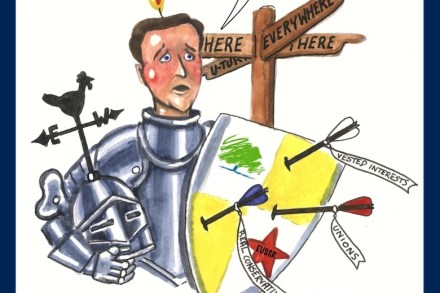
In a way, it would be rude for the unions not to strike later this month. They are in the business of changing government policy by threatening strike action. They had planned to wait until next year, when the cuts would be biting hardest, to force David Cameron into a Heath-style U-turn — but it seems the Prime Minister’s resolve is running out faster than they expected. In a way, it would be rude for the unions not to strike later this month. They are in the business of changing government policy by threatening strike action. They had planned to wait until next year, when the cuts would be biting hardest, to force David Cameron into a Heath-style U-turn — but it seems the Prime Minister’s resolve is running out faster than they expected.
From our UK edition
Here are some of the posts made on Spectator over the past week: Peter Robins sifts through the local and regional newspapers for his first Local Interest post. You can follow The Spectator's Local Interest feed on Twitter here. Fraser Nelson watches Ed Balls' bloodlust get the better of him, and observes that Britain now has the worst inflation in Western Europe. James Forsyth explains why the battle of the bins matters, and sees Ed Miliband relieve the pressure on himself. Peter Hoskin says that Miliband borrowed from the Cameroons for his most substantial speech so far, and observes that Danny Alexander is not for turning. David Blackburn reports on the latest NHS developments, and tests the pressure at the pumps.
From our UK edition
Welcome to the latest CoffeeHousers' Wall. For those who haven't come across the Wall before, it's a post we put up each Monday, on which – providing your writing isn't libellous, crammed with swearing, or offensive to common decency – you'll be able to say whatever you like in the comments section. There is no topic, so there's no need to stay 'on topic' – which means you'll be able to debate with each other more freely and extensively. There's also no constraint on the length of what you write – so, in effect, you can become Coffee House bloggers. Anything's fair game – from political stories in your local paper, to chat about the latest football results.
From our UK edition
…here are some of the posts made at Spectator.co.uk over the weekend. Fraser Nelson says that Labour is working towards a decade in Opposition. James Forsyth believes that David Miliband should join the shadow cabinet or quit British politics, and explains why education is becoming such a success story for the coalition. Peter Hoskin provides a guide to the Ed Balls Files, and reviews Labour’s collection of blunt knives. Jonathan Jones reports on the decline and fall of Newt Gingrich, and has news of a poll to worry Ed Miliband. Daniel Korski evaluates Robert Gates’ valedictory, and ponders the end of Assad. Martin Bright charts his latest quarrels with London Citizens.
From our UK edition
Folly in Libya Sir: Congratulations to Andrew Gilligan and Hugo Rifkind (‘Oh, what a silly war’, 4 June) . You’ve shown exactly what the allied effort in Libya is — an expensive exercise in futility and a farce. Almost nobody outside a narrow band within the political-media class can see the point of having singled out the regime of Gaddafi, hitherto a man with whom we could business, as the Middle East despotism that we had to tackle. Even those who profess support for the war are uncertain about what we are trying to achieve. Yet here we are, stuck in a conflict that we can’t afford and probably don’t even want to win.
From our UK edition
Suicide country The BBC is to broadcast a documentary featuring a man committing suicide at the Dignitas clinic in Zurich. Where else in the world can assisted suicide be carried out without attracting a murder charge? Netherlands: prosecutions for voluntary euthanasia effectively ceased in 1973, after an agreement between doctors and the government. Formally legalised in 2001 by Termination of Life on Request and Assisted Suicide Act 2001 Belgium: euthanasia legalised for adults in 2002.
From our UK edition
Home David Cameron, the Prime Minister, gave five ‘guarantees’ about the National Health Service, including a pledge not to endanger universal coverage and to increase spending on the NHS. He also said that hospital doctors and nurses would be involved in new consortiums to plan and buy care, not just GPs. Wayne Rooney, the 25-year-old footballer, had a hair transplant. Ryan Giggs, the 37-year-old footballer, was said to have spent £30,000 on hair replacement. A man, part of whose skull was blown off when he tried to steal some live cabling, was given a 12-month community order by Leeds magistrates. Energy prices rose again. The Duke and Duchess of Cambridge are to make their home at Kensington Palace when they are in London.
From our UK edition
If Blake were writing ‘Jerusalem’ today, he would find an easy contemporary equivalent for his ‘dark, satanic mills’. If Blake were writing ‘Jerusalem’ today, he would find an easy contemporary equivalent for his ‘dark, satanic mills’. In our attempt to build a welfare state, we have created a national disgrace: welfare ghettoes, which scar every British city. Over the Labour years, millions of people were shovelled away in edge-of-town housing estates and paid (in benefits) to stay there. They were categorised so as to not show up on the unemployment count. They were replaced in the jobs market by an industrious immigrant class.
From our UK edition
Here are some of the posts made on Spectator.co.uk over the past week: Fraser Nelson looks at the latest efforts to fix Britain's economic dysfunction, and explains George Osborne's fiscal flexibility. James Forsyth says that David Cameron is a leader in need of a People, and argues that the coalition's u-turns come at a price. Peter Hoskin writes a five-point guide to the Ed Balls files, and observes that the welfare revolution will require much time and effort. David Blackburn reports on the Archbishop of Canterbury's latest political outburst, and watches Cameron embark on a charm defensive over the government's NHS reforms. Martin Bright welcomes the government's latest anti-terror measures.
From our UK edition
Welcome to the latest CoffeeHousers' Wall. For those who haven't come across the Wall before, it's a post we put up each Monday, on which – providing your writing isn't libellous, crammed with swearing, or offensive to common decency – you'll be able to say whatever you like in the comments section. There is no topic, so there's no need to stay 'on topic' – which means you'll be able to debate with each other more freely and extensively. There's also no constraint on the length of what you write – so, in effect, you can become Coffee House bloggers. Anything's fair game – from political stories in your local paper, to chat about the latest football results.

From our UK edition
…here is a selection of posts made at Spectator.co.uk over the weekend. James Forsyth welcomes the government’s moves to stop the sexualisation of children, and thinks that Downing Street’s political operation is in danger of faltering. Peter Hoskin reacts to the foundation of the New College of Humanities, and laments the return of the signatories war. David Blackburn notes that Ed Balls is opening up a new front with the same old tricks, and sketches the debate over deploying attack helicopters in Libya. Daniel Korski reports on worrying developments on the Golan Heights. And Rod Liddle reckons that the C-word is no longer English’s most heinous.
From our UK edition
Spectator readers respond to recent articles Target practice Sir: It is simply wrong to say — as an anonymous officer claimed in your magazine (‘Target Men’, 28 May) — that every facet of the Metropolitan Police is now dominated or disfigured by targets or quotas. However, if we are to be truly accountable, there must be some performance measures. How else can we reassure the communities of London that they are getting value for money? We aim to increase public satisfaction and confidence — and we conduct surveys to ensure we deliver on this commitment. Is that an unnecessary target? How else can we know if we are getting things right? The people of London have a right to know how we are performing.
From our UK edition
This wek's Barometer Crime lords — Lord Taylor of Warwick was jailed for 12 months for fiddling his expenses. He is the fourth peer of the realm to be jailed, after Lord Archer (jailed for four years in 2001 for perjury), Lord Watson of Invergowrie (16 months in 2005 for setting light to hotel curtains at the Scottish Parliamentarian of the Year awards) and Lord Ahmed of Rotherham (12 weeks in 2009 for dangerous driving). Lord Hanningfield, convicted last week of fiddling his expenses, is also likely to receive a custodial sentence. — If five out of 789 peers are jailed over a ten-year period it suggests an annual imprisonment rate of 0.06 per cent of the ennobled population, about one third of that for commoners.
From our UK edition
This week's Portrait of the week Home The Court of Appeal ruled that Sharon Shoesmith had been sacked unfairly in 2008 as head of children’s services in Haringey after the death of baby Peter; asked if she blamed herself for the child’s death, she said: ‘I am not into the blame game. I don’t do blame.’ Southern Cross, Britain’s biggest care home company, caring for 30,000 people, agreed with its landlords to defer 30 per cent of its rent for four months. Four people were arrested after a Panorama programme about abuse of patients with learning difficulties and autism at a residential hospital in Bristol. In the first quarter of the year 300 cases of measles were recorded, four times last year’s incidence.