Evans 7
From our UK edition
From our UK edition
From our UK edition
From our UK edition
From our UK edition
From our UK edition
Late winners The Nobel Prize is not usually given posthumously; but an exception was made this week for Ralph Steinman, a cancer scientist who, unknown to the Nobel committee, had died three days before being awarded the Nobel Prize for Medicine. He is in good company in being honoured posthumously. Peter Finch, George Gershwin and Heath Ledger all won Academy Awards after their deaths. Alexander McQueen last year won an ‘outstanding achievement award’ following his suicide. Unlike in Britain, where elections are suspended if a candidate dies, US politicians are occasionally elected after their deaths. In 2000 Mel Carnahan of Missouri won election to the US Senate after dying in a plane crash.
From our UK edition
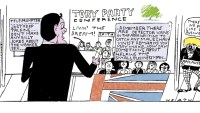
Home George Osborne, the Chancellor of the Exchequer, told the Conservative party conference in Manchester that the Treasury would spend billions buying bonds from small and medium-sized businesses in an exercise called ‘credit easing’. He announced a freeze on council tax for a second year, saving householders an average of £72. He also remarked: ‘We’re not going to save the planet by putting our country out of business.’ David Cameron, the Prime Minister, told the nation to pay off its credit card bills.
From our UK edition
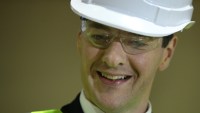
What with all the excitement over Italian courtroom dramas, not enough attention was given to a radical statement by George Osborne at the Conservative party conference. It was one of the few important pronouncements made in Manchester this week. He declared: ‘Let’s at the very least resolve that we’re going to cut our carbon emissions no slower but also no faster than our fellow countries in Europe.’ There is no mistaking his meaning. And while it might not sound like much, it was a declaration of open defiance. Under the Climate Change Act, as it is currently structured, the government is legally bound to cut Britain’s carbon emissions by 34 per cent by the end of this decade. The rest of the EU, on the other hand, has only committed to 20 per cent.
From our UK edition
Boris and the Johnsons Sir: Toby Young speaks of ‘the (Johnson) family’s roots as Turkish immigrants’ (‘Plan B’, 1 October). Though I’m always amused by what Toby writes, I have to point out that he is not always accurate. These are the facts. My paternal grandfather, Ali Kemal, was married to my grandmother, Winifred Blum. Winifred’s mother Margaret was English (née Johnson), while her father was Swiss. While Ali Kemal’s political and other commitments required him to remain behind in Constantinople, Winifred — already several months pregnant — came to England to visit her mother, and to have the baby in more tranquil surroundings. My father was born in Bournemouth on 4 September 1909.
From our UK edition
A selection of posts from the past seven days at spectator.co.uk Fraser Nelson explains Cameron's debt U-turn and says that party conferences are now more for lobbyists than activists. James Forsyth says the Tories knew the importance of Boris' speech and that Cameron did enough in his. Peter Hoskin says Gove's school reforms provided the sunshine in Manchester Jonathan Jones says Ken Clarke won his bet against Theresa May, and reports on the big developments in the US presidential campaign. David Blackburn reports on "catgate", and the deeper Tory split on human rights. Ed Howker declares the Winter Fuel Allowance indefensible. And Will Straw gives his view on Tory conference.
From our UK edition
It's that time of the year again. The nights are drawing in and the Spectator is choosing its parliamentarian of the year. As in previous years, we’re asking you to vote for a readers’ representative. So, which politician has excelled in the noble art of politics in the last twelve months? Think carefully, there must be someone who has dazzled with a moment's oratory, campaigned fearlessly on a matter of principle or merely just represented their local interest with absolute fidelity. To make your nomination, click here and justify your choice in no more than 200 words.

From our UK edition
Welcome to the latest CoffeeHousers' Wall. For those who haven't come across the Wall before, it's a post we put up each Monday, on which — providing your writing isn't libellous, crammed with swearing, or offensive to common decency — you'll be able to say whatever you like in the comments section. There is no topic, so there's no need to stay 'on topic', which means you'll be able to debate with each other more freely and extensively. There's also no constraint on the length of what you write — so, in effect, you can become Coffee House bloggers. Anything's fair game, from political stories in your local paper, to chat about the latest football results.
From our UK edition
…here are some of the posts made at Spectator.co.uk over the weekend. Fraser Nelson asks if the health budget is falling, and writes a short history of George Osborne and tax cuts. James Forsyth watches David Willetts introduce the three Ds, and reports on Cameron’s tricky interview with Andrew Marr. David Blackburn considers Andrew Lansley’s trials, and notes that Tory backbenchers want reassurance from George Osborne. Martin Bright says that Ed Miliband has lessons to learn about speech making from David Cameron. Nick Cohen explains how Barack Obama might help Ed Miliband. Alex Massie laments the “sodding rugby” match between England and Scotland. The Arts Blog relates a truth more terrifying than fiction.
From our UK edition
Europe’s guilty men Sir: What exactly do Peter Oborne and Frances Weaver (‘The great euro swindle’, 24 September) think the pro-euro camp must be called to account for? Apparently for being on the losing side in a debate which they never showed much sign of winning anyway, not least because the Chancellor of the Exchequer set conditions for entry which he knew would not be met. The Financial Times and the BBC may well have lacked even-handedness in their presentation, but their influence was balanced by the solid euroscepticism of many newspapers. In truth, many Eurosceptics were their cause’s worst enemies. Nicholas Ridley’s comparison of Helmut Kohl to Adolf Hitler was unusual only in that it was made by a serving minister.
From our UK edition
Home Ed Miliband, the leader of the Labour party, asked its conference: ‘Are you on the side of the wealth creators or the asset strippers?’ He criticised ‘predatory’ companies, and said that when it came to social housing we should not ‘treat the person who contributes to their community the same as the person who doesn’t’. Ed Balls, the shadow chancellor, sketched a five-point plan to invigorate the economy: to repeat the bank bonus tax; to undertake infrastructure projects; to reduce VAT; to reduce to 5 per cent VAT on home improvements; and to remove National Insurance for a year from new posts appointed by small businesses.
From our UK edition
The Conservatives are granted only two tickets to Labour party conference: a shame, because there could have been no better morale booster for Tory troops. The merger between Labour and their union paymasters has become so advanced that shadow ministers speak about the joint ‘movement’ rather than the party. Dethroned Cabinet members are still wandering around with their old advisers, as if they can’t accept they have no department to run. The standard of debate in the conference’s fringe meetings suggests that Labour suffered not only defeat, but a lobotomy. There are no new ideas, as Ed Miliband demonstrated in his tortuous speech.
From our UK edition
Up in smoke A coroner in Galway has passed a verdict of spontaneous human combustion on a 76-year-old pensioner whose body was found burned in a house otherwise largely undamaged by fire. Not everyone will be convinced, however — any more than they were in 1763, when Jonas Dupont published De Incendis Corporis Humani Spontaneis, an account of numerous deaths attributed to the phenomenon. Among them was that of Nicole Millet, the wife of a Rheims innkeeper who was found burned to death in 1725. Her husband was charged with burning her body, but was saved by the testimony of a young surgeon, Nicholas le Cat, who convinced the court that Nicole had spontaneously combusted.
From our UK edition
A selection of posts from the past seven days at spectator.co.uk James Forsyth dissected Ed’s conference speech and urged Cameron to seize the opportunity for a showdown with Brussels. Fraser Nelson reviewed Miliband vs. Predator and asked whether the leader of the opposition is a (fellow?) Glee fan. David Blackburn reported on Labour’s bid to become the party of law and order and the green threat to growth. Alex Massie wondered whether the Polish Invasion was a Good Thing. Clarissa Tan revealed the one area where the European Union leads the world. Meanwhile our mole in the city, Bounderby, explained why the UK’s Eurozone exposure is cause for concern.
From our UK edition
…here are some of the posts made on the Spectator.co.uk over the weekend. James Forsyth is impressed by the Labour leader's performance pre-conference and thought his brother put on a nice show too. Fraser Nelson's take on Ed Miliband's interview on the Andrew Marr Show: cuts are ok now. David Blackburn isn't surprised as Medvedev names his successor and, closer to home, he takes a look at what we can expect at the Labour conference and from their Purple Book. Clarissa Tan reports on Warren Buffet backing Obama’s new tax-the-rich-more policy. Rod Liddle rubbishes the idea of a pro-Euro conspiracy at the BBC. 20 years on, Charlotte Gore relives her Nirvana crush.
From our UK edition
Welcome to the latest CoffeeHousers' Wall. For those who haven't come across the Wall before, it's a post we put up each Monday, on which — providing your writing isn't libellous, crammed with swearing, or offensive to common decency — you'll be able to say whatever you like in the comments section. There is no topic, so there's no need to stay 'on topic', which means you'll be able to debate with each other more freely and extensively. There's also no constraint on the length of what you write — so, in effect, you can become Coffee House bloggers. Anything's fair game, from political stories in your local paper, to chat about the latest football results.
From our UK edition
Euro bonds Sir: In your leading article, ‘A new deal with Europe’ (17 September), you argue that as Brussels will not agree to radical reform and massive deregulation, the only remaining options are to renegotiate our membership of the European Union or ‘pull out entirely’. However, we must be clear that unilateral withdrawal is out of the question. Over half the UK’s manufactured exports to the EU would face zero tariffs whether we were in or out of the EU. But if the UK left the EU without any new preferential trade agreement the remainder would face an average EU tariff of over 5 per cent, a decisive handicap in many price-sensitive markets. In particular, the vital UK car manufacturing sector would face EU tariffs of 10 per cent.