Drones 4
From our UK edition
From our UK edition
From our UK edition
From our UK edition
From our UK edition
From our UK edition
One-nation Toryism Sir: When my late father, John McKee, stood as Conservative candidate for South Shields in the 1970 general election he gained 19,960 votes, more even than David Miliband in the same constituency 40 years later. In last week’s by-election in the South Shields constituency, the Conservative candidate attracted only 2,857 votes. Many things have changed since 1970 but one important thing that is different is that in those days the local Conservative party had a large number of working-class members helping in the campaign; there was even a flourishing Conservative Trade Union organisation in the constituency. Nor was South Shields unique in this respect.
From our UK edition
Home The UK Independence Party gave the government and opposition a jolt by doing well in the elections for 34 English councils, increasing its number of councillors from eight to 147 and gaining a projected national vote share of 23 per cent (compared with 25 per cent for the Conservatives, 29 per cent for Labour and 14 per cent for the Liberal Democrats). In a parliamentary by-election at South Shields, the Lib Dems were driven into seventh place, with only 352 votes, with Labour retaining the seat with 12,493 and Ukip coming second with 5,988. Nigel Farage, the leader of Ukip, grinned a good deal and said ‘Send in the clowns,’ throwing back at him Kenneth Clarke’s pejorative description of Ukip supporters.
From our UK edition
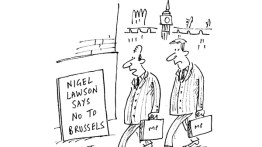
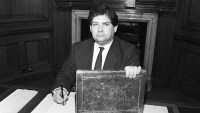
Lord Lawson’s announcement that he intends to vote for Britain to leave the European Union has been interpreted by some as reinforcing demands that David Cameron holds his referendum this year or next, rather than 2017. But it does no such thing. Follow Lawson’s arguments and the logical conclusion is that the best chance of securing a British exit from the EU is for a vote to be held as planned, in four years’ time. As the Prime Minister has said in a letter to MPs, he is powerless to bring in a vote while in coalition because the Liberal Democrats are so vehemently against it. Nick Clegg’s commitment to the Euro project is such that he would not allow it to be threatened by giving the public a say.
From our UK edition
Four kinds of nonsense Lord Lawson accused Nick Clegg of talking ‘poppycock’ on Europe. What are we really saying when we accuse people of talking nonsense? Poppycock From old Dutch word for ‘soft dung’. Codswallop Unknown, but said by some to come from a non-alcoholic beer (or ‘wallop’) brewed by Hiram Codd in the 19th century. Balderdash Unknown, but already in use in 17th century as a term for a poorly mixed cocktail of drinks. Bunkum From Buncombe County, North Carolina, on whose behalf Felix Walker made a poorly delivered speech in the House of Representatives in 1820. Class divide Lord Winston said he prefers to employ people with upper second-class degrees than with first-class degrees. Does getting a first help your career?

From our UK edition
From our UK edition
335: total councillors lost by the Tories 291: seats gained by Labour 124: losses sustained by the Lib Dems 139: seats gained by UKIP 147 UKIP council seats after today's results 10 councils lost by the Tories 2 councils gained by Labour 13 councils now in overall control, up 8 17: the largest gain by UKIP in any council, in Kent 24: the most councillors gained by Labour in one local authority, in Durham 6,505: Emma Lewell-Buck's majority as the new Labour MP for South Shields, down from 11,109 achieved by David Miliband in 2010.


From our UK edition
From our UK edition

From our UK edition

From our UK edition

From our UK edition

From our UK edition


From our UK edition

From our UK edition
From our UK edition

From our UK edition