Bed 3
Beyond the law Sir: In your leading article of 28 June you make the point that the hacking trial demonstrates why political oversight of press regulation, not press regulation by politicians, would be an unnecessary ‘draconian step’ because ‘hacking is already against the law’. Later you compare the illegal but honourable behaviour of Andy Coulson with that of Damian McBride, who ‘broke no law but behaved criminally’. In doing so you weaken the earlier argument. Regulation of the press should not solely be focused on illegal activity; rather it is to ensure that the press does not behave in a way analogous to that you criticise McBride for.
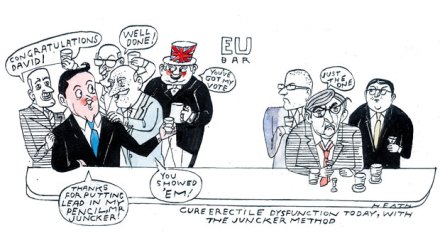
Home David Cameron, the Prime Minister, rang Jean-Claude Juncker to congratulate him on being nominated by EU heads of government as president of the European Commission. Mr Cameron had insisted the question should go to a vote at an EU summit, where 26 voted for Mr Juncker and two against: he and Viktor Orban, the prime minister of Hungary. Mr Cameron announced a review into why, in the face of resistance to antibiotics, few anti-microbial drugs have been introduced in recent years. Sir Elton John came out in favour of gay marriage for clergy: ‘If Jesus Christ was alive today, I cannot see him, as the Christian person that he was and the great person that he was, saying this could not happen.

All must have prizes Paul Pugh, the £104,000-a-year chief executive of the Passport Office, was nominated for ‘leader of the year’ in the government’s Investors in People Awards, in spite of long delays in passport issues. Some more pointless public sector awards: — UK Public Sector Communications Awards. Currently held by Derbyshire County Council, for telling the public it was going to snow. Not to be confused with the Public Sector Communications Excellence Awards. — Government Opportunities Excellence in Public Procurement Awards, held by NHS Greater Glasgow and Clyde for the £842 million South Glasgow Hospitals, which have yet to open.

[audioplayer src="http://traffic.libsyn.com/spectator/TheViewFrom22_3_July_2014_v4.mp3" title="Frank Field and Isabel Hardman discuss the Modern Slavery Bill" startat=1865] Listen [/audioplayer]Who would have expected to find slavery on the outskirts of Cardiff? Not the locals, who were shocked when police carried out a raid while investigating the case of two men understood to have been held in captivity for 26 years. ‘Human trafficking is becoming more prevalent across the United Kingdom,’ said Gwent Police. That’s one way of putting it. Another is to say it has been prevalent for years, but the authorities are only now beginning to take notice. The last government was more interested in apologising for the old form of slavery than recognising the new one.