Clickbait
From our UK edition
From our UK edition
From our UK edition
Italy’s to-do list Sir: You would expect a long letter of rebuttal by a piqued senior diplomat in response to the many barbs that Nicholas Farrell packed into his piece about Italy (‘The dying man of Europe’, 25 October). Among the most painful ones were that Italy is ‘almost doomed’ and parts of it are ‘hopeless’, which are far too simplistic statements. Mr Farrell is remarkably complacent in his negative bias. But beyond the sea of clichés, the piece offers a useful to-do list. So I will limit myself to a brief comment on its title, highlighting some details not mentioned in the article: if decline is the issue, there are plenty of people in Italy who are trying to tackle it — among them a new wave of Italian politicians.
From our UK edition
What's special about Rochester What is special about Rochester and Strood? — Rochester has the second oldest cathedral and school in Britain, after Canterbury. — Medway, the unitary authority area in which the constituency is situated, has one of the highest rates of private home-ownership in Britain, with 92 per cent of homes in private hands. — Rochester has one of the few remaining airports in Britain with only grass runways – though it has filed a planning application to build a paved runway. — Morrisons in Strood was Gordon Brown's first engagement after announcing the date of the 2010 general election. — Strood was once the largest producer of steam rollers in Britain.
From our UK edition
Home The last British combat troops turned over Camp Bastion in Helmand to Afghan forces and withdrew from Afghanistan after 13 years and 453 deaths. Michael Fallon, the Defence Secretary, spoke of ‘whole towns and communities being swamped by huge numbers of migrants’. He later withdrew the word ‘swamped’, but David Blunkett, a former Labour home secretary who used the word 12 years ago, said: ‘I believe that both Michael Fallon and I were right to speak out.’ This came after Angela Merkel, the Chancellor of Germany, responded to an idea of David Cameron, the Prime Minister, that European Union migration could be renegotiated; she said: ‘Germany will not tamper with the fundamental principles of free movement in the EU.
From our UK edition
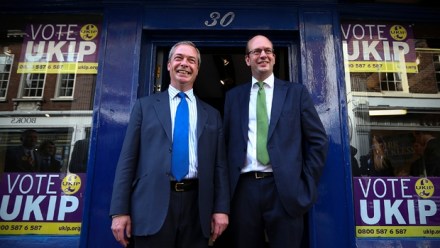
In the 2005 general election this magazine supported the Conservatives, with one exception — we urged voters in Medway not to vote for a deeply unimpressive Tory candidate by the name of Mark Reckless. Our then political editor, Peter Oborne, went so far as to write a pamphlet in support of the Labour rival, Bob Marshall Andrews, who had a commendable record of sticking it to Tony Blair. Reckless, by contrast, had nothing to commend him. He lost by just 213 votes — suggesting that The Spectator’s intervention had been decisive. But nothing, it seems, will prevent Reckless from being elected as Ukip’s second MP in two weeks’ time. The Ukip momentum in Rochester & Strood now looks unstoppable.
From our UK edition

From our UK edition
The chances are that by now either you or someone you know well has begun to practise ‘mindfulness’ — a form of Buddhism lite, that focuses on meditation and ‘being in the now’. In the past year or so it’s gone from being an eccentric but harmless hobby practised by contemporary hippies to a new and wildly popular pseudo–religion; a religion tailor-made for the secular West. But separating meditation from faith is a dubious business, suggest Melanie McDonagh. In this week’s podcast, the comedian Ruby Wax, who has written a best-selling book about mindfulness and is now touring with Sane New World, and Andy Puddicombe, founder of the Headspace app, join Mary Wakefield to discuss the merits of mindfulness.
From our UK edition
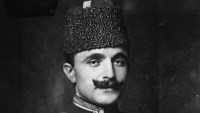
From The Spectator, 31 October 1914: THE most important event of the past week is the entrance of Turkey into the war, announced in the newspapers of Friday. For some time the Committee of Union and Progress, the gang of desperate and intriguing adventurers who control the Porte, have been doing their best by various unfriendly acts to provoke Russia and Britain into a declaration of war. Having failed in this, and probably also being warned that a peace party of considerable dimensions was growing up in Constantinople, they decided to force war by active hostilities, and on Thursday sent their ships to bombard peaceful Russian towns on the Black Sea coast.

From our UK edition
From ‘A Probationer’s Diary’, by a Red Cross volunteer, from The Spectator, 31 October 1914: Friday. The wounded are coming to-morrow. Twenty of them. They are to be drafts from a military hospital, and will be convalescent. Such a flutter in the dovecote, with a cleaning of sinks and of brass, and a preparation of dressings, and a replenishing of medicine bottles! Jane, who is in the women’s ward, affects a great superiority. Turns up her nose, and remarks that she for one is not going to run after the military. She supposes that we shall entirely neglect the old patients now. I conveyed a suitable reply to her. To our great relief, No. 8 is a little better.
From our UK edition
From The Spectator, 31 October 1914: We do not ask for help of any material kind from the United States; we recognize that a strict neutrality is not only her proper course, but represents her true interests. All we desire is the sympathy of comprehension, the sympathy of a clear understanding of the principles on which we have acted. When a man is in a great crisis, whether of sorrow, adversity, or illness, he craves for the sympathy of persons of his own flesh and blood. Their money and their energies may be of no use at all to him, but he does value their thoughtfulness and their regard. We feel somewhat in this relation with the United States, and that the sympathy we prize is being amply offered to us by Americans we must gratefully acknowledge.
From our UK edition
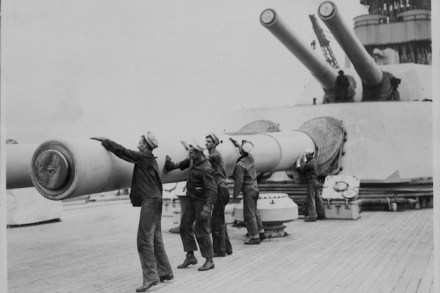
The most curious thing of all is that the sailor should become so much a part of his peculiar element that his detachment from the land is even more marked than the landsman's imperfect acquaintance with the sea. The sailor comes on shore like a man penetrating doubtfully into an unknown hinterland; he has the air of a foreign being in the streets of his native land; he looks about him as though adventures might fall out of the sky. The author of The Ingoldsby Legends has described the impression made by the sailor on others : "It's very odd that sailor-men should talk so very queer— And then he hitched his trousers up, as is, I'm told, their use ; It's very odd that sailor-men should wear those things so loose.

From our UK edition
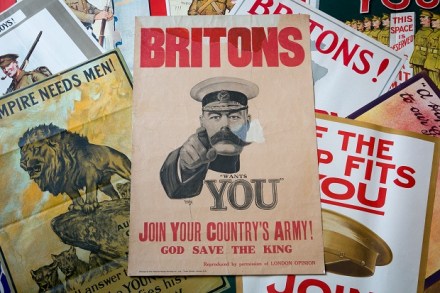
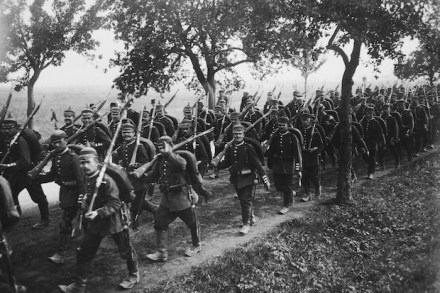
From The Spectator, 31 October 1914: The Germans are doing rapidly and effectively what we ought to be doing, and what we must do if we are to win. They are raising new armies and training the remaining portion of their adult male population to arms. When the war began we all thought that about four million German fighting men was the most we need reckon with. These men have already been put into the firing line in the two theatres of the war, and now Germany is turning to that part of her adult male population—another four millions—who have not yet been trained, or else were trained so long ago that they hardly count as trained men.
From our UK edition
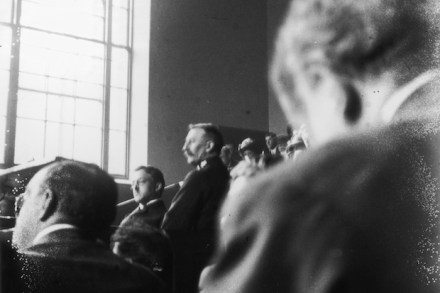
From The Spectator, 24 October 1914: It is alleged that in London there are something like a hundred thousand people, and as many more in the rest of the country—probably the figures are twice too high—of German and Austrian nationality. These aliens are for the most part at present earning their living in various trades. It certainly would be laying rather a heavy burden upon our shoulders to intern the whole of them, and to feed, clothe, and generally provide for their wants. No doubt if it must be done it must, but it would surely be unwise to hound the Government on to such action unless it is clear that it ought to be taken... The spy problem is a special one, and really not very closely connected with the problem of the enemy alien.
From our UK edition
From The Spectator, 24 October 1914: Time being against her, a condition of stalemate on her frontiers is a hopeless business for Germany. Invasion, then, is a logical necessity. It is true that the chances are small, and that failure might mean the loss of a quarter of a million Germans or more, but to the German military philosopher that matters nothing. He would ask you: "What object is there in possessing a quarter of a million armed men unless you use them? And the only way to use them is to fling them on the enemy. To keep them unused is, from the strategist's point of view, just the same as letting them be killed in sunk transports or mowed down on English battlefields. To decide the problem of invasion or not invasion by any thought of the losses involved is ridiculous.
From our UK edition
From The Spectator, 24 October 1914: For years past the vodka monopoly in Russia has been a public scandal. Government officials, in order to get good financial returns, have connived at the abasement of the people by encouraging drink. Year by year the revenue from the vodka monopoly has increased by leaps and bounds till the present year, when it was estimated to yield £93,000,000, or very nearly a third of the total revenue of the Russian Empire. Critics of Russia have long lugubriously prophesied that, in spite of all the Tsar's protestations in favour of temper. ance, he would never venture to take any step which would impair such a magnificent revenue as this. He has not only promised steps; he has already taken them.

From our UK edition
From our UK edition

From our UK edition
From our UK edition
From our UK edition