Watershed
From our UK edition
From our UK edition
From our UK edition
From our UK edition

From our UK edition

From our UK edition
From our UK edition
From our UK edition
The state of Italy... Sir: Ambassador Terracciano’s letter (Letters, 1 November) about Nicholas Farrell’s article (‘The dying man of Europe’, 25 October) seems to me to be ill-researched and not thought through. Nicholas Farrell is spot on. The Ambassador is not. In another forum the Ambassador, on being asked what Italian nationals contribute to Britain, claimed that: ‘There is no area in which they don’t excel. Not only finance and management but also culture and the scientific and medical world, from professorship at Oxford to the chorus director of the Royal Opera, from the Science Festival at Cambridge to the director of the Tate Gallery in Liverpool.’ Has he ever stopped to think why this talent is in England, and not in Italy?
From our UK edition
States of criminality A 90-year-old Florida man feeding the homeless was arrested under a Fort Lauderdale law which makes it illegal to share food with members of the public. Other laws from the 'Land of the Free': — In Indiana you can be arrested for statutory rape if you are caught driving a car with a passenger under the age of 18 who is not wearing socks and shoes. — In Ocean City it is illegal to eat while swimming in the sea. — In New York State it is illegal to walk around on a Sunday with an ice cream cone in your pocket. — In South Dakota it is illegal to lie down and fall asleep in a cheese factory. — In Oklahoma it is illegal to make an 'ugly face' at a dog. — In Nebraska it is illegal to sneeze in church.
From our UK edition
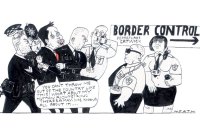
Home The government, expecting a backbench rebellion over the European Arrest Warrant, did not present it for a separate vote in the Commons, which enraged backbenchers all the more. Yvette Cooper, the shadow home secretary, tabled a procedural motion, forcing David Cameron, the Prime Minister, to hurry from the Lord Mayor’s banquet in white tie to vote amid angry scenes. George Osborne, the Chancellor of the Exchequer, came back from Brussels claiming that Britain would now only have to pay half of a £1.7 billion bill that the European Union had presented; but critics said that he was merely counting a future rebate that Britain was owed in any case.

From our UK edition
For decades, interventions of the Archbishop of Canterbury in national debate were like a sporadic bombardment of small pebbles against the door of Downing Street. Justin Welby has changed all that. This week, payday loan companies are facing reform (or in some cases oblivion) as new caps on interest payments come into effect. That the industry finds itself in this position is thanks, in no small part, to it having been hooked around the neck by the Archbishop’s crosier. Welby has inspired reform of the industry not by trying to set himself up as the leader of the opposition in a cassock, but by acting as an effective leader of the Church of England.
From our UK edition


From our UK edition
This is the text of a speech delivered by Sir John Major in Berlin. Thank you for your kind invitation. I feel privileged to be here to talk about the future relationship of the UK and her European partners. Often, on these occasions, speakers deliver their messages delphically; almost in code. But this evening I wish my message to be clear. I do not wish to be misunderstood or misinterpreted. The issue at stake is too important. And the timing is ironic. Twenty-five years ago this week, the Berlin Wall came down. German was reunited with German – and an arbitrary and brutal division of Europe was, at last, at an end. It was a great moment in European history – a triumph of freedom over repression.
From our UK edition
From The Spectator, 14 November 1914: We must make no attempt to conceal the terrible character of our losses. It is true that the German losses have been probably twice, or possibly even three times, as heavy, but that does not make our own losses the less awful. That we shall be able to make them good is no doubt true, but, unfortunately, we have not an inexhaustible human reservoir to draw upon, or, at any rate, not yet. Here, in fact, as in every other direction, we are brought back to the imperative need of more men. Here is the essential, and on this the nation must fix its heart and mind with unwavering determination.

From our UK edition
From ‘News of the Week’, The Spectator, 14 November 1914: We must make no attempt to conceal the terrible character of our losses. It is true that the German losses have been probably twice, or possibly even three times, as heavy, but that does not make our own losses the less awful. That we shall be able to make them good is no doubt true, but, unfortunately, we have not an inexhaustible human reservoir to draw upon, or, at any rate, not yet. Here, in fact, as in every other direction, we are brought back to the imperative need of more men. Here is the essential, and on this the nation must fix its heart and mind with unwavering determination.

From our UK edition
Mark Amory Being a slow reader, I first try the shortest, or anyway shorter, works of famous novelists unknown to me. This year, with many misgivings, I read The Confusions of Young Törless by Robert Musil (Penguin, £8.99) and was shocked and impressed by the intensity of the sex and violence he describes at a military boarding school in Austria. But do I really want to continue to the great works? Nagasaki, by the prize-winning French journalist Eric Faye (Gallic Books, £7.99), describes in 112 pages a middle-aged Japanese man who suspects that someone is secretly living in his house. It is as gripping as a thriller, but sad and serious. I shall try another short one. More confidently, I took Nora Webster (Viking, £18.
From our UK edition
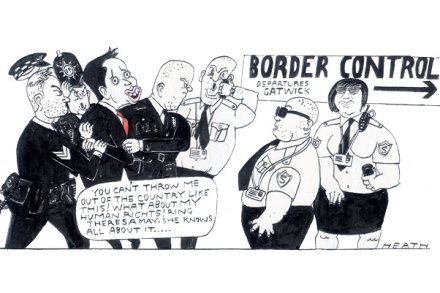
Home The government, expecting a backbench rebellion over the European Arrest Warrant, did not present it for a separate vote in the Commons, which enraged backbenchers all the more. Yvette Cooper, the shadow home secretary, tabled a procedural motion, forcing David Cameron, the Prime Minister, to hurry from the Lord Mayor’s banquet in white tie to vote amid angry scenes. George Osborne, the Chancellor of the Exchequer, came back from Brussels claiming that Britain would now only have to pay half of a £1.7 billion bill that the European Union had presented; but critics said that he was merely counting a future rebate that Britain was owed in any case.

From our UK edition
From The Spectator, 14 November 1914: We have mentioned elsewhere Mr. Winston Churchill's speech on the Navy at the Guildhall, in which he pointed out that in effect patience and vigilance must be the watch-words of our sailors now as heretofore. There seemed at one time a certain restlessness in the public mind in regard to the Navy, which if it had been reflected in our Fleets might have been of the utmost danger. Happily, however, public opinion seems now to have steadied, and there is no fear of any attempt on the part of the man in the street to try to force our Navy into premature action. Nothing could be more foolish or more ruinous than for the public to say : "Why doesn't the Navy do something?
From our UK edition
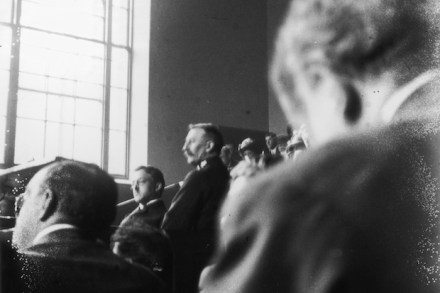
From The Spectator, 14 November 1914: Men guilty of helping the enemy are simply spies within our lines, or traitors to their adopted country. There cannot be any dispute about that. If the penalty visited on them is one of laughable leniency, the spy or traitor, so far from being deterred, has an actual incentive to continue his business. He sees himself in an heroic light—and he will get rich rewards when peace is restored and the time comes to acknowledge his "dangerous" services. Imprisonment, even for a considerable period, is certainly not a practical way of dealing with guilty aliens. They know that with the war will end all imprisonments for war offences.
From our UK edition
From The Spectator, 7 November 1914: We say without hesitation that if every town and urban district and village in England had a Guard formed on the lines of the Mitcham Town Guard, something would have been accomplished that might prove most valuable in the event of invasion. We shall no doubt be asked by many military critics whether we really believe that these Village and Town Guards, composed of boys under nineteen and middle-aged men from thirty-eight to sixty-five, would be of any sort of use from the military point of view.
From our UK edition