The Spectator

Portrait of the week | 20 November 2014

From our UK edition

Home David Cameron, the Prime Minister, said: ‘Red warning lights are once again flashing on the dashboard of the global economy.’ He then offered £650 million to a ‘green climate fund’. In a speech in Singapore, Mark Carney, the Governor of the Bank of England, said that fines for banks over rigging foreign exchange rates showed that ‘it is simply untenable now to argue that the problem is one of a few bad apples. The issue is with the barrels in which they are stored.’ Official figures showed that the number of British Army reservists has been boosted by a recruitment drive in the past year from 19,290 to 19,310. Friends of the Earth went to law to secure the future on the river Otter of a family of beavers living wild there.

The Spectator at war: The happiest young man in the world

From our UK edition

From The Spectator, 21 November 1914: We are glad to learn that the laudable persistence of the Prince of Wales has been rewarded, and that he has been allowed to go to the front, where he is now an A.D.C. to Sir John French. We can well believe the statement that the Prince is at the present moment the happiest young man in the world. He has got his way, and it is the way of honour, but it would have been a bad example if he had been allowed to go a day before his military superiors reported him sufficiently trained to take his place at the front.

From the archives | 20 November 2014

From our UK edition

From ‘News of the Week’, The Spectator, 21 November 1914: We are glad to learn that the laudable persistence of the Prince of Wales has been rewarded, and that he has been allowed to go to the front, where he is now an A.D.C. to Sir John French. We can well believe the statement that the Prince is at the present moment the happiest young man in the world. He has got his way, and it is the way of honour, but it would have been a bad example if he had been allowed to go a day before his military superiors reported him sufficiently trained to take his place at the front.

Matthew Parris on Owen Jones, Alan Johnson on hawks, David Crane on Noah’s Flood: Spectator books of the year

From our UK edition

Jane Ridley 2014 has been the year of 1914. In the same way that Christmas puddings appear in supermarkets in October, many of the contestants in the publishing race for 2014 defied starter’s orders and came out pre-maturely in 2013. What has been striking about the bumper crop of first world war books is the terrifically high standard. One of last year’s books which I’ve only just got round to reading in paperback is David Reynolds’s Long Shadow (Simon & Schuster, £9.99). Because the Great War seemed so meaningless, killing so many British soldiers for reasons which remain remote and obscure even today, it has always been especially difficult for the British to make sense of it.

Yes, Bob Geldof, Africans know it’s Christmas. Do you know it’s time to pack Band Aid in?

From our UK edition

In this week's Spectator, out tomorrow, our leading article looks at the Band Aid 30 single and why it's time for Bob Geldof to pack Band Aid in. Pickup a copy tomorrow or subscribe from just £1 here.  Anyone listening to the BBC this week could be forgiven for thinking that the musician Bob ­Geldof had just emerged from Africa, like a ­latter-day Dr Livingstone, the first westerner with news of a deadly new virus. He and his makeshift band of celebrities have adopted Ebola, their song blazing from the radio while Geldof himself has been in every studio exhorting people, with his usual stream of expletives, to buy it.

The Spectator at war: Stamp of disapproval

From our UK edition

From The Spectator, 21 November 1914: If nations obtain the Governments that they deserve, it may be hoped that they do not always deserve their postage-stamps. If that were so, we should be a less deserving nation than we were in the twenty or thirty years which followed the introduction of "adhesive labels" in 1840, when we had some of the finest stamps that have ever been issued. The black penny, the red penny, and, above all, the blue twopenny stamps of 1840 to 1880 have never been surpassed for strength of colour and simplicity of design. When 1880 brought the brick-red penny, and 1881 began a pale procession of lilacs and greens, surely England fell far.

The Spectator at war: Profound respect and sorrow

From our UK edition

From The Spectator, 21 November 1914: WE record with deep regret the death of Lord Roberts, which occurred last Saturday evening at Sir John French's headquarters. Lord Roberts had gone to France specially to visit the Indian troops, of whom he was Colonel-in-Chief. He caught cold on Thursday week, and his heart was not strong enough to resist the attack of pneumonia -which followed. We have written elsewhere of Lord Roberts's brilliant career, and of his great example not only as a soldier but as a man. We may add here that the Times of Monday published a letter in which M.

The Spectator at war: Signs of strain

From our UK edition

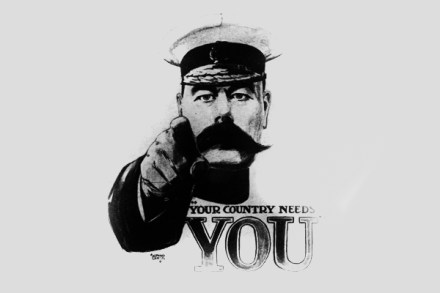
From The Spectator, 21 November 1914: Though we realize how terrible is the strain on our Army in Flanders, we are, of course, well aware that General French and Lord Kitchener are fully conscious of what is going on, and are taking all the measures necessary to provide the requisite reliefs, and to strengthen the line at any places where it is really threadbare. Though the strain and distress in the trenches, and the weariness of the men owing to want of sleep caused by almost continuous fighting, may be very great, and may call loudly for relief, from the higher military point of view there may be no danger.

The Spectator at war: Can’t get the staff

From our UK edition

From The Spectator, 14 November 1914: THACKERAY dealt a blow at domestic service which it has never quite recovered. He made it ridiculous. It was the one bad turn that he did to English society. The litera- ture of his day reflected his point of view. Servants did not then read novels—they were 31s. 6d. each—neither did they belong to lending libraries. The derisive smiles of their employers were hardly understood by them. By now the employer has forgotten that he ever laughed, though it is impossible to deny that some very faint aroma of ridicule still clings to his mind in connexion with the thought of domestic service, at any rate for men. Meanwhile education has made rapid progress. A class which never read before is reading now.

The Spectator at war: State provision for state servants

From our UK edition

From The Spectator, 14 November 1914: A married man who was insured before the war may, if totally disabled, receive as much as 28s. a week for life. This is certainly an extremely liberal allowance, and we may be sure that the pacifists among us, especially those with Socialistic tendencies, will sooner or later draw a contrast between the liberal payment which the State makes to men disabled by war and those disabled in industry. The contrast is not a new one, but so far as it is used for argumentative purposes it rests upon a very obvious fallacy. The allowances made by the State are made by it to its own servants in return for services which they have undertaken at its call for the benefit of the country.

The Spectator at war: Russia and Constantinople

From our UK edition

From The Spectator, 14 November 1914: The Spectator for the last twenty years has urged that the Russians are the appropriate successors of the Turks at Constantinople. Russia is by far the greatest of the Black Sea Powers, and she ought to be given the key to her own back door— the possession of the Bosphorus and the Dardanelles being conditioned, of course, by the guarantee of free access to the Black Sea for the shipping of other Powers, on the lines that govern the Suez Canal and the Panama Canal. We do not doubt for a moment that Russia will be perfectly willing to make such an agreement. That Russia must be given a stretch of territory which will enable her to reach Constantinople by land is obvious.