Bgt
From our UK edition
From our UK edition
From our UK edition
From our UK edition
From our UK edition
From our UK edition
From our UK edition
From our UK edition
From our UK edition
From our UK edition
From our UK edition
From our UK edition
From our UK edition
From our UK edition

From our UK edition
From our UK edition
Enemies within Sir: I thought Matthew Parris was typically incisive in his last column, but perhaps not quite as much as the person who wrote its online headline, ‘Scotland knows the power of a common enemy. We English don’t’ (18 April). It is true that ‘the wish to be the underdog’ is a defining urge of our age, even in relatively prosperous polities such as Scotland and Catalonia. But Parris is wrong when he claims that the closest the English come to the ‘Braveheart feeling’ is in their collective memory of the second world war. If only that were true. Would any other country make so little of its crucial role in the defeat of the most evil ideology the world has known?
From our UK edition
Any answers? Nigel Farage accused the audience in the BBC opposition leaders’ debate of being left-wing. Need insulting an audience destroy a political career? — Former US Vice President Dan Quayle did it on a number of occasions, telling an audience of American Samoans in 1989: ‘You all look like happy campers to me.’ Two years later he upset the American Bar Association by asking: ‘Does America really need 70% of the world’s lawyers?’ — Current US Vice President Joe Biden told a crowd in Wisconsin in 2010: ‘You’re the dullest audience I’ve ever spoken to.’ — Nigel Farage has done it before.
From our UK edition
Home The prospect of a parliamentary alliance between Labour and the Scottish National Party injected an element of fear into the election campaign. The SNP manifesto promised to increase spending and to find a way to stop the renewal of the Trident nuclear deterrent. Nicola Sturgeon, the SNP leader, said she wanted to make Labour in government ‘bolder and better’. Lord Forsyth, a former Conservative Scottish secretary, said that the building up of the SNP, to take seats in Scotland, was a ‘dangerous view which threatens the integrity of our country’. Ed Miliband, the Labour leader, said the Tories should not be ‘talking up’ the SNP. Even the Democratic Unionists began to eye prospects for advantage in a hung parliament.
From our UK edition
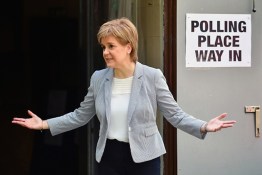
The election campaign is becoming increasingly dominated by a small party whose raison d’être is to preach independence from membership of a union it claims is hindering national ambition. But the party is not Ukip, which had been expected to play a big role in this election. It is the Scottish National Party, which seems ever more likely to hold the balance of power after 7 May and is determined to use it ruthlessly to its own advantage and to the furtherance of its sole objective: the dissolution of the United Kingdom. Nicola Sturgeon has been the only party leader talking about the virtues of national self-government, and she has met with reasonable success. No one else seems to be trying it. Nigel Farage is fighting the campaign as if it were a by-election in South Thanet.
From our UK edition
From our UK edition
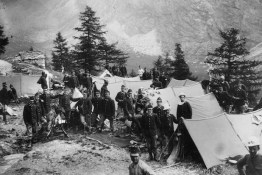
From ‘Soldiers of Italy’, The Spectator, 24 April 1915: It is winter in Florence. The sun shines, but snow lies low on Monte Morello, and the tramontana blows cold as ice, out of a piercingly blue sky. The streets and squares are crowded. Bells are ringing, bands playing, troops marching. The soldiers are coming back from Tripoli. There is to he a reception at the station. A burst of cheering, a scattering of flowers, a blare of music. Here they come. Bronzed, hardy-looking men these, in their war-worn uniforms, swinging along among the crowds and flowers. But the welcome is not altogether joyous. There are wet eyes amongst the onlookers. Wives and mothers whose men are not among the marching soldiers turn away to hide their team.