The Spectator

The Spectator at war: Night riding

From our UK edition

From 'Dawn on Box Hill', The Spectator, 26 June 1915: AS we rode down the gentle eastern slope of Ranmore Common we noticed that we could see our horses' ears. The statement seems commonplace, but for the last two hours we had mostly taken not only our horses' ears but our horses' heads on trust. In the wooded bridle-ways on the summit of the North Downs it is pitch dark even on the night before the summer solstice. We had had two hours of such bridle' paths, with only an occasional" bald" piece of Down where the stars and the open vault of sky made it poseible to see the man in front and the man behind in the column. We left Ranmore Church a few minutes past 1.30, and by twenty minutes to two there was no mistake as to the coming of the dawn.

The Spectator at war: Self denying ordinance

From our UK edition

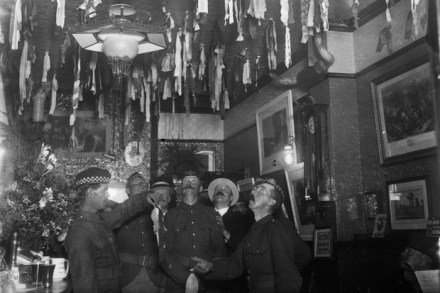
From ‘Food and Drink’, The Spectator, 26 June 1915: The Government have been completely beaten by the trade in their attempts at prohibition. But are they justified at the present time in allowing this great waste of food to continue ? Even if in this the trade is strong enough to beat them, as it probably is, the people of the country can do what the Government cannot do to check this abuse. They are unable to face the question of compensation, but if every loyal citizen followed the example of the King and refrained from alcohol during the progress of the war, the compensation question would be answered in a way eminently satisfactory to the nation, however unsatisfactory to the trade. The writer has never been an advocate of prohibition.

The Spectator at war: Cold-blooded goodness

From our UK edition

From 'Cold-blooded Goodness', The Spectator, 26 June 1915: A young person of either sex who is wholly without sentimentality has not as a rule much heart. On the other hand, where practicality so overruns the character as to destroy all the finest feelings, it may still leave the capacity for sympathy not uninjured, but certainly undestroyed. No good child ever lived who did not wish for approbation, but certain good people do grow out of it. Indifference to it is a cold, unlovable virtue; but some quite kind and lovable people are indifferent to the opinion even of those they really like. It goes, we think, with an overweening desire for independence, a quality always unsocial and rather inhuman.

Letters | 25 June 2015

From our UK edition

Free trade with Africa Sir: Nicholas Farrell suggests that a naval blockade is the only solution to Italy’s immigration crisis (‘The invasion of Italy’, 20 June). Examining the causes of the situation might identify other measures. Since the European Union effectively closed its borders to trade with Africa to protect European farmers from lower food prices, the agricultural economies of most African countries have been in decline. Of course there is another reason for Africa’s decline. About 60 years ago, the Europeans found it convenient to convince themselves that in Africa self-government was better than good government. It followed that aid would be a convenient substitute for the risks or inconveniences of free trade.

Barometer | 25 June 2015

From our UK edition

The spirit of 1945 No one would have been more surprised at the sight of 100,000 people marching in London under the banner ‘End Austerity Now’ and demanding ‘Tories Out’ than Sir Stafford Cripps, President of the Board of Trade and briefly Chancellor of the Exchequer in Attlee’s government. — Hard though it might be to remember now, but austerity was once a proud Labour policy. The rationale of the policy, devised by Cripps, was that by suppressing private consumption, resources could be spent instead on boosting exports. — Any anti-austerity march in 1947 would have been led by the Conservatives, whose slogans of the time included ‘Starve with Strachey’ and ‘Shiver with Shinwell’.