The Spectator

The Spectator at war: Catching the train

From our UK edition

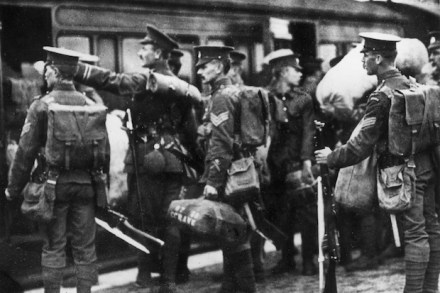
From ‘Catching the Train’, The Spectator, 17 July 1915: ENGLISHMEN have many exasperating habits, but perhaps the most exasperating of all is that of running a train so fine that they only just catch it. What the normal healthy, unnervous Englishman likes to do is to arrive at the railway station one minute before the train starts, walk up the platform a little agitated inside but outwardly very calm and ostentatiously slow in movement, saying to any one he meets that there is not the slightest need to be in a hurry, as there are still twenty-five seconds before she is due to start. "Besides, all the carriage doors are still open and it must take another minute to shut them." That is the scene at the station end.
The Spectator at war: The matter of attrition

From our UK edition

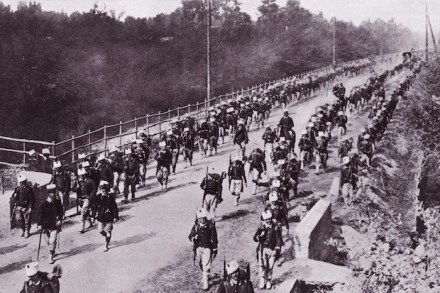
From 'News of the Week', The Spectator, 17 July 1915: ON the western side trench warfare continues on the familiar lines of attack and counter-attack. On the whole, however, we are not, we think, unduly optimistic when we say that on the balance the Allies once more have had the advantage, not only in the matter of small successes, but still more in the matter of human attrition. We and the French both lose heavily in men, but the Germans lose more and can worse afford it. We ought, however, to add that, according to a Berlin wireless telegram, the Crown Prince's attacks in the Argonne have been very successful, and that he has taken a large number of prisoners and put several guns out of action. Against this, the French declare that the enemy's gains have been of a trivial character..

The Spectator at war: A pilgrim in wartime

From our UK edition

From 'A Pilgrim in Wartime', The Spectator, 10 July 1915: WITH a heavy bundle on her head, and gathered skirts which swung as she walked, I mistook her for a peasant carrying fodder home to the farm. Then as I saw the cockleshell sewn on to her cape my heart gave a bound. "O Pellegrina, stop and talk to me a while," I cried. And there on the Fiesole hillside she turned to greet me—a little old woman, erect and agile, with white hair and brown, weather-beaten skin, her poor rough garments clean and neat. At once I felt she could be no ordinary pilgrim, and as I watched her penetrating dark eyes I knew that the Sacred Fire glowed within, giving her a vision of things beyond my reach.

The Spectator at war: Commons courtesy

From our UK edition

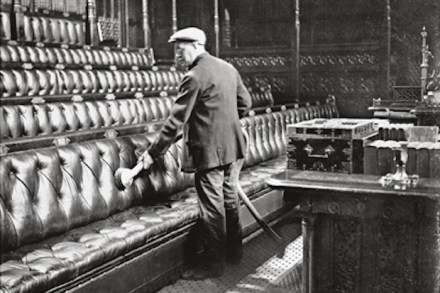
From 'Parliament and Registration', The Spectator, 10 July 1915: The modern rigidity of the party system has enabled Ministers, once they have attained to power, to despise the House of Commons, for they know that the Whips will see that the party votes straight, and that is all they care about. This is a fundamental mistake, for the House of Commons in war time quite as much as in peace time is, with all its defects, one of the most valuable of our institutions. It provides the machinery for the criticism of the Government under conditions in which that criticism can most effectively be made and most effectively be answered.

The Spectator at war: Thought for food

From our UK edition

From ‘The Grand Victualler to the Nation’, The Spectator, 10 July 1915: As important as the supply of munitions is the supply of food. One, indeed, is useless without the other. No matter how much shell we have, we shall not be able to use it if our men are starving and are too weak from privation to load their guns or continue to keep up the supply of ammunition. If we are to ensure that this country shall always be abundantly victualled, we must take vigorous and timely action. If we do not, there is very grave risk that one day the country will be suddenly awakened by the news that there is a serious shortage of food, and that unless some tremendous effort is made we shall run the risk of starvation.

Letters | 9 July 2015

From our UK edition

The case for Daesh Sir: For once the admirable Rod Liddle has got it completely wrong (‘You can’t take the Islam out of Islamic State’, 4 July). We absolutely shouldn’t call the homoerotic, narcissistic death cult ‘Islamic State’ — not because it offends ordinary Muslims, nor because it has nothing to do with Islam (it has everything to do with Islam) but because it legitimises and validates the preposterous project. The media has a responsibility not to run terrorist propaganda unchallenged. Politicians, including the Prime Minister, are starting to wise up to this and should be applauded for doing so. We are in an information war with our enemies.