Books and arts opener – 19 May 2016
From our UK edition

From our UK edition
From our UK edition
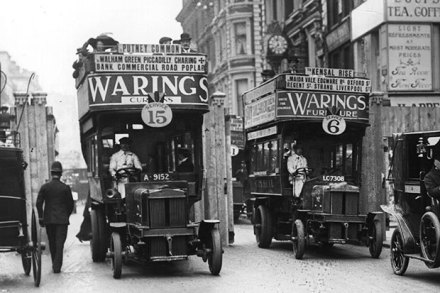
From ‘The softening of street manners’, The Spectator, 20 May 1916: Generally the public opinion of the ’bus entirely upholds the conductor. The influence of the tyrant is too strong to allow of protest, but now and then cases of rebellion occur, and bold females who consider themselves slighted vow that they will write to the company. But an ordinary ’bus-load contains no such heroines…. Sometimes, however, the will of the passengers prevails by reason of unanimity. A few nights ago a drunken soldier got, late at night, into a West End ’bus. The conductor civilly asked him to get out. The man began to argue, and a number of elderly women took his part. ‘Let him stop,’ they begged, one after another.
From our UK edition
Europe is already divided Sir: The Archbishop Emeritus of Westminster writes eloquently about the historical purpose of a ‘union’ in Europe as being primarily to eliminate the wars that for centuries had characterised Europe (‘Let’s renew the EU’, 7 May). He, and Pope Emeritus Benedict, both point to the shared Christian beliefs that defined all nations of Europe. But the EU, as it has evolved, is now no expression of such an underlying faith — in fact, the opposite. As he points out, it has removed any official reference to Europe’s common heritage, and is increasingly set on a shallow, utilitarian course. Europe is now more divided than ever, and it will become more so under its present policies.
From our UK edition
Secrets of the stars The astrologer Jonathan Cainer died after beginning his last horoscope for his own star sign: ‘We’re not here for long. So make the best of every moment.’ Why do people believe horoscopes? — In 1948 psychologist Bertram R. Forer gave each of his students what he said was a unique assessment of their character and asked them to rate it for accuracy. The average rating they gave was 85%. — The assessments were in fact identical, and cribbed from horoscopes in newspapers. The students, Forer suggested, wanted to believe the descriptions and so blinded themselves to their vagueness. Old debts The Nationwide Building Society said it would offer mortgages with a term which runs up the borrower’s 85th birthday.
From our UK edition
The Leave campaign was right to pour scorn on David Cameron’s warning this week that Brexit could threaten Europe’s military stability and lead to war. Boris Johnson mocks the Prime Minister about his prophecy on page 14. If Cameron really believed that Britain leaving the EU could lead to war in Europe, why on earth did he risk having a referendum at all? Why was he suggesting until a few weeks before his negotiations with EU leaders that he would consider voting for Brexit if he didn’t get his way? It’s easy to tease the increasingly shrill alarmism of the Remain campaign. But it is harder to say how exactly leaving the EU would make things better.

From our UK edition
Home David Cameron, the Prime Minister, made a speech in the British Museum warning of war if Britain left the European Union: ‘And if things go wrong in Europe, let’s not pretend we can be immune from the consequences.’ George Osborne, the Chancellor of the Exchequer, said that if Britain left, house prices would go down. The government changed its policy, announced during the budget, of turning all schools into academies. The government changed its policy of denying admission from Europe of unaccompanied children originating in countries such as Afghanistan and Syria. Mr Cameron was heard on television to say to the Queen at Buckingham Palace: ‘We’ve got some leaders of some fantastically corrupt countries coming to Britain.

From our UK edition
From ‘Colonel Winston Churchill’, The Spectator, 13 May 1916: The return of Colonel Churchill to the House of Commons, which we are told is to be permanent, has set going a number of rumours as to the future of the most audacious and brilliant figure in our public life. Colonel Churchill, it is alleged, is to come back into the Cabinet, and to come back as Irish Secretary… What is wanted in the Ministry just now is a man who can he trusted. But who dare say that Colonel Churchill has the quality of political trustworthiness? Be his political genius what it may, he is above all things a mauvais coucheur.
From our UK edition
Summary: Sadiq Khan becomes Mayor of London. SNP fail to win a majority. Scottish Tories become second largest party in Scottish parliament; Scottish Labour in meltdown. Little change in England, Ukip gained seven seats in Wales. Scotland: SNP fails to win majority; Scottish Labour in meltdown The SNP won 63 of the 129 seats at the Scottish Parliament. The Scottish Tories are now the second largest party. They gained 16 MSPs to reach 31 in total. Labour had its worst result since devolution with 24 MSPs, a loss of 13. Scottish Labour is in meltdown. Its new leader, Kezia Dugdale, failed to take Edinburgh East constituency from the SNP - while Ruth Davidson unexpectedly took Edinburgh Central.
From our UK edition
The EU gravy train Sir: Despite his splendid forename, your deputy editor Freddy Gray has a very tenuous grasp of human nature. Having accurately detected a simmering voter mutiny across much of Europe and the UK, he decrees that those heartily sick and tired of being constantly lied to and thus treated with contempt by the EU gravy-train-riding establishments must be either extreme right-wing or mad (‘A right mess’, 30 April). Actually, we are neither. Does he really believe it to be coincidental that 95 per cent of the UK establishment (there are still a few good ’uns in the mix) are screaming, desperate that their gravy train not be derailed by mere electors?
From our UK edition
Following Tuesday night’s Indiana primaries, the race for the Republican nomination is effectively over. Talk of Donald Trump being overhauled in a contested convention in July evaporated when Ted Cruz withdrew from the race after seven successive defeats. Compromise candidates have ruled themselves out, and Trump’s former opponents are reluctantly rallying around. It really has come to this: the people of the most powerful country on earth will be asked to choose between Hillary Clinton and her former campaign donor Donald Trump. It cannot be assumed that Trump will be defeated in November. This week, for the first time, a poll put him ahead of her.

From our UK edition
Home Naz Shah MP was suspended from the Labour Party after the blogger Guido Fawkes revealed that in 2014, nine months before she beat George Galloway to win the seat of Bradford West, she had posted on Facebook a proposal to ‘relocate Israel into the United States’, adding the comment: ‘Problem solved and save you bank charges for the £3bn you transfer yearly.’ Jeremy Corbyn, the Labour leader, said: ‘It’s not a crisis. There’s no crisis.’ Ken Livingstone, the former mayor of London, said on the wireless: ‘When Hitler won his election in 1932, his policy then was that Jews should be moved to Israel. He was supporting Zionism — this before he went mad and ended up killing six million Jews.
From our UK edition
London’s other mayor How many people could name the capital’s other mayor, the Lord Mayor of London? The office, officially renamed the Lord Mayor of the City of London in 2006 to avoid confusion with the Mayor of Greater London, was instituted in 1189 and has been an elected office since 1215 — albeit only by the votes of representatives of livery companies. The current holder, elected last Michaelmas, is Jeffrey Evans, fourth Baron Mountevans, a shipbroker. The mayoralty was Evans’s second election victory last year; in July he won the election to replace the third Viscount Tenby as a crossbench hereditary peer. Top tips The government said it would consult on legislation to prevent diners being duped by extra service charges.

From our UK edition

From our UK edition
From ‘Reconstruction’, The Spectator, 5 May 1916: What Ireland wants just now is firm and judicious military government. The rebellion of last week has been put down, but undoubtedly the embers of the fire are still red-hot, and a very little might fan them into flame again. All students of Irish history know that rebellions in Ireland do not run the course that they run in other countries. The fact that they have become hopeless seems, indeed, sometimes to act as a stimulus to the race which specialises in lost cases. Unless, therefore, a very firm hand is kept in Ireland, and kept till the end of the war, there is a possibility of a recrudescence of trouble.
From our UK edition
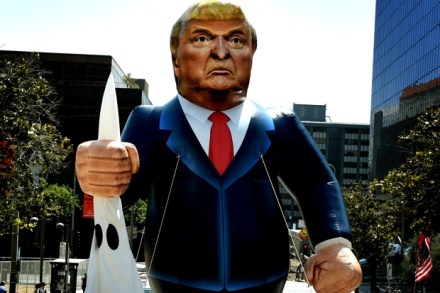
This morning, Ted Cruz bowed out of the race. Now, John Kasich has given up. As a result Donald J. Trump, the most grotesque candidate ever to have run for the Oval Office, is now the only candidate still running for the Republican Party's nomination. And so the most powerful country on earth, a nation teeming with talent, will this November be asked to choose between Hillary Clinton or the egregious Trump. It cannot be assumed that Trump will be defeated in the presidential election itself. This week, for the first time, a poll put him ahead of her. The bookmakers give him a 30 per cent chance: this time last year, he had a 2 per cent chance of winning the nomination.
From our UK edition
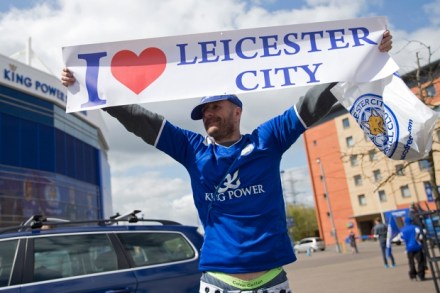
A sneak preview from the 'Barometer' column of facts and figures in the next Spectator, out on Thursday... Other remarkable things about Leicester: 28% of the population is made up of ‘Asians’ or ‘British Asians’, higher than any other district in England and Wales. Leicester has the highest percentage of residents born in India and also the highest percentage born in Zimbabwe. 51% of children have tooth decay, the highest in England and Wales. 41% of children reached the expected level of attainment in the Early Years Foundation Stage, the lowest in England. Leicester has 289 tennis courts, the most in any city except London, Sheffield and Ipswich.
From our UK edition
Green reasons to stay in Sir: As Conservatives we are clear that the European Union has been central to improving the quality of the UK’s environment. European policy is not always perfect, but on environmental issues it has allowed us to move forward in leaps and bounds. The wealth of the environment on which our economy depends is not confined to national boundaries, which is why the EU has become such a vital forum for negotiating Britain’s interest in maintaining healthy seas, clean air, climate security and species protection. It is largely thanks to European agreements that we now have sewage-free beaches in Britain. Because of tough European vehicle standards, British car drivers spend less on fuel.
From our UK edition
Getting a head Barack Obama dismissed Boris Johnson’s accusations that he shown disdain for Sir Winston Churchill by removing a bust from the Oval Office. What’s the going rate on eBay for such a bust? One-sixth scale resin bust of Winston Churchill (removable head) £12.50 Sir Winston Churchill bronze/brass bust £44 English-made marble bust of Sir Winston Churchill £70 Signed classic Winston Churchill bust by Oscar Nemon £80 Tallent Winston Churchill Terracotta Bust Cigar Lighter (used) £165 The academy difference Education Secretary Nicky Morgan partially retreated on plans to turn all schools into academies, free from council control. How do academies perform against maintained schools at GCSE?
From our UK edition
Home Junior doctors went on strike for two days, refusing to provide even emergency treatment. The 96 Liverpool fans who died in the Hillsborough football stadium disaster in 1989 were unlawfully killed, an inquest jury found. Philip Hammond, the Foreign Secretary, contemplated British forces being sent to Libya, but said ‘if there were ever any question of a British combat role in any form — ground, sea or air — that would go to the House of Commons’. Big Ben is to be silenced for months while its clock and tower are restored.
From our UK edition
Strange as it may seem, there are still people around David Cameron who regard the Scottish referendum campaign as a great success. Yes, they say, the nationalists didn’t like the original ‘Project Fear’ — the attempt to frighten Scotland into voting no — but it worked. Alex Salmond was defeated by a 10 per cent margin — proof, it’s argued, that relentless negativity works. Those who complain about it are either losers, or too squeamish to win. Andrew Cooper, chief of the Scottish ‘in’ campaign, said afterwards that the only criticism he would accept is that it was not negative enough. This attitude is a poison in the bloodstream of the Conservative party.