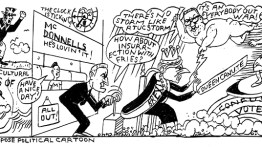
to 2326: ‘Suits you, sir!’
From our UK edition
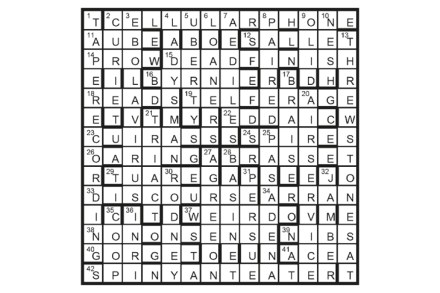
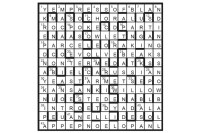
The unclued lights are part of a SUIT of armour.
From our UK edition
The unclued lights are part of a SUIT of armour.
From our UK edition
On Monday 11th September, The Spectator hosted a round table discussion over lunch about whether being green is good for business. Guests included: Philosopher Sir Roger Scruton, Shaun Spiers, CEO of Green Alliance, Mark Saxon from Coca-Cola Great Britain, journalist Harry Mount, Tom Robinson, founder of Adaptavate, Bill Wiggin MP, Peter Aldous MP, Neil Parish MP, Scott Mann MP and Anthony Marlowe of Edelman. Fraser Nelson chaired the discussion. A podcast was recorded on the same day, which can be played above. Recent bedtime reading for Sir Roger Scruton was a 50-page treatise by an art historian on the design of the classic Coke bottle, whose twists, it transpires, were designed specifically to foil counterfeiters.
From our UK edition
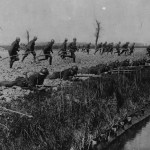
From ‘The progress in Flanders’, 29 September 1917: The fighting has reached a degree of intensity never before known. There is no leisure or rest for any one. The instruments of destruction which fly through the air by day and night are more numerous and more various than before… The strain to which the enemy, even more than ourselves, is subjected is terrific beyond words. We imagine that for one shell that the Germans send over we throw across four, five, or perhaps six. There is also what may be called a kind of camouflage in artillery work, when the drum-fire which the Germans regard as the sure herald of a coming attack culminates in no attack. The nerves of the enemy are, in fact, kept at the breaking-point the whole time.
From our UK edition
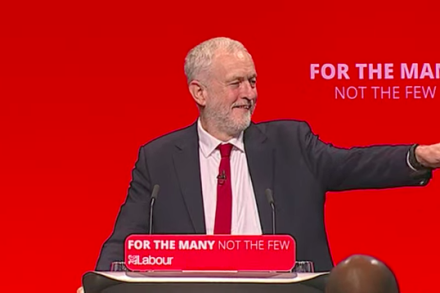
We meet here this week as a united Party, advancing in every part of Britain, winning the confidence of millions of our fellow citizens, setting out our ideas and plans for our country’s future, that have already inspired people of all ages and backgrounds. And it’s a privilege to be speaking in Brighton. A city that not only has a long history of hosting Labour conferences, but also of inspirational Labour activists. It was over a century ago, here in Brighton, that a teenage shop worker had had enough of the terrible conditions facing her and her workmates.
From our UK edition
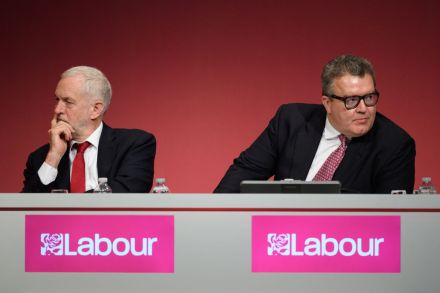
Conference, thank you for being here. Thanks for your enthusiasm, for your passion, for all your hard work on behalf of the Labour Party, on behalf of our country. I’m grateful to every one of you. Last week, the Prime Minister made yet another speech to reboot, yet again, her Brexit strategy. She chose to deliver this latest oration in the great city of Florence, though no-one seems to know why. For politicians, Florence, even more than the city of Dante, the Medicis and Michelangelo, is the city of Niccolo Machiavelli. I can only assume Michael Gove picked the venue. Michael Gove, who undermined his own Tory leadership bid last year, by admitting he doesn’t have the right skills to be Prime Minster. For once in his life, he was right.
From our UK edition
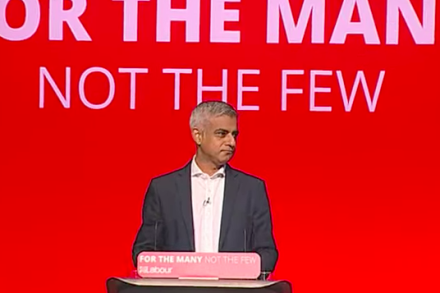
Conference, it's great to be back in Labour Brighton. And it's great to see our Labour Party so fired up under Jeremy Corbyn. Labour confounded all expectations at the general election this year. Let's be clear, Theresa May called this snap election to try and wipe us out. And boy did she fail. It was inspiring to see millions of people vote for the first time - especially so many young people. And it was inspiring to see so many people who used to vote for our Party return home to Labour. We made huge progress in the general election and the credit for that goes to one person – the leader of our party - Jeremy Corbyn. He mobilised our movement. He motivated our activists and reached voters we hadn't reached before.
From our UK edition
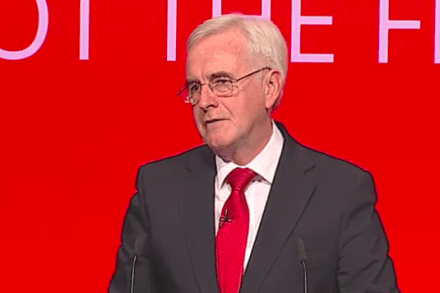
I’d like to thank Ken Loach for that wonderful film and thank Ken for his incredible contribution to our movement. Can I also thank the Shadow Treasury Team: Peter Dowd our Shadow Chief Secretary to the Treasury; Anneliese Dodds; Jonathon Reynolds; Denis Tunnicliffe; Bryan Davies and my brilliant PPS Karen Lee Only a few months ago we were 24 points behind in the polls. Our opponents and virtually every political commentator = those two groups are often interchangeable by the way - they predicted that we would be wiped out in the general election. I said then in interview after interview that the polls would narrow and we would shock them all. Not many believed me. And let’s be honest until you saw the exit polls, most of you were pretty on edge too, weren’t you?
From our UK edition
Few world leaders have fallen from grace as quickly as Aung San Suu Kyi. The Nobel prize-winner, who also holds the US Congressional Gold Medal for her bravery and peaceful resistance to Burma’s military junta, now stands accused of aiding and excusing the suppression — even the genocide — of the Rohingya Muslims, more than 400,000 of whom in recent weeks have fled from Burma, which elected her leader nearly two years ago. There have been calls from her fellow Nobel laureates for her peace prize to be annulled. The UN has described action against the Rohingya as a ‘textbook example of ethnic cleansing’ and complained that its observers have been denied access to Burma to judge the situation for themselves.

From our UK edition
It’s good to be here in this great city of Florence today at a critical time in the evolution of the relationship between the United Kingdom and the European Union. It was here, more than anywhere else, that the Renaissance began – a period of history that inspired centuries of creativity and critical thought across our continent and which in many ways defined what it meant to be European. A period of history whose example shaped the modern world. A period of history that teaches us that when we come together in a spirit of ambition and innovation, we have it within ourselves to do great things. That shows us that if we open our minds to new thinking and new possibilities, we can forge a better, brighter future for all our peoples. And that is what I want to focus on today.

From our UK edition
Christians betrayed Sir: Michael Karam’s article (Ya Allah!, 16 September) is timely. Many Westerners seem to be unaware that there is such a person as a Christian Arab (a Christian who speaks Arabic as their first language), yet there are millions. At the time of the Crusades, Christians were a majority in the Near East. In 1914 about 25 per cent of the Near and Middle East was still Christian. The percentage is now much lower because events have forced massive Christian emigration, especially to North America. The serious consequences of this ignorance were not only felt by the Christian Iraqi removed from a flight after another passenger heard him speaking Arabic.
From our UK edition
Roll up, roll up Party conferences this year revolve around the familiar settings of Bournemouth, Brighton and Manchester. But one party used to be more adventurous. — For its first conference in 1981 the newly formed Social Democratic Party (SDP) opted to have a rolling conference with meetings in Perth, Bradford and London, with the entourage travelling between them (to quote the Conservative Research Department) ‘rather like Trotsky in his armoured train’. — The following year the train rolled between Cardiff, Derby and Great Yarmouth, but broke down between Peterborough and Ely on the last leg.
From our UK edition
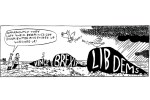
Home Boris Johnson, the Foreign Secretary, issued a manifesto for a ‘glorious future’ for Britain outside the European Union as ‘the greatest country on Earth’. This was seen as a challenge to Theresa May, the Prime Minister. People like Sir Vince Cable, the Lib Dem leader, and Kenneth Clarke, the Tory arch-Remainer, said he should have been sacked. Mr Johnson’s lengthy piece in the Daily Telegraph came six days before a big speech on the subject promised by Mrs May, in Florence, before the next round of Brexit negotiations. He declared that Britain should pay nothing for access to the EU single market. Amber Rudd, the Home Secretary, went on television and accused him of ‘back-seat driving’.
From our UK edition
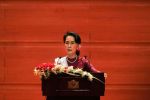
Few world leaders have fallen from grace as quickly as Aung San Suu Kyi. The Nobel prize-winner, who also holds the US Congressional Gold Medal for her bravery and peaceful resistance to Burma’s military junta, now stands accused of aiding and excusing the suppression — even the genocide — of the Rohingya Muslims, more than 400,000 of whom in recent weeks have fled from Burma, which elected her leader nearly two years ago. There have been calls from her fellow Nobel laureates for her peace prize to be annulled. The UN has described action against the Rohingya as a ‘textbook example of ethnic cleansing’ and complained that its observers have been denied access to Burma to judge the situation for themselves.
From our UK edition
From our UK edition
The theme was PIGS. First prize J. E. Green, St Albans, Hertfordshire Runners-up Michael Moran, Penrith, Cumbria; John M.
From our UK edition
It is with a real sense of pride that I stand before you as leader of the Liberal Democrats. First of all, I’d like to put on record my thanks to my predecessor, Tim Farron. He hands over a Party, which is larger, stronger and more diverse than the one he inherited. He stood up for refugees whose plight the government had shamefully ignored. He established our very clear identity as the only real, undiluted pro-European party. We are all hugely indebted to him. It’s good, today, to be amongst friends. So please forgive me if I start by addressing people who are not yet our friends, but whom we might persuade. People who say they don’t know what we stand for, or that we are irrelevant.

From our UK edition
Fat responsibility Sir: Prue Leith is right to note that the state picks up the bill for our national obesity problem (‘Our big fat problem’, 9 September). But the kind of large and expensive scheme she proposes only deepens the mindset that the government is responsible for our choices. Manufacturers should be forced to display hard-hitting facts about obesity on the labels of the unhealthiest food, in the vein of cigarette packets. This would leave people in no doubt about the consequences to their health, while avoiding extra cost to the state or punitive taxes which also hit those who exercise moderation.
From our UK edition
Selfie-worth The animal rights charity Peta dropped a case claiming that a macaque which took its own photo was entitled to the royalties, rather than the camera owner (but only after the photographer agreed to donate a quarter of the royalties to animal charities). — The idea of animal property rights was advanced by Australian philosopher John Hadley in the Journal of Social Philosophy in 2005. He suggested animals be granted rights over territories and human guardians appointed to represent them in court. — There are issues still to be reconciled, however: what of non-territorial animals, and those which dispute each other’s territories? Would cats be expected to resolve differences in court rather than yowling at each other?
From our UK edition
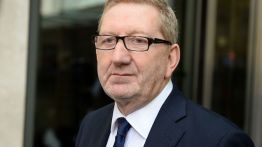
Jeremy Corbyn has never been very keen on parliamentary democracy. He may be changing his mind now. The British electoral system has allowed him to strip the Conservatives of their majority, an extraordinary result that not even he had thought possible. As a reward, he can watch the government squirm as well as shape its policy. All he needs to do is threaten a vote which Theresa May thinks she might lose, and she buckles — as we are now witnessing. For some time, the Prime Minister had stood firm on the public sector pay cap, arguing that when you factor in generous pensions, the average government worker is still paid 10 per cent more than their private sector counterpart.
From our UK edition
Home The European Union (Withdrawal) Bill was given a second reading by 326 votes to 290, with seven Labour MPs rebelling against the whip. Tony Blair, the former Labour prime minister, said it would be quite all right for Britain to stay in the European Union after all, with agreed adjustments to the free movement of people. Jeremy Corbyn, the current Labour leader, said that it was ‘open for discussion’ whether Britain remained in the EU single market, though Labour’s policy is for Britain to stay in the single market after March 2019 for a temporary period. Sir Peter Hall, the founder of the Royal Shakespeare Company and a former director of the National Theatre, died aged 86.