to 2341: Durum, durum
From our UK edition
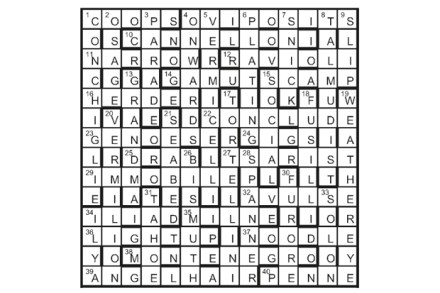
The unclued lights are varieties of PASTA.
From our UK edition
The unclued lights are varieties of PASTA.
From our UK edition
Sir: Sir James Dyson is right (Letters, 20 January). We need big farming; that is where our food comes from. But the elephant in the room is tax — inheritance tax and roll-over relief — which of course he conveniently skirts. Farming at this level needs subsidy precisely because land is too expensive for food production to give an economic return through income. And why is this? Because so much money chases land for tax reasons. The massive distortion of the allocation of capital due to tax reliefs is one of the fundamental problems of the UK. The solution is not more tax, it is to reduce tax to a level so that the economic case , not tax, drives decisions; and then remove reliefs.


From our UK edition
PM: Mr President, how are you? DT: I'm good thank you, Piers. PM: It's been a while! DT: It has, since you became my Champion on the Apprentice. PM: Well that was 10 years ago. DT: Can you believe it? It's a long time but I appreciate all the nice things you've said, and every once in a while a hit, but that's OK. PM: I always say that you don't mind criticism if it's not hysterical. DT: That's true. PM: You don't mind listening to criticism, do you? DT: That's true. No I don't, if it's real. If it's fake, I don't like it. I mean when they give you false stories, and there's so much of it in the media, but you've always been very fair. And you really are a talented guy.
From our UK edition
Reasons to use less plastic Sir: Yes, packaging from petrochemicals is bad, but what if we set out to use less of it? Like Ross Clark, I was once dismayed by wilting vegetables in my village shop (‘The great plastic panic’, 20 January). Then the shop closed, to be replaced by a community shop and café which stocks produce from local farmers and steers away from excess plastic packaging. This is not just a middle-class rural luxury: grass roots movements such as Food Assemblies are springing up in major cities, enabling shoppers to bring their own bags and buy food straight from producers who don’t put their vegetables in plastic costumes. These may be micro-gestures, but they point to the need for a root-and-branch rethink of packing in our food industry.
From our UK edition
A decade ago, bankers were not merely the masters of Davos, but the ‘masters of the universe’. No one calls them that any more. It is a mark of how far the global economy has shifted that the market capitalisation of Goldman Sachs was this week overtaken by that of Netflix, the online entertainment company. The world’s five largest companies are now all in the field of technology and the internet: Apple, Google, Microsoft, Amazon and Facebook. Ten years ago, none of them made the top five: the masters, then, were Exxon, Walmart, China National Petroleum and the Industrial and Commercial Bank of China.

From our UK edition
Home Boris Johnson went on manoeuvres again. The media were briefed that, in a meeting of the cabinet, he would call for the National Health Service to be given another £100 million a week. ‘Mr Johnson is the Foreign Secretary,’ Philip Hammond, the Chancellor of the Exchequer, said. ‘I gave the Health Secretary an extra £6 billion at the recent Budget and we’ll look at departmental allocations again at the spending review when that takes place.’ No. 10 also slapped him down. ‘The Prime Minister and a large number of ministers made the point that cabinet discussions should remain private,’ said the official spokesman for Theresa May, the Prime Minister.
From our UK edition
Redundant robots Fabio, a robot assistant in an Edinburgh grocery store, was retired after scaring customers. We worry about artificial intelligence destroying jobs, but sometimes it’s the robot that gets the P45: Elektra, a 7ft-tall robot with a brain formed of 48 electrical relays, was displayed at the World’s Fair in New York in 1939. He could talk, respond to voice commands and smoke a cigarette. He ended up in a California amusement park. K9, a robot helping security staff in San Francisco’s Mission District, was taken out of service after it was accused of discriminating against homeless people. Steve, a security ‘roboguard’ in Washington DC, suffered an ignominious end by tumbling into a fountain last July.

From our UK edition
From our UK edition
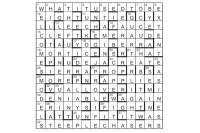
Amongst the many ‘aphorisms’ of Yogi Berra, the New York Yankees baseball manager, were ‘The future ain’t what it used to be’ and ‘It was déjà vu all over again’. First prize Christopher Hanafin, Adare, Co. Limerick Runners-up John Challoner, Newport, Essex; P.D.H.
From our UK edition
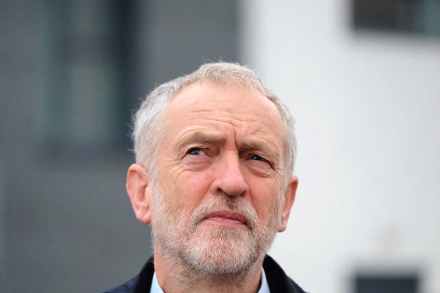
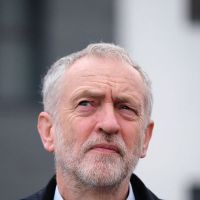
For Jeremy Corbyn and his allies, there has been no far-left takeover of the Labour party or its governing National Executive Committee. It’s true that, this week, Corbyn supporters came to control the majority of the NEC, completing their command of the party apparatus. But they see this as getting rid of the last of the right-wingers and enabling — for the first time — the Labour party to dedicate itself to the interests of the working class. It’s not the triumph of a fringe, they say, but the expulsion of a fringe. The Corbynite agenda of government expansion, mass nationalisation of railways, utilities and more, can now be pursued. Those still laughing at all that have not been paying attention.
From our UK edition
Investing in farming Sir: Martin Vander Weyer (Any other business, 13 January) says, unhelpfully and inaccurately, that subsidies ‘absurdly’ favour bigger farms. As we look towards life after Brexit, instead of debating the merits of small vs large, the government should incentivise good rather than bad. My family’s farming business, Beeswax Dyson Farming, farms 33,000 acres directly and has invested £75 million in technology, training, soil improvement and environmental stewardship over the past five years. These are hardly the acts of a mere ‘wealthy landowner’, in his dismissive parlance. Subsidies we receive go directly into the activities that they are designed to support but are dwarfed by our own investments.
From our UK edition
Big losers Construction company Carillion collapsed with debts of £1.5 billion. How does that compare with other UK corporate failures? Overend Gurney & Co, a bank, collapsed in 1866 with £4 million in liabilities (£400 million at today’s prices). Polly Peck failed after a fraud probe with £100 million in debts (£217 million). Barings Bank failed in 1995 after rogue trader Nick Leeson ran up £827 million of losses (£1.55 billion). MG Rover failed in 2005, leaving behind £1.4 billion of debt (£2 billion). Northern Rock was saved in 2007 after the government provided emergency loans to the tune of £27 billion (£35.7 billion).
From our UK edition
For Jeremy Corbyn and his allies, there has been no far-left takeover of the Labour party or its governing National Executive Committee. It’s true that, this week, Corbyn supporters came to control the majority of the NEC, completing their command of the party apparatus. But they see this as getting rid of the last of the right-wingers and enabling — for the first time — the Labour party to dedicate itself to the interests of the working class. It’s not the triumph of a fringe, they say, but the expulsion of a fringe. The Corbynite agenda of government expansion, mass nationalisation of railways, utilities and more, can now be pursued. Those still laughing at all that have not been paying attention.
From our UK edition
Home Carillion, the construction and service-provider with 20,000 employees and many contracts for the public sector, went into liquidation with debts of £1.5 billion, owing 30,000 businesses £1 billion. The government said it would pay employees and small businesses working on Carillion’s public contracts ‘to keep vital public services running rather than to provide a bailout on the failure of a commercial company’, as David Lidington, the minister for the Cabinet Office, told Parliament. Greg Clark, the Business Secretary, asked the Official Receiver to investigate the conduct of its directors; ‘Any evidence of misconduct will be taken very seriously,’ he said. The annual rate of inflation fell back a smidgen to 3 per cent in December, from 3.
From our UK edition
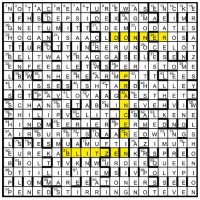
A beastly business The quote is 1A/92/18D from the poem ‘A Visit from St Nicholas’. The theme was the names of the eight reindeer in the poem. Three were highlighted whilst the others each suggested three unclued lights: Dasher (26, 63 and 83 — sprinters); Comet (12, 48 and 64 — astronomers’ names given to comets); Dancer (7, 49 and 74); Vixen (64A, 85 and 89 — female animals); Cupid (4, 25 and 46 — love deities). The winners The first prize of £100, three prizes of £25 and six further prizes of Bletchley Park Brain Teasers by Sinclair McKay (Headline) go to the following. In addition, the first four winners each win a bottle of champagne. First prize Peter Turner, Bearsden, Glasgow Runners-up F.
From our UK edition
From our UK edition
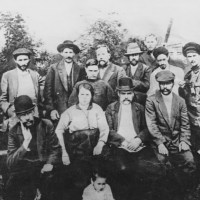
From ‘The Bolshevik negotiations with Germany’, 19 January 1918: We think that the fact is fairly emerging from the negotiations that the Bolsheviks are not, as some people supposed, the pliable tools or even the agents of Germany, but are idealists genuinely inspired by their mania. Of course, a great deal of harm may be done by a mania, however intellectually sincere it may be, and we can set no precise limits to the mischief that may be done by the Bolshevik leaders before they have finished. The habit of preferring the shadow to the substance, and rating the sound of words as more important than the realities implied by words, commonly ends in a terrible disillusionment.
From our UK edition
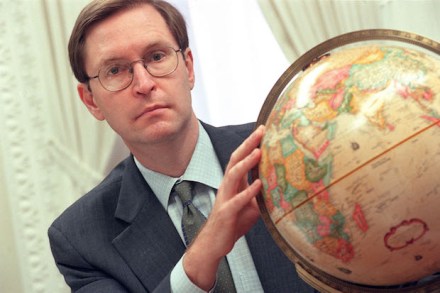
This piece first appeared as the leading article in this week's Spectator magazine. It is only a few months since gloomy economic commentators were confidently predicting that the world was about to plunge into a dark era of protectionism. Yet the global economy begins this year in its healthiest state ever, growing faster than any time since 2011. There has been a change in political rhetoric, but not in the willingness of people around the world to trade with each other. According to the OECD’s most-recent projection, made in November, world trade grew at 4.8 per cent last year. Something seems to be going badly right. Negative sentiments about the world economy echo those which have hung over Britain’s economy ever since the Brexit referendum.
From our UK edition
It is only a few months since gloomy economic commentators were confidently predicting that the world was about to plunge into a dark era of protectionism. Yet the global economy begins this year in its healthiest state ever, growing faster than any time since 2011. There has been a change in political rhetoric, but not in the willingness of people around the world to trade with each other. According to the OECD’s most-recent projection, made in November, world trade grew at 4.8 per cent last year. Something seems to be going badly right. Negative sentiments about the world economy echo those which have hung over Britain’s economy ever since the Brexit referendum.
From our UK edition
Long lives and pension pots Sir: Jon Moynihan is too optimistic about the prospects for further increasing life expectancy, and too gloomy about those of the pensions industry (‘Falling Short’, 6 January). The wondrous advancements of medical science have offered little to solve the most pervasive problem we now face: declining mental health. It seems unlikely that society will chose to invest endlessly in repairing bodies to extend lifespans, when the minds relating to those bodies have already been lost. So the viability of pension providers is not as parlous as suggested.