The Spectator

Letters | 30 August 2018

From our UK edition

Venezuelan sanctions Sir: Contrary to the impression given by Jason Mitchell, Venezuela does not have a socialist economy (‘Maduro’s madness’, 25 August). It has a ‘mixed’ economy (and therein lies some of its problems; such as food hoarding by private companies hostile to the regime). The private sector is large, and involved in numerous sectors within the economy; food distribution, pharmaceuticals and so on. The US sanctions against Venezuela have always been about regime change, and these sanctions amount to a blockade of the country.

Into Africa

From our UK edition

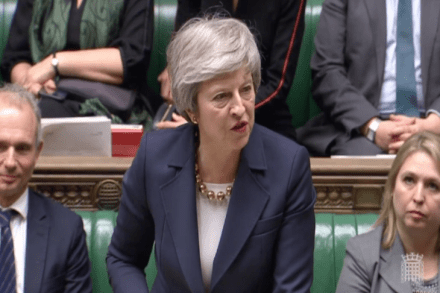
On her tour of South Africa, Nigeria and Kenya, Theresa May finally made a positive case for Brexit. For too long her government has tried simply to salvage what they can of Britain’s trading relationship with the EU, overlooking the possibilities that Brexit offers to build trading relations with the wider world.  The tone of this week’s tour, however, was different: a pitch for how Britain can make new alliances. This country will soon have the freedom to do so — no longer bound by its role as the most reluctant member of a 28-nation bloc. The opportunity is to treat African nations as partners and equals, not as risks or charity cases.

to 2371: In a paddy

From our UK edition

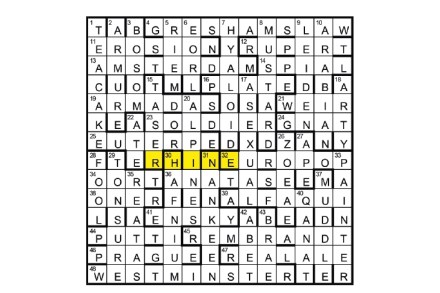
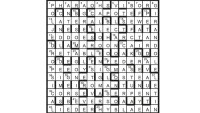
The unclued lights and those clued without thematic definition (2, 11, 26, 33 and 42) are Irish forenames. Nuala Considine’s crossword compiling career spanned over 70 years. Doc was privileged to meet her five years ago when Saga magazine invited five British compilers to a photoshoot to accompany an article about the hundredth anniversary of the British crossword.

The facts about the Venezuelan economy

From our UK edition

Contrary to the impression given by Jason Mitchell, Venezuela does not have a socialist economy (‘Maduro’s madness’, 25 August). It has a ‘mixed’ economy (and therein lies some of its problems; such as food hoarding by private companies hostile to the regime). The private sector is large, and involved in numerous sectors within the economy; food distribution, pharmaceuticals and so on. The US sanctions against Venezuela have always been about regime change, and these sanctions amount to a blockade of the country. US and European banks have refused to handle Venezuelan payments for medical supplies, and pharmaceutical companies have refused to issue export certificates for cancer drugs — therefore stopping them being imported into Venezuela.

Britain’s economy is not suffering as much as the doom-mongers insist

From our UK edition

This piece first appeared as the leading article in The Spectator.  Economies run on confidence — as Franklin D. Roosevelt observed when he told Americans, in his first inaugural address during the depths of the Great Depression in 1933, that they had ‘nothing to fear except fear itself’. If that confidence is lost, if people collectively start drawing in their horns, squirrelling money away because they fear turbulent economic times ahead, then recession can all too easily become a self-fulfilling prophecy. No serious economist would dispute this theory. The puzzle is why the UK economy, riddled with Brexit anxieties, is in such good health. The Dutch prime minister said we were ‘collapsed’.

Letters | 23 August 2018

From our UK edition

Not up to snuff Sir: The country is indeed crying out for expertise, as James Ball and Andrew Greenway wrote last week (‘The rise of the bluffocracy’, 18 August). But the main problem is with the civil service, not politicians. The civil service has traditionally wanted experts to be ‘on tap, not on top’. This attitude has done immense damage to Britain. Since 1970 the scientific civil service has been abolished in a series of reductions and privatisations. The result in 2001 was that there was nobody in government who had any clue about the epidemic of foot and mouth disease. In the education department there seems to be nobody who understands what a standard deviation is; nobody who appreciates the bottom one-sixth of the ‘Bell Curve’.

When fear fails

From our UK edition

Economies run on confidence — as Franklin D. Roosevelt observed when he told Americans, in his first inaugural address during the depths of the Great Depression in 1933, that they had ‘nothing to fear except fear itself’. If that confidence is lost, if people collectively start drawing in their horns, squirrelling money away because they fear turbulent economic times ahead, then recession can all too easily become a self-fulfilling prophecy. No serious economist would dispute this theory. The puzzle is why the UK economy, riddled with Brexit anxieties, is in such good health. The Dutch prime minister said we were ‘collapsed’. The New York Times publishes frequent reports saying that Britain is falling apart, even that our country has ‘vanished’.

Portrait of the week | 23 August 2018

From our UK edition

Home Government finances were in surplus by £2 billion in July. Public sector net debt rose to £1,777.5 billion, equal to 84.3 per cent of GDP, £17.5 billion more than a year before, but less as a proportion of GDP than last year’s 86 per cent. Jeremy Hunt, the Foreign Secretary, flew to Washington and made a speech urging the European Union to take stronger sanctions against Russia. President Vladimir Putin of Russia danced with Karin Kneissl, the new foreign minister of Austria, at her wedding, and then met Chancellor Angela Merkel of Germany at the Meseberg Palace near Berlin.

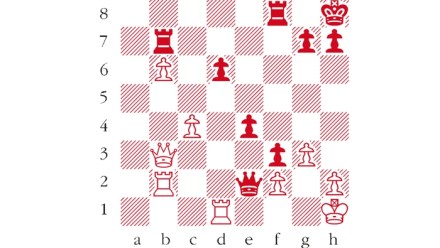
to 2370: Problem XII

From our UK edition

The numbers were linked to titles of classic works of FICTION (12): The Two DROVERS (26) (Walter Scott), The Three MUSKETEERS (1D) (Alexandre Dumas (père)), The Thirty-Nine STEPS (34) (John Buchan), The Five RED HERRINGS (36D/5A) (Dorothy L. Sayers), Eight COUSINS (15D) (Louisa M. Alcott) and Five WEEKS IN A BALLOON (14/20) (Jules Verne). 2 x 3 x (39 + [5 x 8]) x 5 = 2370.   First prize M.

Barometer | 16 August 2018

From our UK edition

Black list Jeremy Corbyn was attacked for attending a ceremony for members of Black September, the terrorist group which carried out the Munich Olympics massacre in 1972. The group took its name from a PLO terror campaign in Jordan two years earlier.

Portrait of the Week – 16 August 2018

From our UK edition

Home Unemployment fell by 65,000 to 1.36 million — at 4 per cent the lowest level since 1975. The economy in the United Kingdom grew by 0.4 per cent in the second quarter, compared with 0.2 per cent in the first. The rate of inflation rose a jot from 2.4 to 2.5 per cent, measured by the Consumer Price Index. Sports Direct, run by Mike Ashley, agreed to buy the House of Fraser chain of 59 department stores for £90 million after it had gone into administration. Homebase said it was closing 42 of its 241 stores. Marks & Spencer closed seven clothes stores as part of its programme to close 100 by 2022. Ofcom fined Royal Mail £50 million for anti-competitive behaviour.

The futility of terror

From our UK edition

By now, the routine is familiar: a lone wolf strikes, roads are sealed off, buildings locked down and a biographical picture begins to emerge. Often, the perpetrator turns out to be born and bred in Britain. His astonished friends and neighbours say they saw no signs that he had succumbed to fanaticism. It later emerges that radicalisation happened incredibly quickly — perhaps inspired by online videos — and the terror plan was so low-tech that interception would have been impossible. How, it might be asked, can any country protect itself against such threats? But Britain has protected itself, both in thwarting such attacks and in blunting their impact. The latest attacker found the House of Commons protected by barriers.

to 2369: Prodigious

From our UK edition

WUNDERKIND — given by corrections of misprints in clues — can be read as W UNDER KIND, indicating the unclued lights in each of four columns. First prize Cathy Staveley, London SW15 Runners-up Frank Anstis, Truro, Cornwall; S.J.J.

2018 finalists – Scotland and Northern Ireland

From our UK edition

  Amiqus ID is an encrypted online system for client-onboarding and transaction checks, with the intention of tackling cyber risk and money laundering.   Avocet Infinite makes use of a 'unique hydroponic system' to produce fodder to grow ideal barley for cows.   See.Sense makes ACE, an award-winning smart bike light that uses advanced sensor technology to give cyclists more visibility on their ride.

2018 finalists – The North East

From our UK edition

  rradar has established a vast online resource for clients seeking legal advice, a database for risk management, and the opportunity to contact a team of experts who can respond quickly to their queries.   Surfaceskins have developed push pads for the fight against superbugs. Designed to be placed at hand height on doors they dispense an alcohol-based gel when pressed. The gel disinfects the user's hand, leaving the door germ practically germ-free for the next person.   ZeroLight uses immersive technologies such as augmented and virtual reality to create an 'Intelligent Car Configurator'.

2018 finalists – The North West and Wales

From our UK edition

  AMPLYFI has created DataVoyant, which it claims is 'the most advanced business intelligence and research tool in the world'.   Arctic Shores is developing pioneering psychometric assessments to help people and organisations make better career and personnel decisions.   Evergreen Life's NHS-approved app enables people to own and take control of their own health data, managing and sharing information on allergies, conditions and fitness, while also allowing users to order repeat prescriptions, book appointments with their GP and check test results.