The Spectator

David Harding’s donation to Cambridge is the perfect antidote to Jeremy Corbyn 

From our UK edition

The British are said to be among the most generous people on earth. When it comes to ordinary people scraping together pennies to give to children’s hospitals or donkey sanctuaries, this is unquestionably true. Yet when it comes to wealthy individuals using large slices of their fortunes to make transformative donations to institutions such as universities and schools, we are a long way behind America. Where are the Carnegies, the Rockefellers? We do have wealthy donors, but they are generally on a much smaller scale, and quite often feel inclined to make their donations anonymously, as if it were an embarrassment to be seen to be acting with generosity.

Letters | 7 February 2019

From our UK edition

Fawning over China Sir: In reading your recent leading article on Huawei (‘Red-handed’, 2 February), I feel I should point out that it is not solely the British government who have been wrong-footed by the rise of China. Here in Canada, Prime Minister Trudeau has long desired to open up Canadian markets to Chinese companies, going so far as to express admiration for the country’s ‘basic dictatorship’. The Chinese press even bequeathed him with a charming nickname: the Little Potato. Now, in the face of the Huawei charges, Mr Potato has been forced to change course and has fired his ambassador, John McCallum, after he defended Huawei’s Chinese executives rather than supporting Canadians who have recently been imprisoned in China.

Portrait of the week | 7 February 2019

From our UK edition

Home Theresa May, the Prime Minister, went off to Brussels again to talk about ‘alternative arrangements’, for which parliament had voted, to the Irish backstop in her EU withdrawal agreement, which parliament had rejected. First she gave a speech in Northern Ireland, saying: ‘There is no suggestion that we are not going to ensure in the future there is provision for this insurance policy… the backstop.’ Lord Trimble (once an Ulster Unionist, now Conservative), the winner of a Nobel Peace Prize, said he was ‘exploring’ the possibility of a legal challenge to May’s deal on the grounds that it undermines the Belfast Agreement of 1998.

2391: Stout and bubbly

From our UK edition

The LITTLE GENTLEMAN IN BLACK VELVET (4/8/16D) was a Jacobite toast to the MOLE (34) who made the molehill on which KING (30D) William III’s horse fatally stumbled. Frances HODGSON BURNETT’s (10) LITTLE LORD FAUNTLEROY (4/1D) also wore black velvet, which also describes Guinness mixed with champagne.

Letters | 31 January 2019

From our UK edition

Vegan excess Sir: As a lifelong vegetarian I am heartily sick of vegans and of the amount of attention that is being paid to them. (‘The great carniwars’, 26 January). Vegan food is everywhere, in places where it used to be difficult to find vegetarian dishes. Often it tastes of nothing much and has the consistency and flavour of sawdust. Their principles of not harming animals seem to me to be a little warped. I accepted long ago that animals have to die to provide meat for people and pets. Vegans would do well to campaign, if campaign they must, against factory farming and cruel methods of slaughter. Issuing death threats for farmers seems a little extreme. Why should the life of an animal have more importance than that of a human?

Portrait of the week | 31 January 2019

From our UK edition

Home Theresa May, the Prime Minister, set off to seek a change to the Irish backstop of the EU withdrawal agreement after the Commons voted by 317 to 301 for a government-backed amendment by Sir Graham Brady, the chairman of the backbench 1922 committee, proposing unnamed ‘alternative arrangements’. Mrs May said there was ‘limited appetite for such a change in the EU’ and hardly had the words passed her lips before Donald Tusk, the President of the European Council, said: ‘The withdrawal agreement is not open for renegotiation.’ An amendment by Dame Caroline Spelman to rule out no deal passed 318 to 310, but lacked legal force.

2390: Tea Shop

From our UK edition

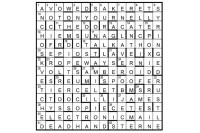
The theme word is GRASS (for which the title is a cryptic clue). 1A, 1D, 6 and 37 are informers; 28, 29, 33 and 39 are types of grass; 8A, 15, 22 and 26 are German Nobel literature laureates.   First prize Mrs R.J.C.

On political tribalism

From our UK edition

From The Spectator, No. 152, 24 July 1711: There cannot a greater judgment befall a country than such a dreadful spirit of vision that rends a government into two distinct people, and makes them greater strangers to one another, than if they were actually two different nations… A furious party-spirit, when it rages in its full violence, exerts itself in civil war and bloodshed; and when it is under its greatest restraints naturally breaks out in falsehood, detraction, calumny, and a partial administration of justice. In a word, it fills a nation with spleen and rancour, and extinguishes all the seeds of good-nature, compassion and humanity.

Letters | 24 January 2019

From our UK edition

Autistic freedom Sir: Jonathan Mitchell, an autistic writer, argues that autism is an affliction and that a cure should be found (‘The dangers of “neurodiversity”’, 19 January). When my son was diagnosed I would have agreed with him, but I disagree strongly now. My son’s autism comes with real challenges, but I value the ways it’s helped him become a thoroughly decent person: he doesn’t lie, it wouldn’t occur to him to be nasty and he’s totally logical. Surely, the world needs more people like him, not fewer. As Mr Mitchell says, the autism spectrum is huge, encompassing people who can’t communicate, who are locked in a sensory hell and need a high level of care, often for conditions that are not part of their autism.

Portrait of the week | 24 January 2019

From our UK edition

Home Theresa May, the Prime Minister, having survived a parliamentary vote of no confidence, came to the Commons with an amended plan for Brexit which would entail changing the Irish backstop agreement with the European Union. Otherwise Plan B looked very much like the Plan A that had been defeated by a majority of 230 a week earlier. There would now be a vote on 29 January, with Labour putting down an amendment that could open the way for another referendum. Amonportg British MPs there was a good deal of plotting in the wind. Margaritis Schinas, the European Commission’s chief spokesman, said that in the case of a no-deal Brexit, ‘I think it’s pretty obvious — you will have a hard border’ with the Irish Republic.

to 2389: All change

From our UK edition

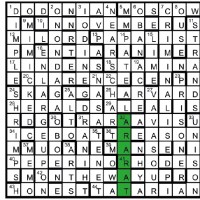
The paired unclued lights are anagrams of one another, most being symmetrically arranged; 2/21, 5/23, 12/41, 15/25, 19D/20.   First prize Alan Peevers, Manchester Runners-up Martin Dey, Hoylandswaine, S.

Raw and noisy debate is exactly how laws should be made

From our UK edition

An unexpected outcome of the tortuous process of Brexit negotiations has been the enhancement of Britain’s reputation as a parliamentary democracy. For many years, it has seemed as if political debate was draining away to the TV and radio studios, or even to social media — with MPs reduced to simply rubber-stamping decisions which have already been made elsewhere. This week, the Commons reasserted its authority in the most dramatic way imaginable, inflicting the largest ever government defeat on a substantive motion. The rejection of the Prime Minister’s Brexit deal is a humiliation on a scale which confounded the government’s attempts at expectation-management. To Mrs May’s credit, she immediately conceded that MPs must decide what happens next.

Barometer | 17 January 2019

From our UK edition

Turkey and the deep state Boris Johnson said that if Brexit was blocked, the public would blame it on the ‘deep state’. The expression comes from the Turkish Derin Devlet — coined to express the conspiracy of military, police, intelligence bodies and even organised criminals which many Turks believed were operating against their democratically elected government. It made its way into the English language in the 1990s when Kurdish separatists were threatening to declare independence. While there is little doubt that police and the military were involved in the underhand suppression of Kurdish insurgents, their efforts did not support the existence of a well-organised secret government.

Letters | 17 January 2019

From our UK edition

The straight dope Sir: Much of the media and a large part of the political class in Britain seem to have fallen completely for the propaganda of one of the biggest greed lobbies in the world, the billionaire-backed campaign for cannabis legalisation. Articles such as the one by Robert Jackman (‘Homegrown industry’, 12 January) suggest that marijuana is a benign drug, and make vague claims for its supposed medical benefits. Yet across the world, as Alex Berenson’s new book on the subject, Tell Your Children, shows, worrying developments are correlated with this poorly researched, expensively hyped and brilliantly spun adventure.