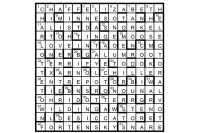
to 2401: sign here please
The unclued lights are ACCENTS or DIACRITICAL SIGNS and any appearing on letters in the grid had to be ignored. First prize Professor Colin Ratledge, E. Yorkshire Runners-up V.A. Plomer, Swindon; B.
From ‘Israel’s Candidature’, The Spectator, 22 April 1949: Israel’s application for UN membership received a chillier reception than had been expected. There was a widespread feeling more needs to be known about Israel’s intentions on certain points before the final seal is given to her international position. Does she propose to do anything about the Arab refugees except quibble ? Was the round-up of the Stern Gang which followed Count Bernadotte’s assassination a piece of window-dressing, or is there a serious intention to bring the murderers of the UN mediator to book? Does Israel mean to block or to co-operate with plans for the internationalisation of Jerusalem?
Flextensions Some organisations which may have benefited from Donald Tusk’s offer of a ‘flextension’ to Article 50: — Adidas, which has marketed a ‘Porsche Design Sport Flextension Easy Trainer’. — DB Flextension, a South Africa company which makes commercial signage systems. — Flextension, a Dutch charity which supports the development of wheelchairs and other equipment for boys and young men suffering from muscular dystrophy. Worse than smoking? A University of Washington study claimed that poor diet kills more people globally than smoking does.
All Cameron’s fault Sir: In this time of febrile political speculation, there can have been few more arresting subject headings on your Letters page than ‘Not Cameron’s fault’ (6 April). Your correspondent Mike Jeffes added to the sense of unreality by writing that ‘Cameron did nothing wrong’. You need to be neither a Remainer nor Brexiteer to follow in horror the painful result of Cameron’s opening of this Pandora’s Box in 2016. In the 2010 and 2015 elections, the subject of Europe was well down on the list of voter concerns, but with a mixture of hubris, stupidity, and narrow political interest, Cameron’s decision to call the referendum has driven us into this political quagmire.
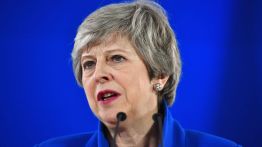
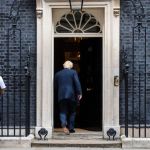
Home Theresa May, the Prime Minister, wrote to Donald Tusk, the President of the European Council, asking for an extension until 30 June of the period under Article 50 for which the United Kingdom should remain in the European Union. She hoped for parliament to agree to an ‘acceptance of the withdrawal agreement without reopening it’, perhaps through reaching a consensus by means of ‘a small number of clear options on the future relationship that could be put to the House in a series of votes’. She thought her talks with Jeremy Corbyn, the Leader of the Opposition, might reach such a consensus. Not only that, but she hoped that parliament would give its agreement before the elections to the European Parliament, due on 23 May, in which case they would be cancelled.
The European Union’s official goal — an ever-closer union of people — remains its single most attractive feature. Our continent is marked by its diversity: nowhere can you find a greater range of languages, histories and cultures. Closer co-operation is within everyone's interests, and the EU has done much to facilitating this. Its mistake was a lack of respect for the democratic traditions of its member states, and when it sought to impose a fixed set of rules over the most culturally and economically diverse club of nations it became a source of instability in Europe. The rise of populist parties in Europe is the most visible sign of the over-reach.
The preamble suggests that unclued entries are partial anagrams of UNCLUED. The ‘repeated cryptic clue (= anagram of CLUE)’ ‘fixes not only’ LUCE ‘but also’ the central 2x2 block as [CE/LU] and ‘as a result’ LUNE.
One of the many tragedies of Theresa May’s premiership is that, having come up with a coherent policy on how to enact Brexit, she spent her prime ministerial career failing to follow it. The words she used in her speech at Lancaster House in 2017 seemed clear enough: ‘No deal is better than a bad deal.’ It made sense to repeat this in the last Tory manifesto. She was to seek a free trade deal with the EU, but if that proved impossible, then Britain would be leaving anyway. In the event, the EU has not merely failed to offer a good deal, it has refused to offer any trade deal at all — only a withdrawal agreement that might or might not lead to a trade deal in future but which in the meantime threatens to trap Britain in the customs union indefinitely.
German customs The original customs union, or Zollverein, was established by Prussia along with 17 other states which make up modern Germany in 1834. Prior to that, traders crossing what is now Germany, were obliged to make multiple declarations and pay taxes as they moved across state borders. — It had taken 15 years to establish, but achieved a big step towards realisation in 1828 when Prussia formed a union with neighbouring state Hesse-Darmstadt, Bavaria formed its own union with Wurttemberg, and Saxony with Thuringian. — Not everyone was convinced. Hamburg and Bremen, which conducted much external trade by sea and made a lot of money from import duties, were not persuaded to join until 1888, by which time they had already been part of the German Empire for 17 years.
About the Bible Sir: I was confirmed by Richard Holloway as a schoolboy at Fettes College, and then taught by John Barton while an Anglican ordinand at Oxford University. So I was intrigued to read Holloway’s review of Barton’s latest book, A History of the Bible (30 March), and disturbed by their conclusions. Indeed, both the book and the review go a long way to explaining why the median size of a Church of England congregation is 28, and why numbers are at an all-time low. One doesn’t have to be an anti-intellectual fundamentalist to believe in orthodox biblical Christianity, or to realise that being a disciple of Christ means one cannot have a lower view of the Bible than he did.
One of the many tragedies of Theresa May’s premiership is that, having come up with a coherent policy on how to enact Brexit, she spent her prime ministerial career failing to follow it. The words she used in her speech at Lancaster House in 2017 seemed clear enough: ‘No deal is better than a bad deal.’ It made sense to repeat this in the last Tory manifesto. She was to seek a free trade deal with the EU, but if that proved impossible, then Britain would be leaving anyway. In the event, the EU has not merely failed to offer a good deal, it has refused to offer any trade deal at all — only a withdrawal agreement that might or might not lead to a trade deal in future but which in the meantime threatens to trap Britain in the customs union indefinitely.
Home Brexit exerted ever stranger effects on politics. After an eight-hour cabinet meeting, Theresa May, the Prime Minister, said she would ‘sit down’ with Jeremy Corbyn ‘to try to agree a plan’, though it ‘would have to agree the current withdrawal agreement’. The United Kingdom had been required to present a plan to a European Council summit on 10 April in order to be granted a long extension of the Article 50 process, or else leave the European Union on 12 April with no withdrawal agreement. But now Mrs May wanted a short extension, to pass a withdrawal bill before 22 May and avoid EU elections due the next day.
The unclued lights form the folk rhyme ‘Tinker, tailor, soldier, sailor, rich man, poor man, beggar-man, thief’. A.A. Milne (MILNE had to be highlighted) used this as the basis for Cherry-Stones, (9d) though the beggar-man became a ploughboy. Milne’s next five jobs are also mentioned in various clues.
From ‘The disconsideration of the House of Commons’, 5 April 1919: The House of Commons is legally supreme in the land; it has eaten up and destroyed all competitors and become the sole depository of political power under the Constitution; and yet, instead of earning the respect which one might imagine would belong to such absolutism, it is, as we have said, suffering from a disconsideration such as has never before attached to it in its history. How has this come about? What is it that has, as it were, robbed the House of Commons of the complete authority at which it grasped? Why has its supremacy made it less, not more, respected by the nation at large?
It is not hard to make the case that vaccination programmes have been one of the greatest contributions to mankind over the past century. It is sufficient simply to list the most common causes of death in 1915 of British children aged under five, in descending order: measles, bronchitis, whooping cough, diphtheria, tuberculosis, pneumonia, infective enteritis and scarlet fever. Few parents in Britain now have to undergo the trauma of nursing a child suffering from any of these conditions, still less of burying a child who has died from one. That these diseases have receded into history is down entirely to advances in medicine and public health.
Theresa May's Brexit deal has been voted down for a third time in Parliament. MPs rejected the Prime Minister’s withdrawal agreement by 344 to 286 votes, a margin of 58.
MPs have rejected Theresa May's Brexit deal for a third time in the House of Commons. This time, the Withdrawal Agreement had been split from the Political Declaration, which laid out the future relationship the UK would have with the EU. The deal was rejected by 344 votes to 286 - a majority of 58. 277 out of 314 Tory MPs voted in favour of the deal, but only five Labour MPs rebelled to join them in the division lobbies.
Despite suffering two historic losses in the House of Commons, Theresa May will bring her Brexit deal back for a third time today, after separating the withdrawal agreement from the political declaration. At the last vote on her deal, the Prime Minister lost by a majority of 149, which included 75 Tory rebels and 10 DUP MPs. Ahead of MV3, Coffee House will be keeping track of the Tory rebels who voted against May's deal last time, but have now publicly announced that they are supporting it. To have any chance of winning, May will need the support of the DUP (who have said they oppose the deal) and roughly the same amount of Labour votes as there are Tory rebels.