Books and Arts – 9 May 2019
From our UK edition
From our UK edition
From our UK edition
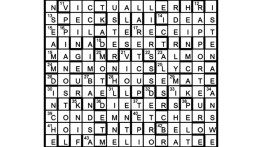
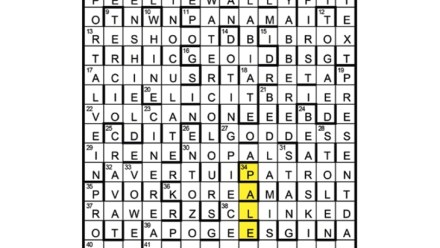
The first and second letters of the unclued lights are the same as the third and fourth ones. All the solutions are words or one phrase eight letters long. ARARAT at 32 Down matches the pattern but is only six-letters in length and had to be highlighted. First prize D.
From our UK edition
From 10 May 1919: The heart of the country is always for moderation. Nothing could show this more plainly than the recent by-elections. It was felt that the Prime Minister had been given too clean a sheet of paper to write his policy on, and that it would be good for him to feel that the country had criticism to offer, and was, moreover, able to put on the curb. But this balancing process was not, and never is, a violent swoop towards pulling down everything that exists. There was certainly nothing revolutionary in it.
From our UK edition
What does it mean to be a conservative? Last night, The Spectator brought together Douglas Murray and Roger Scruton to discuss that question. Here is the full transcript of their conversation: Douglas Murray: Some months ago, The Spectator said to me that they would like me to do an event and who would I like to do it with. And I said I'm very used to doing events with my enemies and spend rather too much time with them and would like to spend the evening with a friend. And they said: anyone in particular? And I said first choice, Roger Scruton. And a lot of things have happened since we agreed to get together with you all. Sir Roger and I have known each other for almost 20 years now.
From our UK edition
Great shakes Shale gas commissioner Natascha Engel resigned in protest at what she called ‘absurd’ restrictions on fracking — in particular rules which state that fracking operations must cease. Has anyone ever been harmed by a tremor at magnitude 0.5? — The Richter scale was devised by seismologist Charles F. Richter in 1935. It is a logarithmic scale, each ascending number marking an increase of approximately 31 times the amount of released energy. — The largest recorded earthquake, in Chile in 1960, measured 9.5. A tremor less than 4.0 is unlikely to cause damage and one of 2.0 or below unlikely even to be felt. — A tremor of 1.
From our UK edition
The last straw Sir: In his vindication of Sir Roger Scruton, Douglas Murray quite rightly refers to the affair as ‘a biopsy of a society’ (‘The Scruton tapes’, 27 April). It was also a biopsy of the Conservative party in particular, and a dispiriting one at that. It is notable that while a good slice of the conservative commentariat came to Scruton’s defence, Conservative MPs were conspicuously silent, except for those who rushed to excoriate Scruton. This response was indicative of the gap between the party in the country and the Parliamentary Conservative Party, which has seen an attenuation of the conservative instinct and — as has been argued in these pages — seems bereft of ideas or vision. It was also the last straw for me personally.
From our UK edition
Home Of those who voted Conservative in 2017, 53 per cent intend to vote for the Brexit party in the EU elections on 23 May, according to a YouGov poll. Brandon Lewis, the Conservative party chairman, said: ‘As a government, our first priority is not to have to fight the EU elections,’ adding that there was still time to cancel them if parliament approved the Brexit withdrawal agreement reached by Theresa May, the Prime Minister. Labour’s National Executive Committee agreed party policy should be to hold a referendum (with a question yet to be decided) if it could not get changes to the government’s deal or precipitate a general election. The Conservatives said they always expected to do badly in this week’s local elections.
From our UK edition
When a political party is in trouble, we see infighting, leak inquiries, resignations, mass loss of council seats, dismissals and botched attempts to depose the leader. But when a party implodes, something different happens: it loses the ability to defend or explain itself. An imploding party can and will lose any argument, no matter how strong its track record. The Tories entered this terminal stage under John Major after the disastrous local elections of 1995, which were followed by their landslide defeat of 1997. With the party now having had its worst set of election since 1995, it looks very much like they might be entering it again.
From our UK edition
From our UK edition
The second and fourth letters of six unclued lights gave abbreviations of the states forming New England: ACATER (13) Connecticut, ERNIE (24) Rhode Island, AMBEROID (27) Maine, ANCHOS (1D) New Hampshire, KVETCHED (22) Vermont and SMEAR (34) Massachusetts. NAG/LEND (17/36) is an anagram of ENGLAND suggesting ‘New England’. First prize Mike Conway, Grantham, Lincs Runners-up John Sparrow, Padbury, Bucks; G.H.
From our UK edition
Hundreds of people have been arrested after violent May Day clashes in the centre of Paris. Tens of thousands of demonstrators took to the streets of the French capital to mark the event. Stone-throwing protestors clashed with police, as officers – more than 7,000 of whom were deployed – responded with tear gas. Gilets jaunes, who have held anti-government protests weekly since November, teamed up with May Day marchers.
From our UK edition
Why does the NHS need to change? Increased pressure The waiting list for hospital treatment has risen by 46% over five years. The number of beds available overnight in NHS hospitals has fallen by 11,220 (8.1%) since 2011. In the past 12 months, 834 overnight beds have been lost. The waiting list for consultant-led treatment has risen by 46% in the past five years. The current waiting list is estimated at 4.28 million — up 7% year-on-year. In 2018, an average of 12,835 people were admitted to hospital via A&E each day — up 6.7% on 2017 and 22.9% on five years ago. This amounts to an extra 2,389 emergency admissions a day. In 2018, 18.5% of people attending hospital A&E spent longer than four hours in the department, compared with 3.4% in 2010.
From our UK edition
Not an island Sir: I and those with whom I live and work are all within coughing distance of Sam Leith’s ‘threshold of death’ and we need no reminders that your body is your own, because we wish to God it wasn’t (‘Last rights’, 20 April). But as it is, we owe it to that body to see the process through. My ‘going hence’ is not a private matter. I am not an island but a piece of the continent and that connection is the key to the human genius of social literacy. We demented dodderers are an eighth age, a new demographic, practically a new species, and we bring with us new ethical dilemmas.
From our UK edition
Spires on fire Paris was lucky not to lose its medieval cathedral entirely, a fate which London suffered in 1666 in spite of great efforts to keep the Great Fire away from it by pulling down surrounding buildings. The original St Paul’s, commissioned by William I in the 1080s and completed in the early 14th century, would still be one of the world’s largest cathedrals. It was 586 ft long, 68 ft longer than the current St Paul’s and 30 ft longer than Winchester cathedral. Its spire was estimated at between 60 and 80 ft higher than that of Salisbury cathedral (404 ft) — although still 30 ft short of Lincoln cathedral, whose spire collapsed in a storm in 1549.
From our UK edition
Home Theresa May, the Prime Minister, returned to parliament after the Easter recess to find backbenchers plotting to get rid of her. The 1922 Committee agonised over whether to change its rules in order to hold another vote of no confidence in her. More than 70 local Conservative association chiefs called an extraordinary general meeting of the National Conservative Convention to consider the proposition: ‘We no longer feel that Mrs May is the right person to continue as prime minister.’ A poll of Conservative councillors by Survation, for the Mail on Sunday, found that 40 per cent were planning to vote for the Brexit party in next month’s EU elections.
From our UK edition
It has become commonplace to describe terror attacks as ‘senseless’. The horrific Easter Sunday bombings in Sri Lanka, which cost the lives of more than 350 people, several British citizens among them, make little sense. The only way to understand them is as a symptom of the growing globalisation of terror. The tactics — synchronised bombs on a Christian holy day — are grotesquely familiar. And it was not surprising to learn that one of the attackers was partly educated in London. The attacks, on three Catholic churches and three hotels favoured by westerners, clearly targeted Christians. The culprits have been identified as local Islamic extremists. The purpose of the attacks, therefore, was to increase tensions between Muslims and non-Muslims.
From our UK edition
From our UK edition
BOYCOTT (24), GOWER (25), MAY (40), GRACE (2), STRAUSS (23), HAMMOND (27), CLOSE (34), and ROOT (36) have all held the England Test CAPTAINCY which solvers had to highlight.
From our UK edition
From ‘Be brave’, 28 April 1979: We can think of a number of reasons why voters might feel reluctant to vote for Mrs Thatcher. But this reluctance should be set aside. We must be brave. Only time can tell whether the Tories possess the necessary qualities of resolution and ability which are needed to deal with the nation’s problems. What we do know is that Labour entirely lacks them… The problems are familiar: a State which spends an ever-increasing proportion of ever diminishing national wealth; the atrophy of those traditions and mores which have supported British social life, resulting in growing lawlessness; a deplorable industrial record which may reasonably be blamed on a trade union movement that positively exults in maintaining low productivity.
From our UK edition
Embassy endurance Julian Assange was thrown out of the Ecuadorian embassy in London, seven years after seeking sanctuary from extradition proceedings. But there are people who have hidden longer in embassies: — Jozsef Mindszenty, a Hungarian cardinal, spent 15 years in asylum in the US embassy in Budapest. He had served eight years in jail for opposing the communist regime but was freed during the Hungarian uprising in 1956. In 1971, he was allowed to leave Hungary to live in exile in Austria. — Berhanu Bayeh, Ethiopian foreign minister between 1986 and 1989, has been sheltering in the Italian embassy in Addis Ababa since 1991, when his government was overthrown by the Ethiopian People’s Revolutionary Democratic Front.