The Spectator

What happened to the other Dukes of York?

From our UK edition

Old Dukes of York Prince Andrew is the 14th royal to have held the title Duke of York (three were styled the Duke of York and Albany). What happened to the other Dukes of York? — Two were killed in battle: Edward of Norwich at Agincourt in 1415 and Richard of York at the Battle of Wakefield in 1460. One, Richard of Shrewsbury, was murdered; he was one of the ‘princes in the tower’ who disappeared in 1483. — Barring unexpected events, Andrew will be the first Duke of York since Prince Frederick in the early 19th century not to progress onto the throne. Unlike Andrew, Prince Frederick moved closer to the throne throughout his life and was heir presumptive when he died in 1827 of overindulgence. He left vast debts incurred through gambling.

Portrait of the week: The leaders’ debate, the Duke’s interview and the gilet jaunes’ birthday

From our UK edition

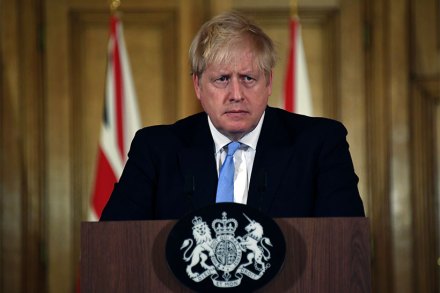
Home In a television debate Boris Johnson, the Prime Minister, was jeered by the studio audience when he was asked about the importance of truth and Jeremy Corbyn, the leader of the opposition, was jeered when he refused nine times to say whether he thought Britain should leave the EU. Neither dealt a knock-out blow and polls ranked them as neck and neck. The Liberal Democrats failed in an appeal to the High Court to include their leader Jo Swinson in the debate. But polls by YouGov indicated that the more voters saw of Miss Swinson, the less they liked her. Labour promised everyone free internet broadband, by nationalising Openreach and other parts of BT.

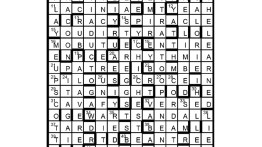
to 2432: Getting dry

From our UK edition

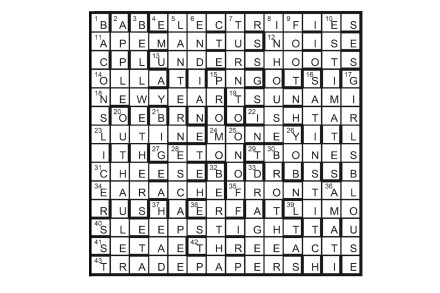
The DODO (30) organised the CAUCUS RACE (12) to get dry. Participants included ALICE (2), EAGLET (7), DUCK (17), MOUSE (31) and LORY (42). EVERYBODY (33) won, and the prizes were COMFITS (10) and a THIMBLE (39).   First prize  John Fahy, Thaxted, Essex Runners-up  A.M.

Jeremy Corbyn’s manifesto launch speech: Full transcript

From our UK edition

Thank you for coming to help launch our manifesto and a special thanks to Birmingham City University for hosting us in this wonderful building. Labour’s manifesto is a manifesto of hope. A manifesto that will bring real change. A manifesto full of popular policies that the political establishment has blocked for a generation. But you can’t have it. At least, that’s what the most powerful people in Britain and their supporters want you to believe. Over the next three weeks they are going to tell you that everything in this manifesto is impossible. That it’s too much for you. Because they don’t want real change. Why would they? The system is working just fine for them. It’s rigged in their favour. But it’s not working for you.

The winners of the Economic Disruptor of the Year Awards 2019

From our UK edition

Who are the companies that are rewriting the rules, the game-changers that are redefining their own marketplace? The Spectator and Julius Baer have once again come together to present the Economic Disruptor of the Year Awards – a celebration of creative entrepreneurship throughout the UK. In front of more than 120 guests from across the business world, the awards were announced on Wednesday 13 November at a gala dinner at the Postal Museum in London, chaired by Spectator chairman Andrew Neil. The winners were drawn from nearly 150 nominations from across the UK. The entrants have all been innovators, driven by real passion for what they do, and represent each of the different regions of the UK.

How many countries have been ruled by a Boris?

From our UK edition

Leaders called Boris How many countries have been ruled by a Boris? — Russia has had two Borises in charge. Boris Godunov was tsar between 1598 and 1605, during the Time of Troubles, and was credited with improving education in the country, importing foreign teachers and sending Russian children abroad for schooling. Boris Yeltsin was president of Russia from July 1991 to December 1999, becoming the first post-communist leader of the country. — Bulgaria had three King Borises. Boris I, ruler between 852 and 889, introduced the country to Christianity. Boris II (969-977) fought the Byzantine Wars and was accidentally shot by one of his own border guards. Boris III (1918-43) has been praised for resisting the rounding-up of Bulgarian Jews demanded by Hitler.

Letters: Why I’ll vote for Boris

From our UK edition

A bad idea Sir: Your editorial in favour of an amnesty for illegal immigrants (‘The case for amnesty’, 9 November) flies in the face of extensive evidence. Italy, Spain and France have, between them, granted any number of amnesties; almost without exception, each one prompted further waves of illegal immigration. In 2005 the French Interior Minister said further amnesties were out of the question. His German counterpart in the same year said that ‘wide-ranging campaigns to legalise illegal immigrants such as in Spain mean more illegal immigrants are drawn to Europe’. Your editorial avoids any mention of the potential risks to life highlighted by the recent tragic events, and suggests that a ten-year rule would have little effect on inflows.

Our flood defences aren’t fit for the climate we have now

From our UK edition

This week’s political fuss over whether the floods in Yorkshire constitute a ‘national emergency’ misses the point. It is too easy to declare an emergency for political purposes, to give the impression that the government is taking an issue seriously. It’s quite obvious that the scenes we have seen this week represent an emergency — the question is whether, once the helicopter visits and photo opportunities have ceased, all is forgotten and the political world moves on to the next emergency. What has happened in Yorkshire over the past week is a symptom of chronic failure to manage the threat of flooding. We keep suffering these events. In 2015, it was Cumbria; a year earlier it was Somerset.

Portrait of the week: Farage’s climbdown, Yorkshire’s floods and Australia’s fires

From our UK edition

Home Nigel Farage, the leader of the Brexit party, climbed down from his resolution to field 600 candidates in the general election, promising not to contest the 317 seats won by the Conservatives in 2017. The Conservatives, Labour and the Liberal Democrats said they would spend large sums of taxpayers’ money on things that might please voters (such as the NHS or, from the Lib Dems, a ‘skills wallet’ of £10,000 for every adult). The Conservatives claimed that Labour’s promises would cost £1,200 billion, which Labour denied. A review commissioned by the government into the HS2 railway said it should be built, despite the cost.

to 2431: Pride of place

From our UK edition

Each of the pairs of unclued lights is a CITY (formed from the letters in the yellow squares) and its nickname: 6D/11, 9/34, 13/29 and 28/18.

Books of the year – part two

From our UK edition

Richard Ingrams A book that gave me great enjoyment (for all the wrong reasons) was Harvest Bells: New and Uncollected Poems by John Betjeman (Bloomsbury Continuum, £16.99). The compiler, Kevin J. Gardner, professor of English at Baylor University, Texas, claimed that all the poems in the book had been subjected to his ‘rigorous scrutiny’; yet somehow a spoof Betjeman poem, published in Private Eye after the exposure of Anthony Blunt as a Russian agent in 1979 (for which I was partly responsible), had found its way into the professor’s ragbag of a compendium: Who’d have guessed it? Blunt a traitor And a homosexualist, Carrying on with tar and waiter — There’s a sight I’m glad I missed.

Letters: How to squash a Speaker

From our UK edition

No special protection Sir: Rod Liddle’s joke that the election might be held on a date when Muslims cannot vote, thereby reducing support for Labour, has apparently led to outrage. There has been no similar outrage over your front cover (‘A vote is born’), which satirises the Christian nativity by portraying Johnson, Corbyn and Swinson visiting the stable in Bethlehem. It should be a principle of free speech in any free society that all religions are equally subject to satire, criticism and even gentle mockery; there should be no special protection for one set of beliefs over another. In allowing satire about two mainstream religions in the same issue, you have shown admirable balance.

Do ‘Workington Man’ and ‘Worcester Woman’ decide elections?

From our UK edition

National characters How useful is it to characterise an election with a single anthropological specimen such as ‘Workington Man’? ‘Worcester Woman’ was identified by Tory strategists ahead of the 1997 election as a key voter who had helped John Major win, against expectations, in 1992. Worcester was then a Conservative seat. Has the city followed the national trend since?

Portrait of the week: Bercow steps down, Hoyle steps up and an election begins

From our UK edition

Home Sir Lindsay Hoyle, the Labour MP for Chorley and deputy Speaker since 2010, was elected Speaker by the Commons. His first words were: ‘No clapping.’ Nigel Farage, the leader of the Brexit party, proposed an electoral pact with the Conservatives, but only if Boris Johnson, the Prime Minister, repudiated the agreement on Brexit that he had made with the European Union. When this was not forthcoming, he said: ‘We will contest every single seat in England, Scotland and Wales.’ But he declined to stand for parliament himself (which he had done seven times before, without success). Philip Hammond, the former chancellor of the Exchequer, decided against standing as an independent in the election after all.

The case for amnesty: why it’s time to offer citizenship to illegal immigrants

From our UK edition

There is an unspoken truth about British life: we have two classes of citizen. The first are those born or formally settled here, who have all the rights and protections of the law. Then there are perhaps a million others who may have lived here with their families for years but without the proper documents. They can be our neighbours, work in our shops, contribute to our economy — yet they do not have the same basic protections and are far more vulnerable to exploitation. These are the so-called illegal immigrants, and it is past time to offer them amnesty. Britain has become the most successful melting pot in Europe, absorbing 2.5 million people over this decade without the far-right backlash seen in much of the continent.