The Spectator

Shinzo Abe’s luck is finally running out

From our UK edition

The Japanese are fond of poeticising the fleeting beauty of the cherry blossom season, which no sooner reaches its full glory than is gone, leaving behind nothing but bare branches, scattered petals, and a sense of wistful regret and nostalgic yearning. It’s the theme of countless haikus and mournful folk ballads. But if the cherry blossoms themselves soon vanish, the cherry blossom party scandal, currently vexing prime minister Shinzo Abe, is proving as worryingly hard to remove as Japanese knotweed. It’s in danger of turning into a Japanese version of Watergate. The annual prime minster’s cherry blossom viewing party is a tradition going back to 1952.

Letters: I was once on Prince Harry’s side. Not any more

From our UK edition

On child care Sir: Your recent editorial deplores, among other things, the cost of child care, to which you attribute the loss of female skills to the workplace (11 January). I would agree that pursuing a career is easier if one has no children. I also agree that the cost of child care is a significant drain on the income of young families. I am less convinced by the implicit suggestion that cheaper child care is the solution. I speak from experience and with hindsight. My son was born in 2000. For women of my age and education, at that time it was almost imperative to shove your baby into an expensive nursery and get back to work as quickly as possible. This is what I did — and I can’t say it was a good investment, for me, for his father or for him.

Portrait of the week: Harry and Meghan quit, America avoids war and the Labour leadership race begins

From our UK edition

Home The Queen agreed to ‘a period of transition’ during which the Duke and Duchess of Sussex would spend time in Canada and Britain. The Queen had summoned a family conference at Sandringham five days after the Sussexes issued a statement saying: ‘After many months of reflection and internal discussions, we have chosen to make a transition this year in starting to carve out a progressive new role within this institution. We intend to step back as “senior” members of the royal family and work to become financially independent.’ Since the plan had not been agreed with the Queen or the Prince of Wales, royal incandescence tended towards the white end of the spectrum.The Duchess flew off to Canada to rejoin the dogs.

Treating oil companies as pariahs will kill off any green revolution

From our UK edition

When fossil fuel divestment was merely a gesture by universities, the Church of England and the Prince of Wales it was easy to ignore; it is rather less so when the head of the world’s largest fund management company says that he is going to start ‘exiting investments’ in coal producers and other companies he claims represent a ‘high sustainability--related risk’. That is what Larry Fink of Blackrock, which manages £5 trillion worth of investors’ money, did in a letter to business leaders this week, citing last year’s climate change protests as evidence that attitudes were changing.

‘A perfect knight’: Remembering Roger Scruton

From our UK edition

Daniel Hannan Roger Scruton changed the course of my life. He addressed my school’s philosophy society when I was 16, speaking so compellingly about Wittgenstein and language that, when he finished, no one wanted to ask the first question. So, more to fill an awkward silence than anything else, I stuck my hand up and asked him what he saw as the role of a conservative thinker. ‘The role of a conservative thinker,’ he replied, in his charmingly diffident manner, ‘is to reassure the people that their prejudices are true.’ That beautiful aperçu never left me. It animated my career in politics, not least during the Brexit referendum. I spent part of my gap year in what we then still called Eastern Europe, observing the end of communism.

Megxit is a diplomatic nightmare

From our UK edition

The government has wisely kept away from the Harry and Meghan story so far. Despite that, no one should imagine that the latest royal farrago causes anything other than extreme concern for HMG, which will be worried at the potential for a rogue royal to upset the direction of government policy. There is still much to learn about how the Sussexes intend to conduct their lives, but the couple’s desire to pursue ‘a progressive new role’ will cause alarm in Whitehall. Anything that calls for interpretation risks going wrong. To put this into context it is helpful to look at three examples, one extreme, the others less so. For the first, historians would look to Edward VIII after the abdication. The deeply embittered Duke was a constant worry to the authorities.

Soleimani’s death shows just how easy drone killings have become

From our UK edition

It's no surprise the Ministry of Defence is struggling to recruit and retain drone pilots. The psychological burden of operating these remote-controlled killing machines can be considerable. Although thousands of miles separate the target and the person pulling the trigger, there is no escape from the fundamental point that drone operators - for right or wrong - are tasked with taking a person's life. This story is also a reminder that each new era of warfare presents its own unique horrors. In my career as a military lawyer, before my ordination as a priest, I devoted a great deal of thought to the morality of war and questions about the legality of drone strikes. The battlefield is constantly evolving.

Princess Madeleine of Sweden shows Harry how to exit a royal family

From our UK edition

Can a royal who grew up third in line to the throne marry a rich American and move over there? Swedes have been here before: Princess Madeleine, sister to the Crown Princess, did this a few years ago. She now lives in Florida, and her example could be instructive to Prince Harry and Meghan. Like Harry, she first tried love at home, but it didn’t work out: her 2009 engagement to Jonas Bergström, a lawyer, was broken off after rumours of him cheating on her. The news rocked Sweden and when she moved to New York shortly after, it was seen to be quite understandable. And then she just stayed there.

In pictures: Iran’s anti-government protests

From our UK edition

The Iranian government has faced growing internal pressure following the downing of a civilian jet last week. The Ukraine International Airlines flight was shot down on Wednesday shortly after takeoff, killing all 176 passengers on board. The regime has since taken responsibility for the deaths, blaming 'human error' amid rising tensions with the US following the assassination of Qasim Soleimani. Some have suggested that the regime's tragic error could signal the beginning of the end for Iran's theocratic dictatorship as increasing numbers of Iranians take to the streets. Over the weekend, the British ambassador was arrested while attending a vigil for those who died on the Ukrainian flight, including four Brits.

Is a double-barrelled surname still posh?

From our UK edition

Lock, stock and double barrels In Rebecca Long Bailey, who sometimes hyphenates her name and sometimes doesn’t, the Labour party may soon have a leader with a double-barrelled surname. Is such a name still an indication of elevated social class? — According to an Opinium poll in 2017, 11 per cent of couples now use a double-barrelled name on marriage. — The changing social connotations of double-barrelled surnames can be seen in the England football squad. Three of the 24 current members listed by the FA have double-barrelled names. — By contrast, none of the 23 members of the Conservative cabinet does, although the wider body of 33 ministers attending cabinet includes Jacob Rees-Mogg.

Letters: Roger Scruton and the meaning of life

From our UK edition

Wonder and gratitude Sir: Roger Scruton, in a very personal and moving portrait of his year (‘My Strange Year’, 21 December), reminds us that crisis is opportunity; and concludes that the meaning of life is gratitude — something we may only realise when, as Virgil put it, ‘mentem mortalia tangunt’. I think that language may betray us a bit on this great question and that there is no meaning of life. Rather, the meaning is life. Our response to this is-ness — this amazing, often painful gift — may be to turn aside into the ressentiment which Nietzsche warns against; or — as Roger Scruton does — to feel wonder and sheer gratitude at what is, might never have been, and one day will not be.

Portrait of the week: Crisis in Iran, fires in Australia and Manchester rapist jailed

From our UK edition

Home Dominic Raab, the Foreign Secretary, who had not been told in advance of America’s killing in Iraq of Qassem Soleimani, the leading Iranian military leader, said that America ‘had a right to exercise self-defence’. British troops were put on standby to be sent to the region, and the frigate Montrose and the destroyer Defender sent to the Strait of Hormuz. Boris Johnson, the Prime Minister, returning from holiday in Mustique, said: ‘Given the leading role he has played in actions that have led to the deaths of thousands of innocent civilians and western personnel, we will not lament his death.’ England secured a 189-run victory over South Africa on the fifth day of the second Test in Cape Town, levelling the series 1-1.

to 2437: Sketchy

From our UK edition

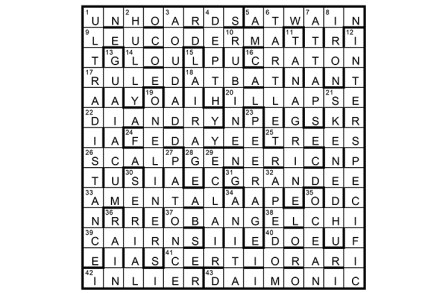
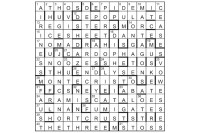
The unclued lights are PAINTING terms.   First prize Martina Fabian, Bourne End, Bucks Runners-up Phillip Wickens, Faygate, West Sussex; A.H.

Full text: New EU president says full trade deal not possible by end of 2020

From our UK edition

The new president of the European Commission Ursula von der Leyen made a speech to the London School of Economics earlier today. During the speech, von der Leyen said: 'Without an extension of the transition period beyond 2020, you cannot expect to agree on every single aspect of our new partnership. We will have to prioritise.' You can listen to the speech and read the full transcript below: Ladies and Gentlemen, It is a great pleasure to be back here at the London School of Economics – a place which brings back so many happy memories for me. The year I spent here taught me so much – both in and out of LSE. As anyone who knew me at the time will tell you, I spent more time in Soho bars and Camden record stores than I did reading books in Senate House Library.

How project fear saved us from the Millennium Bug

From our UK edition

With just 35 minutes of 1999 to go, and as most of the country was preparing to celebrate the arrival of the new millennium, Peter Snow was desperately trying to fill airtime. He was the BBC’s Millennium Bug correspondent on a marathon 28-hour live broadcast called '2000 Today', and every hour or two he would update viewers on which countries had fallen victim while standing in front of a large world map.  The only problem was that the bug did not appear to be striking…anywhere. At the time the bug was a major worry. The concern was that when the date rolled over to 2000, because computers may only store the date as two digits – '99' instead of '1999' – suddenly systems across the world could revert to thinking that it was 1900.