2459: 22 down solution
From our UK edition
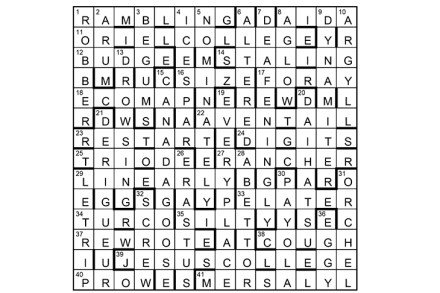
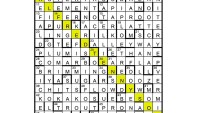
22D was TABLEWARE, and the quotation from Ralph Waldo Emerson reads: ‘The louder he talked of his honour, the faster we counted our spoons.
From our UK edition
22D was TABLEWARE, and the quotation from Ralph Waldo Emerson reads: ‘The louder he talked of his honour, the faster we counted our spoons.
From our UK edition
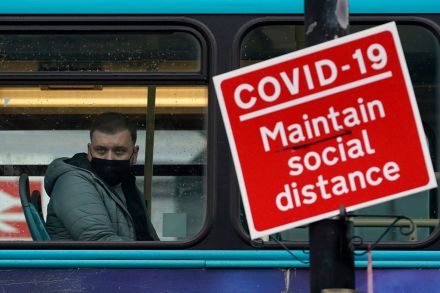
Made to measure The government started reviewing whether we should stay two metres apart while social distancing or whether one metre would do. What is a metre? — Since 1960 it has been defined as the distance travelled by light in a vacuum in 1/299,792,458th of a second. — But it was originally defined by the post-revolution French government as one ten-millionth of the distance between the Equator and the North Pole, on a meridian through Paris. — The signing of the Metre Convention on 20 May 1875 by representatives of 17 nations officially established the metre as an international unit of measurement. — If everyone in Britain joined the queue for Primark it would go 1.6 times round the Earth with social distancing at one metre, and 3.
From our UK edition
Hong Kong’s success Sir: Carl Heneghan and Tom Jefferson are right to compare the UK’s Covid-19 response with Hong Kong’s (‘Who cared?’, 6 June). We write as UK-trained emergency physicians, who have worked as specialists in both the UK and Hong Kong. In many ways, the economic and healthcare contexts are similar. The majority of care is delivered at minimal cost to the patient at the point of care; we share similar per capita GDP and human development indices. But we responded very differently to Covid. In Hong Kong, initially all patients with possible Covid were admitted to hospital until they tested negative. No one with suspected Covid was transferred to care homes. Healthcare staff, patients and the public routinely wear surgical masks.
From our UK edition
The Spectator brings you the latest insight, news and research from the front line. Sign up here to receive this briefing daily by email, and stay abreast of developments both at home and abroad. News and analysis The government has granted the NHS immediate authorisation to use dexamethasone, the 50p a day steroid that Oxford University researchers say can cut Covid-19 deaths by a third for patients on ventilators. Ross Clark has the details.Keir Starmer confirmed in PMQs today he believes it is safe for children to return to school. James Forsyth has the details below.More than half of businesses plan to make redundancies within three months of the government’s furlough scheme expiring.
From our UK edition
The Spectator brings you the latest insight, news and research from the front line. Sign up here to receive this briefing daily by email, and stay abreast of developments both at home and abroad. News and analysis Researchers at Oxford University have said that a £5 steroid can cut Covid-19 deaths by a third.The number of people claiming work-related benefits has jumped to 2.8 million while 600,000 people have lost their jobs since March. Kate Andrews has the details below.The Department for International Development is set to be merged with the Foreign Office, which will control the £14 billion aid budget. James Forsyth explains on Coffee House.
From our UK edition
The Spectator brings you the latest insight, news and research from the front line. Sign up here to receive this briefing daily by email, and stay abreast of developments both at home and abroad. News and analysis Shops reopen in England today, with long queues outside stores like Primark (see photo below). The government is considering lowering VAT to lure back nervous shoppers, according to the Times.More than one million people have not been able to receive any support from government coronavirus schemes, according to the Treasury Select Committee.Antibody tests used by the government could miss up to 25 per cent of coronavirus cases.Controls to stop the spread of Covid-19 in hospitals were relaxed at the height of the crisis, according to a report in the Telegraph.
From our UK edition
Home The government lurched uncertainly in dealing with coronavirus. Not all years in primary schools would after all return before September, and secondary schools perhaps not even then. A 14-day quarantine was imposed on people entering the country. Churches could open for individual prayer from 15 June, as could shops of all kinds. Pubs, restaurants and hairdressers would have to wait until 4 July at the earliest. Face coverings were made obligatory on public transport from 15 June. The number of workers furloughed reached 8.9 million, and 2.6 million more had made claims under the Self-Employment Income Support Scheme. The drug company AstraZeneca began to make a planned two billion doses of a coronavirus vaccine while trials proceeded on its safety and efficacy.
From our UK edition
The Colston chronicles Who, exactly, was Sir Edward Colston? Colston was born into a family of merchants and spent the first years of his career working for his father, trading cloth, wine, sherry and port around the western Mediterranean and North Africa. In 1680 he joined the Royal African Company which had been set up 20 years earlier by the Duke of York, the future James II, initially to exploit gold reserves in west Africa. In the 1680s it moved into the slave trade. Colston served one year as deputy governor of the company (the governor being James II). Colston also owned 40 of his own ships.
From our UK edition
There is a grim inevitability to the trickle of round-robin letters from scientists who feel aggrieved at the government’s handling of the Covid-19 crisis. Right from the beginning, the Prime Minister gave scientific advisers a very public platform at the heart of government. He realised that if it became necessary to impose the most severe restrictions on personal freedom any government has had to introduce in peacetime, it would help if the public could see policy was being shaped by experts who understood the threat. But as time has gone on it has become increasingly clear that there is no such thing as ‘the science’ — a mythical set of incontrovertible truths. Scientists are as divided as politicians and the general public on how to tackle Covid-19.
From our UK edition
Hong Kong’s future Sir: So we have a moral duty to protect the people of Hong Kong and guide them back to the golden world which existed before 1997 under British rule (‘Let them come’, 6 June)? Come off it. It is true that the hope behind the 1984 Joint Declaration was for HK to move gradually to stronger democratic forms, although under the direct authority of the government of the PRC, as it had been with the UK. What has destabilised Hong Kong and alarmed Beijing is digital grass-roots empowerment — the same thing that half the world’s governments are facing. In Hong Kong it appears in a particularly virulent form. The Chinese have their own way of trying to police it.
From our UK edition
The unclued lights Across are Shakespearean LORDS and the Down ones are LADIES. (The plant ‘lords and ladies’ is an ARUM.) First prize Giles Cattermole, Orpington, KentRunners-up Norman Watterson, Hillsborough, Co.
From our UK edition
The Spectator brings you the latest insight, news and research from the front line. Sign up here to receive this briefing daily by email, and stay abreast of developments both at home and abroad. News and analysis New Covid-19 analysis from the University of Cambridge finds the R number has risen throughout England due to ‘increasing mobility’ and ‘mixing households’. It is estimated to be around 1 in the North West and South West, and below one in all other regions of England.American employment rose by a staggering 2.5 million in May – the biggest monthly jobs gain in US history.Covid-19 infections peaked roughly five days before lockdown was announced in England and Wales, according to a new study. Details below.
From our UK edition
The Spectator brings you the latest insight, news and research from the front line. Sign up here to receive this briefing daily by email, and stay abreast of developments both at home and abroad. News and analysis Business Secretary Alok Sharma has self-isolated after showing symptoms of Covid-19 in the House of Commons. Around 25 people are diagnosed in London each day.The two-week quarantine for arrivals to the UK was not put before the science advisory group Sage, according to members of the body. Details below.However, while Tory backbenchers dislike the policy, exclusive polling for The Spectator reveals that 67% of the public support the two-week quarantine. Katy Balls has the details.Boris Johnson is to host a virtual vaccine summit today with 35 other heads of state.
From our UK edition
Home Primary schools were allowed to reopen but many did not want to. MPs voted to return to their physical presence in parliament. The government told people they were allowed to meet in gardens or on rooftops, up to the number of six, as long as those from different households remained two metres apart. About 2.5 million vulnerable people in England and Wales, who had been advised to stay at home, were now advised that those living alone might meet another single person out of doors. Rosie Duffield, the Labour MP for Canterbury, resigned as a whip after she was found to have gone for a walk with her current partner at a time that he was still living with his wife. Racing resumed. The Queen rode a fell pony at Windsor Castle.
From our UK edition
Covid deaths Has Covid-19 evolved to become less deadly?— Global infections reached a new peak on 29 May, with 125,473. The daily average for the past seven days is 108,965, 36% higher than in the week beginning 14 April.— However, deaths peaked at 8,429 on 17 April. The daily total for the past seven days is 3,902, 43% lower than in the week beginning 14 April.Source: Worldometers Quiet hospitals How did NHS activity change in the last quarter of 2019/20 compared with a year earlier?Hospital admissions -9.6% Elective admissions -9.7%GP referrals -13.9% Other referrals -8.
From our UK edition
Poor treatment Sir: My recent experience supports Dr Max Pemberton’s view that the NHS is letting down thousands of patients (‘Nothing to applaud’, 30 May). I am a 71-year-old living alone, with no symptoms of coronavirus. For several weeks I have, however, been experiencing severe pain in my left hip. A consultation with my GP diagnosed that I needed a shot of cortisone to reduce the inflammation, but I was told that the NHS was unable to offer clinical consultations due to a focus on the crisis. I was unable to cope with the pain any longer, so my daughter arranged a private consultation and an injection at a cost of £220. My heart problem is potentially more serious and is proving more difficult to resolve.
From our UK edition
In Minneapolis, where George Floyd was killed, a black entrepreneur had his bar destroyed before he even had a chance to open its doors for the first time. In Richmond, Virginia, a mob set light to a building, then blocked firefighters who were trying to save a child from the flames (-thankfully the child survived). These actions, repeated in cities all over America, are harmful in two ways: night after night, rioters are trashing their own backyard, destroying private property and putting innocent lives at risk. They are also diverting attention away from the legitimate grievances of peaceful protestors, whose efforts are far more laudable than looting.
From our UK edition
From 22 March 1986: They used to say that war is the ruin of serious soldiering. Too much disorder, too many accidents. So it could be said of the bubonic plague: it spoilt dying completely. There was so much to fear. Not merely a sudden, unexplained and incurable form of disease, since brevity of life and mysterious illness were commonplace; besides, there was no lack of plague-theories and official nostrums. What was truly dreadful was the subversion and mockery of all that was usually done to dignify the final moment, of the pains taken to celebrate death, and prevent him from doing irreparable harm to the community. So plague gave death a bad name, and for more than 300 years no Englishman could grow up without expecting to witness or suffer one outbreak or more before he died.
From our UK edition
Unclued lights suggested a section of the international radio communications alphabet: Bravo (VILLAIN: 6), Charlie (DIMWIT: 16), Delta (DEPOSIT: 19), Echo (MIMIC: 15A), Foxtrot (DANCE: 38), Golf (GAME: 36) and Hotel (BOARDING HOUSE: 1D). ZULU appears in the third row and was to be shaded. The title suggests ‘alpha’.
From our UK edition
The Spectator brings you the latest insight, news and research from the front line. Sign up here to receive this briefing daily by email, and stay abreast of developments both at home and abroad. News and analysis More Covid-19 deaths in Scotland have happened in care homes than hospitals, according to the National Records of Scotland. Details below.A report from the Education Endowment Foundation finds that the attainment gap caused by shutting down schools could wipe out a decade of gains from education policy. Ross Clark has the details below.The NHS test-and-trace programme is not tracing the contacts of at least 60% of people who test positive for Covid-19.MPs have voted to end voting from home.