Susanna Gross

Bridge | 29 June 2017

I’ve just returned from two weeks playing in the European Open Championships in Montecatini in Italy, and I’m so whacked I can hardly get out of bed. Playing pressurised bridge for nearly ten hours a day is exhausting, but try doing it under the relentless heat of the Tuscan sun, in a huge tent with inadequate air conditioning (three players actually collapsed). We all grumbled like mad, but of course I loved every second. I only wish I’d done better: I reached the A-final in both the mixed and women’s pairs, but played poorly each time, which was hugely frustrating for me and my poor partners.
Bridge | 15 June 2017

How is it possible to be assigned four ‘away’ matches on the trot? Strange, but that’s how it was for my Young Chelsea team, competing in the National Inter-Club Knockout: lots of driving down country lanes in Essex or Buckinghamshire in the gloaming, seeking out our opponents’ houses. At last, when it came to Round 5, we were assigned our first home match. We popped down the road to play — and were promptly knocked out by Tunbridge Wells. They had a strong team (Espen Erichsen and Norman Selway among them), but then we did too (Phil King and Mike Bell), so it was a blow — especially as I’ve loved partnering Phil. Phil is one of England’s top players, and a superb teacher and coach.

Bridge | 1 June 2017

It’s the funniest bridge story I’ve heard in ages. At the recent Lady Milne championship (the women’s Home Internationals), one of the English pairs was fined a point for slow play during their match against Ireland. The pair insisted that they hadn’t been particularly slow — indeed they’d bid to a grand slam rather quickly — and appealed to the Vugraph operator to support them. The operator replied sarcastically: ‘I certainly wouldn’t be proud of the way you bid that slam if I were you.’ To which one of the pair retorted: ‘Well we can hardly expect an Irish operator to be impartial.

Bridge | 18 May 2017

Long after my own team had been knocked out of this year’s Spring Fours in Stratford-on-Avon (the most prestigious and enjoyable tournament of the year), I was still glued to the action. And even more so when the two teams who made it to the final turned out to be two I normally root for — the Allfrey team (they’re all pals) and the wonderfully witty and charismatic Irish Open team (but don’t go drinking with them unless you have a strong head).   In the end it was Allfrey who won. (Don’t they always?

Bridge | 4 May 2017

Janet likes to tease me that whenever it’s my turn to write this column, it ought to be renamed The David Gold Experience. Well, maybe I do write about him a lot, but then again, he is one of the best players in the world. Anyway, this week I’ve decided to give David’s regular partner Mike Bell an airing. Mike is also a superb player, and I’m lucky enough to be on his Nicko team. ‘Nicko’ stands for national inter-club knock out — and we’re one of several teams representing London’s Young Chelsea. It’s the first time I’ve played in the event, and I’ve had great fun driving up and down the country with my teammates for our ‘away’ matches.

Bridge | 20 April 2017

Not many people can say they’ve partnered David Gold and been the better player — but I’m one of them. Admittedly, it was 20 years ago. He was 17 and had been playing for about a month when he decided to test his skill in the pound game at St John’s Wood bridge club. I’d been playing there for a couple of years. I can still vividly remember a sweet, shy, slightly ungainly boy who was unsure of his bidding and kept apologising, but who clearly had a big talent for the game. I managed to stay better than him for all of a week. Today David is, of course, one of the world’s top players, and my bridge guru. I’m lucky enough to play with him regularly, and I even carry a notebook to jot down his many tips on bidding and play.

Bridge | 6 April 2017

We all know how important it is to stop and think when defending a hand. There’s just one problem with that advice: sometimes it’s equally important not to stop and think. Every hesitation gives something away — and although it often doesn’t cost you anything, it can prove fatal. I regularly find myself having to decide in a heartbeat — before I’ve managed to work out what’s going on — whether I can afford to pause and consider my actions, or whether to duck smoothly and hope for the best.   Declarers who draw inferences from our hesitations are acting perfectly legitimately; it’s all part of the game. You may not be aware, though, of the extent to which some experts do it.

Bridge | 23 March 2017

Everyone knows him, but hardly anyone can pronounce his name — which is why Jacek Pszczola is universally called Pepsi. He’s Polish, of course, but lives in the US, and is one of the world’s most successful — and popular — bridge pros. He does, however, have one very disconcerting habit. As soon as he’s dummy, he opens a dog-eared crime thriller and starts to read — it doesn’t matter who he’s partnering, or how important the tournament. The first time I saw him do this, he was sitting opposite a client and I thought it was incredibly rude. But she didn’t seem to mind — and nor, it turns out, does anyone else.

Bridge | 9 March 2017

There are plenty of bridge professionals who believe in flattering lesser players (whether they’re clients, friends or spouses) by exaggerating how well they play, or claiming their mistakes are perfectly understandable. Not so Espen Erichsen. Espen is a great player and I like him enormously, but he’s also the most blunt-talking man I’ve ever met. More than ten years ago we used to play together a bit, and I’ve never forgotten the time I mistakenly ducked a trick in defence. ‘Let me give you some advice,’ he said sternly. ‘Never try to do anything clever. It will always backfire.’ Last week, I played against him at the Young Chelsea. I had a difficult hand to bid, but my partner and I fumbled our way to a good slam.

Bridge | 23 February 2017

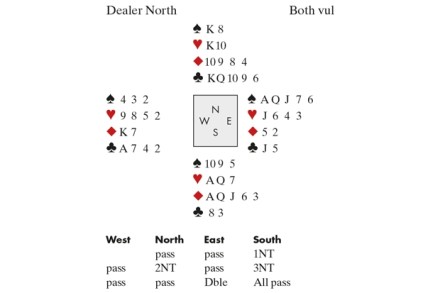
If there’s one tournament I’d really like to play in, it’s the Cavendish in Monaco, the largest money bridge tournament in the world. Last Sunday, the winners of the main auction pairs, the Bulgarians Diyan Danailov and Jerry Stamatov, scooped the players prize of €16,000, and whoever bought them for €12,000 won €100,000. But it’s not just the money: what really sets this tournament apart is the thrillingly high standard. Even great players sometimes err — at this level, though, the smallest slip-ups are pounced on without mercy. This deal grabbed my attention while I was watching online — the same contract at three tables, a defensive mistake at each: At table 1, Zia Mahmood was declarer. West led the ♠K.

Bridge | 9 February 2017

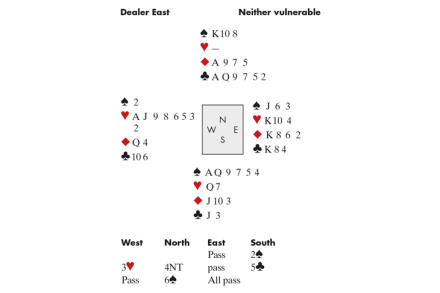
It’s so hard not to whinge when you’ve had bad luck at bridge — it’s just one of those things you’ve got to get off your chest. One thing’s for sure, though, if you’re going to be a moaning Minnie, pick an example that proves your point, not one that betrays the limits of your skill.   I made that mistake the other day. Sally Brock and I had failed to qualify for the Lady Milne (and, by the way, many congratulations to Fiona Brown and Helen Erichsen, who won the trials). Of course, I made the usual quota of mistakes, but we both felt we’d been unlucky. On the last round, I was the only person to get a problematic lead against 6♠ — and it seemed typical of the whole weekend.

Bridge | 26 January 2017

You can always tell a beginner, or a poor player, at the bridge table — they’re the ones who start cashing their tricks as soon as dummy comes down. Any reasonable player knows the importance of stopping to think: of counting winners and losers, and working out a strategy. But it’s the mark of a really good player to never entirely trust their first thoughts. As Tom Townsend once advised me with his usual pithy wit: ‘Think of a plan. Now think of a better one.’ Eric Rodwell makes precisely this point in his brilliant book The Rodwell Files, which I’m reading at the moment. He warns us to double-check our decisions to ensure we haven’t missed something — maybe something an opponent can do to foil us, or simply a better plan.

Bridge | 12 January 2017

There’s a bit of a ruckus going on in the bridge world at the moment; a lot of people are getting very hot under the collar. The issue is this: should the laws of the game always be enforced, or should players sometimes waive them in favour of creating a friendlier, more enjoyable atmosphere? Many of England’s star players — David Gold, Artur Malinowski and Tony Forrester among them — are fiercely opposed to calling for ‘rulings’ at the table unless it’s strictly necessary: they feel it goes against the spirit of the game, and deters weaker players from playing in tournaments. But others argue that rules are rules, and must be applied consistently, not according to an individual’s whims.

Bridge | 29 December 2016

There are an awful lot of bridge babies in the world — that is, babies born to mothers so addicted to the game that they’re still playing when they go into labour. I recently learnt that the actor Jack Lemmon was one: his mother Mildred was playing in New York’s Ritz-Carlton hotel when her contractions began. She was rushed to hospital but didn’t quite make it — Jack was born in the hospital lift. My friend Lou Hobhouse can beat that: not only was she at the bridge table hours before giving birth to her first child — she was back just hours afterwards. Cradling her cards in her arms, she quipped that having a baby was a cinch compared to playing in a redoubled slam.

Bridge | 1 December 2016

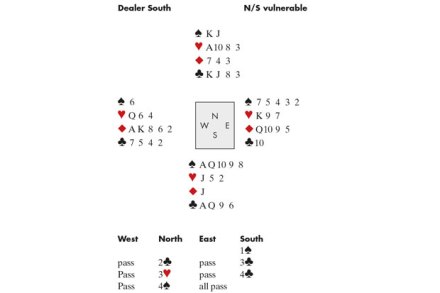
It was the best hand I’d had all year — and what’s more, I picked it up while playing rubber bridge for money at TGRs. The pound signs flashed before my eyes: there was no way I was stopping short of game, and the merest squeak from my partner would get me slamming. Well, you can guess what happened next: the bridge gods were having a laugh. In a few short minutes the hand turned to ash. Not only did I go down, cursing my bad luck, but one of my opponents happened to be the brilliant Thor Erik Hoftaniska, whose sharp analytical brain was able to point out almost instantly that I could in fact have made it. I was South: 2♣ was artificial and strong; 2♦ was artificial and ‘waiting’; 3NT showed a minimum of 25 points.

Bridge | 17 November 2016

Have you ever felt that none of your partners are on the same wavelength as you? Despite regularly partnering the world’s top players, Zia Mahmood often jokingly moans (well, semi-jokingly) that he’s made a subtle or clever bid which has fallen on deaf ears. But that shouldn’t surprise anyone: whether he’s bidding or playing, you can always rely on Zia to do something imaginative and unexpected. Zia was on the winning Lavazza team at the recent HCL International Bridge Championship held in New Delhi last month (India’s biggest bridge tournament, with a $200,000 prize pot). His partner faced the following lead problem and Zia gave it to various players, including me. It came with the warning: ‘So far no one has got it right.

Bridge | 3 November 2016

My ten-year-old football-loving son thought I was making some silly joke when I told him last weekend that I was off to Manchester to play in the Premier League. No, I said, I’m serious: that’s what it’s called in bridge too. I’m playing in the Second Division. Three weekends of bridge, and at the end the top two teams get promoted to Division 1. It’s a tough field: many of the star names of English bridge are competing, even in Division 2, and we’re currently lying 7th out of 10. There are six of us in our team, and we’re taking turns to play, swapping partners according to who’s available. Last weekend I played with Peter Taylor: we took the train together and spent two solid hours discussing our system.

Bridge | 20 October 2016

I felt like an absolute hypocrite the other week. Sally Brock’s team had just beaten Alexander Allfrey’s in the semi-finals of the Gold Cup. They were due to go face to face against Simon Gillis’s team in the final the next day. I texted Sally: ‘Good luck, hope you win!’ Later that afternoon I bumped into Simon, who is also a friend, and heard myself blurting out: ‘Good luck, go get ’em!’ Well, I meant it both times; man cannot live by logic alone.   Anyway, the following day I decided to go and watch some of the match at the Young Chelsea; naturally I was feeling a little anxious about being expected to root for either side.

Bridge | 6 October 2016

It often strikes me that learning to bid is just like mastering a language. As you take on new conventions and deepen your understanding of what different bids convey, you can begin to communicate properly. Things are complicated by the fact that there are so many different dialects — how much simpler life would be if we could all play the same system and the same conventions, instead of having to agree on them afresh with every new partner. All the effort is worthwhile, though, when you realise the eloquence that can be achieved. At the top level, well-honed partnerships are able to convey their hands so accurately that they may as well just show each other their cards. Take this deal from the 2015 World Senior Teams Championship.

Bridge | 22 September 2016

I’ve been in a bridge bubble in Wroclaw for the past two weeks, playing in the World Bridge Games. I competed in the Mixed Teams then the Mixed Pairs, playing against nations from across the world, each wearing their own distinctive shirts (Japan’s pink and blue gets my vote for the most stylish). I wish I’d made fewer mistakes and done better, but it was a privilege to be there among the greats, from veterans like Hamman, Meckstroth and Versace, to younger stars like Dennis Bilde and Justin Lall. And I’m firm in my resolve to take everything I can from the experience, up my game, and try again at the first opportunity. Two nations emerged victorious: the Netherlands, who won the Open and Mixed Teams, and the USA, who won the Women’s and Seniors’.