Stuart Jeffries

Stuart Jeffries is a former Guardian journalist and author of Mrs Slocombe’s Pussy and Grand Hotel Abyss.

We all need to be let alone —not just Greta Garbo

‘You’re never alone with a Strand,’ went the misbegotten advertisement for a new cigarette in 1959. What the copywriter didn’t realise is that smokers often smoke to be alone. As Mass Observation had reported a decade earlier: In an increasingly gregarious world, where fewer and fewer habits and pastimes are entirely individual, the cigarette remains for most people a pleasure that, whatever its social significance, can be enjoyed in entire solitude, and a pleasure that remains entirely individual. At the time, 80 per cent of British men and 40 per cent of women were regular smokers. Smoking was not just a means of inhaling death and of escaping the dead hand of others’ sociability, but briefly put the unbearableness of life behind a smoky veil.

Radio 4’s new H.P. Lovecraft adaptation will give you the chills

Of all the many things I’ve learned from the radio so far this decade, the most deranging is that the universe is the dream of the god Azathoth. Not unreasonably, Azathoth yearns to wake up and visit his creation. In The Whisperer in Darkness (Radio 4), a crusty coven of drug-addled neopagans seek to realise this wish by summoning Azathoth through a mystic portal they’ve opened — just off the B1084 in Suffolk. Fools! Don’t they realise that they risk unleashing forces they don’t understand? Waking Azathoth would mean there will be no dreamer to dream the dream and so not just Suffolk but all reality would be obliterated as a result.

Enchanting but outrageously expensive: Tutankhamun reviewed

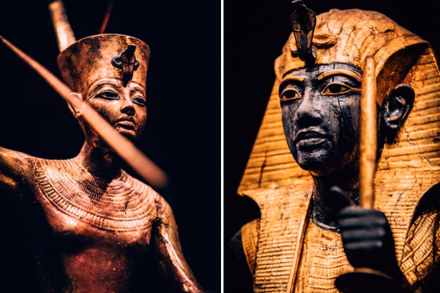
Like Elton John, though less ravaged, Tutankhamun’s treasures are on their final world tour. Soon these 150 artefacts will return permanently to Egypt. Nearly a century after Howard Carter disrupted their 3,000-year rest in the Valley of the Kings, they are to be retombed in the new Grand Egyptian Museum in Giza. But first they undergo their final ordeal, an outing in London. The genius of the Saatchi show, curated by Tarek El Awady, is to simulate the trials the pharaoh’s mummified corpse endured in the netherworld. After having his brain pulled out through his nose, Tutankhamun had to pass through 12 gates guarded by snakes, crocodiles, vultures and supernatural beasts.

Meet Congo, the Leonardo of chimps, whose paintings sell for £14,500

Three million years ago one of our ancestors, Australopithecus africanus, picked up a pebble and took it home to its cave, most likely because the pattern of lines and holes on its surface looked beguilingly like a face. Perhaps this was the birth of art. Or perhaps not. Maybe art arrived in this world later. One day in 1940 Marcel Ravidat was walking in the Dordogne when his dog, Robot, fell into a hole. Robot had stumbled across the entrance to a network of caves containing more than 600 wall and ceiling paintings of horses, deer, aurochs, ibex, bison and cats dating from 17,000 to 15,000 BCE. The discovery of Lascaux’s caves in the era of the Holocaust and Hiroshima resonated for many.

‘The only place I can’t get my plays on is Britain’: Peter Brook interviewed

‘Everyone of us knows we deserve to be punished,’ says the frail old man before me in a hotel café. ‘You and I for instance. What have we done this morning that is good? What have we done to resist the ruination of our planet? Nothing. It is terrifying!’ Peter Brook fixes me with blue eyes which, while diminished by macular degeneration that means he can make me out only dimly, shine fiercely. But for the genteel surroundings and quilted gilet, he could be Gloucester or Lear on the heath, wildly ardent with insight. ‘Think of Prospero. He’s a bad character, hell-bent on revenge for his brother’s wrong, a colonialist who dominates Caliban and the rest of the island.

A cast of Antony Gormley? Or a pair of giant conkers? Gormley’s RA show reviewed

While Sir Joshua Reynolds, on his plinth, was looking the other way, a little girl last Saturday morning was trying to prise a littler sculpture from the pavement of the Royal Academy’s courtyard. For all its tininess — from a distance the sculpture’s curvy lumps, 12 x 28 x 17cm, resemble horse droppings a security guard might dig into their rose bed — she couldn’t shift it. ‘Iron Baby’ (1999) is a solid iron cast made by Sir Antony Gormley of his six-day- old daughter abased before the Enlightenment temple of art, buttocks facing Piccadilly in eloquent critique. But for the Instagramming hordes, you might step over her heedlessly on the way to the exhibition, a survey of Gormley’s works from the late 1970s to today.

A dog’s life is infinitely superior to our own — so let’s embrace it

The Dominican friar Henry Suso was once carving Jesus’s name in his chest with a knife when he noticed a puppy playing nearby. Seeing the little dog amusing itself with a dirty cloth gave the friar an epiphany. Suso realised that redemption is granted not to those who mortify their flesh — for to do so is merely to glorify oneself. Rather, one shows love for God by living in grace, simplicity and sportive celebration of the world. Like dogs. Those who have seen dogs in action might well demur. Once, in a pub, I was giggling with a friend as the publican’s Welsh spaniel humped the leg of a man at the bar. ‘More drinks?’, my friend asked. As she placed the order, the spaniel transferred his allegiance to her leg.

The poetry of sewers

‘Welcome,’ says our guide Stuart Bellehewe, with an imperious sweep of his arm, ‘to the cathedral of shit.’ Before us rises Abbey Mills Pumping Station in all its grade II*-listed glory. It arose on east London’s marshes in 1868, giving Victorians a fecally fixated premonition of postmodernism’s fetish for mashing up architectural styles. Observe, urges Stuart, the Russian Orthodox-style cupola surmounting the cathedral, clearly quoting church design. Savour, he urges, the gothic Venetian design of the arched windows and of the corkscrew twist incorporated into the rainwater downpipes. The steeply pitched mansard roofs evoke Flemish designs; brass and copper florets on the doorways are derived from Celtic art. Until 1940, there was more.

‘I merge into the background, me’

‘I live completely anonymously,’ whispers Jim Broadbent down the phone from Lincolnshire. Nonsense, I counter. You’re one of the most recognisable actors in this united luvviedom. ‘Am I?’ he asks gently. Oh come on. You’re Bridget Jones’s dad, Del Boy’s arch-enemy Roy Slater, Lord Longford campaigning for Myra Hindley’s parole, dotty antiques-shop owner Samuel Gruber in the Paddington films, Game of Thrones’s Archmaester Ebrose, testy but lovable W.S. Gilbert in Mike Leigh’s Topsy-Turvy, and the blackmailer who unacceptably shakes down Maggie Smith’s eponymous Lady in the Van.

Oddballs and outcasts

Charles Kay Ogden once proposed that conversations would be conducted more efficiently if participants wore masks. Apart from confirming the hypothesis that Britons don’t care much for philosophising but rarely miss an excuse to dress up, this made me think if only Theresa May had visited Brussels as Darth Vader to meet Jean-Claude Juncker in his Princess Leia mask, Brexit would have been sorted out years ago. Ogden, who not only translated Wittgenstein but wrote a book offputtingly called The Meaning of Meaning, also had the idea that English could be boiled down to 850 words — which, as you know, is 830 more than you’ll need to take part in a football phone-in.

No shrinking violet

‘I have fallen in love many times in my consulting room,’ writes the psychotherapist Jane Haynes. ‘I do not mean that I want to have an explicit sexual relationship,’ she clarifies. That said, she describes herself as the Desdemona of the consulting room, falling in love as she listens to ‘someone share the pity of their history’. And like Othello’s stories that titillated Desdemona, Haynes’s narratives of her and her patients’ painful lives are compelling, if passing strange, particularly given that her profession is usually reticent about what goes on behind closed doors between shrink and shrunken.

The great seducer

Peyrot, the chef at Le Vivarois in Paris, had a fascinating theory of how one of his regulars, the otherwise taciturn psychoanalyst Jacques Lacan, communicated. ‘He was convinced that the farts and burps which Lacan, as a free man, did not restrain in public, were meant to signal to Peyrot the two syllables of his name,’ recalls Catherine Millot. A translator’s footnote helpfully explains that in French pet means fart and rot burp. I love this story as told in this beguiling memoir by Lacan’s last lover — and not just because it evokes a time when deference to Gallic intellectuals was such that even their airy nothings were submitted to bravura semiotic analysis.

Snatching victory from the jaws of defeat

Lord Woolton put it best: ‘Few people have succeeded in obtaining such a public demand for their promotion as the result of the failure of an enterprise.’ By that, the Tory grandee meant that in the spring of 1940 Winston Churchill managed to use Britain’s grotesque military cock-up in Norway, for which he was responsible, to supplant Neville Chamberlain. Churchill sidelined Chamberlain’s most likely successor, the foreign secretary Lord Halifax. He overcame Tory backbench distrust. He even got Labour on side, though its leaders had long considered him the class enemy incarnate.