Stephen Daisley

Stephen Daisley

Stephen Daisley is a Spectator regular and a columnist for the Scottish Daily Mail

The problem with ABC’s Matt Gutman

From our UK edition

Matt Gutman has the hairstyle of Anderson Cooper and the literary style of Danielle Steel.  In a special report on the Charlie Kirk assassination, ABC News’s chief national correspondent wistfully described text messages between the suspect, Tyler Robinson, and his roommate and alleged boyfriend. The exchanges were, Gutman gushed, ‘very touching in a way that I think many of us didn’t expect’ and ‘a very intimate portrait into this relationship’. Gutman quoted Robinson’s sweet nothings (‘my love’ and ‘I want to protect you, my love’) and mused on a ‘duality’ between the aggravated murder charge and ‘on the other hand, he was, you know, speaking so lovingly about his partner’.

Six questions the National must answer

From our UK edition

Scottish daily the National is known for its inimitable approach to journalism. The mainstream media bombards SNP ministers with impertinent questions about missed NHS targets, widening attainment gaps, and delayed ferries. The National, on the other hand, does proper reporting, like its front page denouncing the inclusion of Reform on a Question Time panel, the hard-hitting coverage of a Tory politician’s quip about Nicola Sturgeon’s hairdo, and an uncompromising expose on a Labour candidate’s ‘deeply disrespectful’ attitude towards the Gaelic language. While other newspapers fixate on the actions of government, the National is out there bravely holding the opposition to account.

Britain needs a First Amendment

From our UK edition

Well, if they’re arresting comedians, at least Nish Kumar is safe. Graham Linehan, not so much. The British like to sniff that Americans don’t get irony. Arresting a comedian fresh off the plane from the US after months of dismissing US concerns about freedom of speech is one way to teach them. Not only was Linehan detained by the police for tweets attacking an establishment-approved ideology, he was subsequently bailed on the condition that he not post any further tweets. Britain is never beating the allegations.  I’m a Glinner (his X handle) sceptic.

How the West infantilises Palestinians

From our UK edition

Belgium will become the latest western country to recognise a Palestinian state. Its foreign minister Maxime Prevot cited ‘the violence perpetrated by Israel in violation of international law’ and Belgium’s obligation to ‘prevent any risk of genocide’. He maintained his government was not ‘sanctioning the Israeli people’ but ‘ensuring that their government respects international and humanitarian law’. Belgium, he added, was ‘taking action to try to change the situation on the ground.

Farage, flags and the forgotten English

From our UK edition

The flag-raisings in towns and cities across the country are an inevitable consequence of elites’ seeming preference for every flag but England’s. High-status flags: Ukraine, Palestine, Pride. Low-status flags: Union Jack, St George’s Cross. It is possible, of course, to favour multiple flags. Although a Scot, I am quite partial to St George’s Cross, a simple emblem that stirs up a thousand years of English history – of blood and bravery, trial and triumph – in a crisp, snapping flutter of its folds. The Ukraine flag is the banner of a people who, rather than surrender their homeland, have chosen to fight to the death for it. However you feel about your compatriots flying another country’s flag, Kyiv’s is at least an honourable one to fly. Honour.

Ed Davey should stick to his silly stunts – not lecture us on Gaza

From our UK edition

Ed Davey’s got this Middle East business figured out. The Liberal Democrat leader has tweeted — because, honestly, what else is there to do as Lib Dem leader other than tweet? — his latest insight into the Gaza war: ‘Now the Hamas terrorists behind the October 7 atrocities are trying to erode support for recognition of a Palestinian state by falsely claiming it would be a victory for them. Hamas do not represent the Palestinian people and have no future in Gaza with a two-state solution.’ I know who we can ask about what the Palestinians really think. Let’s ask…the Palestinians That’s nice, Ed.

Kate Forbes showed real bravery

From our UK edition

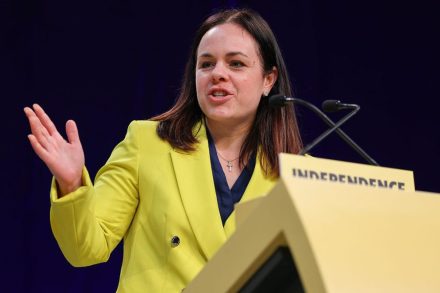
There is a certain worldly cynicism aroused by the announcement that a politician is stepping down to spend more time with their family. It was for a long time the refuge of MPs who had earned themselves an entry in the News of the World, the Who’s Who of romeos, rogues and reprobates, for their activities with ladies – or young gentlemen – of the night. Less commonly, it was regarded as an admission that someone could not hack it or was frustrated by their slow progress up the greasy pole. After all, no one wants to quit politics. Contra the cynics, Kate Forbes. Scotland’s deputy first minister will stand down from Holyrood at next May’s elections, having somehow crammed a whole political life into ten tempestuous years.

There is no escaping politics with Palestine

From our UK edition

Foreign relations are among the most political functions of a government. Ministers favour or disfavour other states based on calculations about which relationships might better serve the national interest. Human rights violations are condemned here, while a blind eye is turned there. Dictators are treated as democrats and democrats as dictators depending on the diplomatic needs of the day. It’s a dishonest, venal, hypocritical business conducted by people with almost no morally redeeming characteristics. Like I said, it’s politics.  Too many state actions are compelled – or claimed to be compelled – by law or judicial interpretation of the law.

Israel should make its own statehood claims

From our UK edition

Britain intends to follow France, and now Canada, in recognising a Palestinian state in September. I’ve already set out the practical and theoretical problems inherent in such a policy, not least the absence of a functioning Palestinian state to recognise. But we shouldn’t lose sight of another effect of this policy: in recognising a state which claims territory also claimed by Israel, Britain, France and Canada harm Israel’s sovereign interests in territories where Jewish self-government can be traced back three millennia. This is one of the most inflammatory acts possible in statecraft, one which Whitehall has noticeably refrained from in other conflicts.

Do Donald Trump’s fans like South Park or not?

From our UK edition

Eric Cartman, the antihero of South Park, is a disgusting bigot who mocks disabled people, demeans women and says hateful things about Jews. When the series debuted in 1997, much of what offended parents, educators and religious groups came out of the mouth of this school-aged Alf Garnett. Later, it was the forces of coercive progressivism who bridled, especially at its derision of the trans creed. Suddenly, the median South Park disapprover was Emily, 30 ans, who worked in HR, actually met a black person once, and renamed her dachshund because ‘Dumbledore’ made her feel complicit in JK Rowling’s gendercide. Now the series is displeasing MAGA groupies after its 27th season debuted with a mild satire of Donald Trump.

The problems with a state of Palestine

From our UK edition

France intends to recognise a state of Palestine at the United Nations, which I’m sure will be followed by UK recognition of the same. We can be sure of this because the UK does not have an independent foreign policy when it comes to the Middle East. Inside or outside of the European Union, London’s stance on Israel and the Palestinians has become indistinguishable from the position of the European Commission. The European Commission simps for the Palestinians and Britain simps for the European Commission. I take the somewhat contentious view that Britain should simp for itself, which is why in my occasional (read: incessant) Coffee House posts recommending, beseeching, UK recognition of Jerusalem as the capital of Israel I have made a case based on the British national interest.

It’s time to overthrow the lanyardocracy

From our UK edition

The trials of Sandie Peggie are a parable of where power lies in a country when lies are power. Peggie is a nurse from Fife, by all accounts a hard-working professional dedicated to her vocation and her patients. Things went awry, however, when she objected to undressing in a changing room in front of Dr Beth Upton, a male medic who identifies as a woman. If that sentence sounds absurd, that’s because it is, but we are supposed to pretend otherwise – especially if we want to be considered good people. Dishonesty is the best policy. Following a complaint from Dr Upton, Peggie was suspended by NHS Fife in January 2024, and she took the health board and Dr Upton to an employment tribunal.

Why Ross Greer would be good for the Scottish Green party

From our UK edition

Ross Greer is for Palestine, trans rights and riling up the Daily Express, making him the ideal candidate to lead the Scottish Greens. At an event in Glasgow today, the West Scotland MSP put himself forward as a successor to Patrick Harvie, who is standing down after 17 years at the helm of the environmentalist party that occasionally takes an interest in the environment. Under Harvie’s leadership, the Greens have prioritised cultural and identity politics over economics and ecology, helping to push the Gender Recognition Reform Bill through Holyrood and press for free bus travel for asylum seekers (an idea pinched by the SNP-run Scottish government).

What was missing from the 7/7 commemorations

From our UK edition

Something was scarce, if not absent, in the commemorations of the 7/7 Islamist attacks yesterday, and that is the fact that these were Islamist attacks. The word did not appear in the Prime Minister’s official statement to mark the anniversary. Keir Starmer commended ‘the unity of Londoners in the face of terror’, but what kind of terror? Far-right? Far-left? The IRA? Eco-warriors? The trouble is that if you specify the nature of the attacks, you specify the nature of the perpetrators. They were: Mohammad Sidique Khan (born in Leeds, parents from Pakistan); Shehzad Tanweer (born in Bradford, parents from Pakistan); Hasib Hussain (born in Leeds, parents from Pakistan); and Germaine Lindsay (born in Jamaica, family converted to Islam after settling in Yorkshire).

Rachel Reeves, Winston Churchill and a short history of crying in politics

From our UK edition

The scenes of a tearful Rachel Reeves are all anyone is likely to remember from yesterday’s Prime Minister’s Questions. The Chancellor wept openly, her expression distraught; it was difficult to watch. The death of Princess Diana and the extraordinary outpourings of public grief that followed marked the end of stiff-upper-lip Britain. Vestiges remain, however, and we still become uncomfortable at the sight of the prominent and powerful brought to tears. It triggers a Pavlovian response in much the same way that the mention of religion in polite company has our toes scrunching in our shoes, as we try to dig a hole to escape the awkwardness. The tearful politician has been with us for some time In fact, the tearful politician has been with us for some time.

Being a Christian isn’t easy

From our UK edition

Spare a thought for Chris Coghlan, who has learned to his horror that not only is the Pope a Catholic, his own priest is one too. The Liberal Democrat MP, who voted to legalise assisted suicide, attends St Joseph’s Catholic Church in Dorking. He complains to the Observer that Father Ian Vane ‘publicly announced at Mass that he was… denying me Holy Communion as I had breached Canon Law’. Coghlan believes this represents a ‘completely inappropriate interference in democracy by religious authorities’. If you’re not a Catholic, at this point you’re thinking one of two things: ‘No thanks, I’ll leave the Papists to their internal disputes’, or ‘Canon Law would be a cracking name for a courtroom series about a priest turned barrister’.

Nigel Farage and George Galloway share a common problem

From our UK edition

A more gracious person would refrain from saying, ‘I told you so’, but I’m not a gracious person. So, as George Galloway announces his backing for another Scottish independence referendum, allow me to say – nay, crow – I told you so.  Galloway, leader of the Workers party, says he and his party ‘support the right of the Scots to self-determination’ and that ‘the time for another referendum is close’. He adds: ‘Speaking personally, I can no longer support the British state as presently constituted.

Trump is making the world a safer place

From our UK edition

Strength works. It’s a foreign policy lesson that sounds too simple to be true and too unequivocal to be wise, and yet there is much truth and a good deal of wisdom in it. Strength does not mean wanton thuggery or hubristic swagger, it must be considered, well-regulated and guided by reflection and sober analysis. But when it is properly deployed to clear and realistic ends, strength can achieve results that negotiation, compromise and avoidance cannot. Strength, when put in service of just goals, can sometimes be the preferable moral option, checking threats, risks and baneful intentions.

Stephen Fry could do with a lesson in ‘radicalisation’

From our UK edition

Stephen Fry has accused J.K. Rowling of being ‘inflammatory and contemptuous’, ‘mocking’ and adding to ‘a terribly distressing time for trans people’. Fry, who narrated the Harry Potter audiobooks, has damned their author for saying ‘cruel’ and ‘wrong’ things and for failing to ‘disavow some of the more revolting and truly horrible, destructive – violently destructive – things that people say’. He suspects that she’s been ‘radicalised by Terfs’, charged her with kicking up ‘a hornet's nest of transphobia which has been entirely destructive’, and dismissed her as ‘a lost cause’.

How the SNP wrecked Scottish education

From our UK edition

A small but not insignificant morsel of data on the state of education after 18 years of the SNP running Scotland. New figures show the gap between the poorest and wealthiest school leavers has widened to a five-year high. In the least deprived areas, just 3 per cent of school leavers fail to go to a ‘positive destination’, the Scottish Government’s term for higher or further education, training, employment or voluntary work. Yet in the most deprived areas, areas like the former Lanarkshire industrial town from which I’m writing this, more than one in ten children leave school to what is euphemistically called ‘other destinations’, i.e. unemployment.