Simon Winchester

The cartographer’s power to decide the fate of millions

From our UK edition

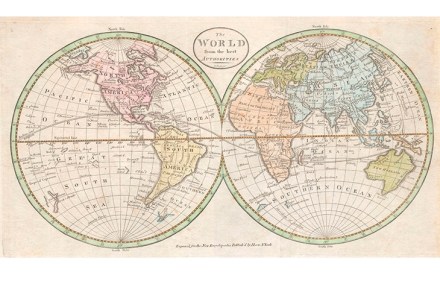
I had searched for it for the better part of 20 years. An enormous trove of lost maps, the 800 or so sheets of an immense and madcap Victorian project known as the International Map of the World at the Scale of One to a Million. It had taken its makers 70 years of costly surveying, engraving and printing before it was abandoned unfinished in the 1980s.  An original set of these stunningly lovely British-made maps was first deposited in the swanky Manhattan offices of the American Geographical Society. But, after falling on hard times, the AGS had to move to smaller digs in Brooklyn and had no room for the IMW collection. The set then seemed to vanish from the face of the Earth that once it had sought to chart.


The invisible boundaries of everyday life

From our UK edition

Norman Shrapnel, the wise and kindly parliamentary correspondent of the Guardian back in the day when it was a readable newspaper, tried never to give a book a bad review. He liked to say that anyone who had taken the time and trouble to write about anything at length deserved to be given the benefit of the doubt, and so he generally dipped his reviewer’s pen in honey rather than vinegar. I must say that on picking up Maxim Samson’s Invisible Lines, I felt quite otherwise. I wanted at first (an important caveat) to paint my laptop’s entire screen with vitriol. Within two pages I’d begun to loathe the author’s use of ‘foreground’ as a verb (technically he is not wholly wrong, just wanting in style).

How 19th-century gold rushes led to a distrust of China

From our UK edition

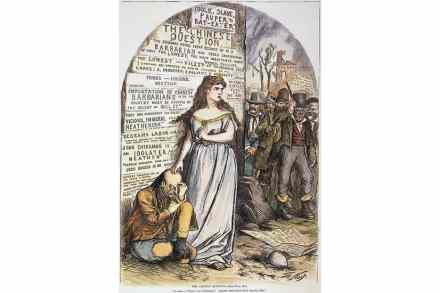
For a brief moment three summers ago it seemed that the clear Idaho air wafting through the Sun Valley Literary Festival had become tainted with the smoke and soot of Nuremberg. Here was Thomas Friedman, bloviator-in-chief to America’s chattering classes, standing before a rally of thousands, delivering a powerful philippic about the ascent of the Asiatic East. As he warmed to his theme, he decided for some messianic reason to demand that his audience chant the phrase that he suggested now dominated the American economic landscape. Come on, he urged like a latter-day Elmer Gantry, yell out with me the words: ‘Everything. Is. Made. In. CHINA!

An orange or an egg? Determining the shape of the world

Thirty-two years ago, the young Nicholas Crane, who would go on to become one of England’s most esteemed television geographers, set out to woo a young woman by spiriting her off to the unfailingly romantic landscape of Chimborazo and Cotopaxi. The couple spent their high-altitude idyll walking the hills in hobnail boots, making river passage in dugout canoes and boarding a Quito-bound steam train through the Andes, run by the estimable Empresa de Ferrocariles Ecuatorianos. Their journey had its moments: at one stage both parties were to be found at 13,000 feet, crusted with ice and huddled overnight from the gales inside a pair of plastic trash bags; they then got themselves lost for a while among a wilderness of huge and very active volcanoes.

crane

An orange or an egg? Determining the shape of the world

From our UK edition

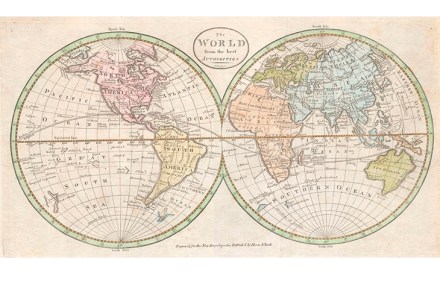
Thirty-two years ago the young Nicholas Crane, who would go on to become one of England’s most esteemed television geographers, set out to woo a young woman by spiriting her off to the unfailingly romantic landscape of Chimborazo and Cotopaxi. The couple spent their high-altitude idyll walking the hills in hobnail boots, making river passage in dugout canoes and boarding a Quito-bound steam train through the Andes, run by the estimable Empresa de Ferrocarriles Ecuatorianos. Their journey had its moments: at one stage both parties were to be found at 13,000 feet, crusted with ice and huddled overnight from the gales inside a pair of plastic rubbish bags; they then got themselves lost for a while among a wilderness of huge and very active volcanoes.

Towards a technological utopia

From our UK edition

The rebranding of John Browne has been a long and, to those of us living overseas, instructive affair. Readers will recall the unedifying circumstances leading to his dismissal from BP ten years ago, when the country’s usual gang of disagreeable and unkindly figures such as Paul Dacre and Tom Bower were snapping busily at his heels. Much has happened since. In the classic style of the British establishment, his disgrace has been followed by a steady stalactitic drip of preferments and praise, committees and chairs and board memberships, much aided by quires of unctuous journalism, most tending to focus on the impeccable taste and artistic judgment (not to say financial savvy) with which he has furnished and stocked his digs in the fashionable quarters of London and Venice.