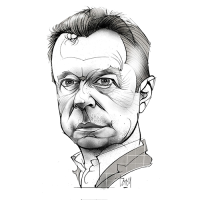
Sean Thomas

Sean Thomas

Sean Thomas is a bestselling author. He tweets from @thomasknox.

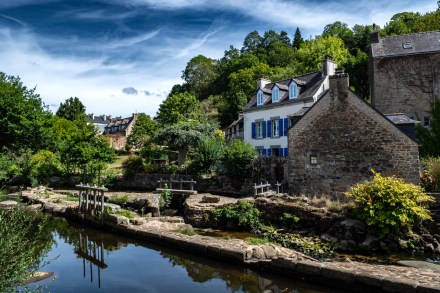
The forgotten forests of Italy

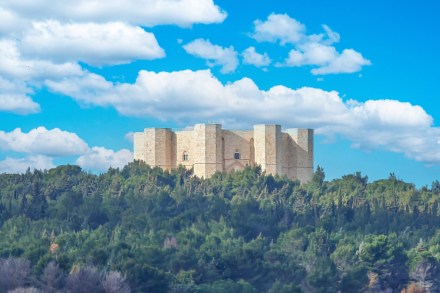
Everyone knows that Italy is a boot. Many people know that the boot has a heel – the rocky, sunburnt region of Puglia. Perhaps a few know that the heel has a spur – the Gargano Peninsula. Yet virtually no one knows that the Gargano hides a magical woodland – the Foresta Umbra – a national park and treasure. And one of a dozen or more Italian parklands that are practically unvisited by foreign tourists.

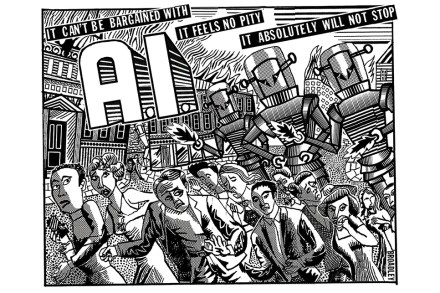
AI will change everything – so why is the election ignoring it?

Imagine if you somehow knew a war was coming in the next few years. Imagine if you knew this war would change societies, transform economies, and possibly even endanger humanity. Now imagine Britain held a general election, with that certain knowledge of imminent turmoil, and no one mentioned it, and instead the politicians waffled on about stealth taxes, low traffic neighbourhoods, and making energy drinks harder to obtain for children aged 15 and 3/4. Not only is this raging silence insane, it is bizarrely, recklessly irresponsible That would be mad, right? And yet that is what we are doing in Britain today, in regards to the looming revolution that is Artificial Intelligence. We are simply not talking about it.

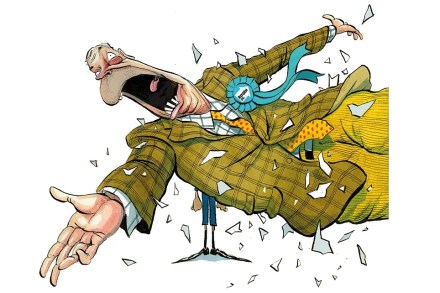
The Farage factor

45 min listen

This week: The Farage factor. Our cover piece looks at the biggest news from this week of the general election campaign, Nigel Farage’s decision to stand again for Parliament. Farage appealed to voters in the seaside town of Clacton to send him to Westminster to be a ‘nuisance’. Indeed, how much of a nuisance will he be to Rishi Sunak in this campaign? Will this boost Reform’s ratings across Britain? And could it be eighth time lucky for Nigel? The Spectator's political editor Katy Balls joins the podcast to discuss, alongside former Clacton and UKIP MP, Douglas Carswell (2:32).Then: Gavin Mortimer reports from France ahead of the European and local elections this weekend, where the country is moving to the right.

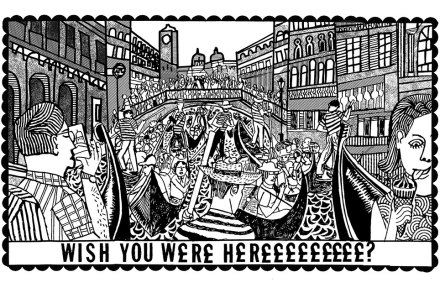
Tourists are the new pariahs

Think of Majorca and what do you picture? Maybe it is elegant tapas bars in the Gothic quarter of Palma, full of yachties and foodies from across the world. Maybe it is literary pilgrims trekking to the house of Robert Graves or noisy parties of Brits and Germans, squabbling over sunbeds in Magaluf. In one Japanese town, residents have erected a screen to block a much-prized view of Mount Fuji Any which way, what you picture is tourists. Lots of tourists. So many tourists that the reality of Majorca as an authentic place is quite obscured, invisible under the weight of visitors. And if you think that sounds bad, so do the Majorcans, which is why they are finally – perhaps belatedly – rebelling.

Sick of Cornwall? Visit Cornouaille

I am Cornish. Indeed I am so Cornish my sister lives about three miles from where my echt Cornish ancestors lived in the 13th century (near Falmouth), and my mum makes working-class Cornish recipes so obscurely Cornish most of the Cornish have barely heard of them (‘date and lemon pie’). As such, I am pretty fond of the place, and I like to go back as much as I can. Except in summer, when it’s crowded. And increasingly May. Or September. Or October. Or the rest of autumn. And Christmas, And Easter. And New Year. And any weekend at any time, ever.

Sam Altman is not evil

It’s a classic trajectory. You start as a likeable and geeky tech tyro, you morph into a squillionaire with disagreeable habits, and somewhere on the way you become loathed by large sections of the population.  It happened to Bill Gates – remember when he was an amiable nerd making glitchy but intriguing software? Now he is a mogul apparently injecting us with nanobots. Look at the career of Elon Musk, once a move-and-break-things hero sending amazing jets into the sky. Now he’s the brooding Trumpite Satan, who has supposedly turned Twitter into a fascist hellhole. Steve Jobs of Apple nearly went through the same process, but avoided it by the devious means of dying too young. Now the same evolution seems to be happening to OpenAI CEO Sam Altman.

No tips please, we’re British

I hate tipping, not because I am intrinsically mean but because of the anxiety it induces. You pitch up at some glam hotel, after a gruelling flight, then the guy next to the concierge takes your bags to your room, and, as you go, you fumble in your pockets, searching for the mysterious notes and coins, even as you try to estimate the right amount to tip the porter. Tipping is yet another toxic byproduct of America’s tragic past and should be treated like an invasive species This is a complex equation at the best of times, as it involves so many imponderables: the state of the local economy, the likely wages hereabouts, the emotionally correct sum to give – not insultingly little but not so much that you look like an oligarch.

AI is coming for artists

It’s a famous theme in science fiction: the idea that, one day, humanity and the thinking machines will somehow go to war. It’s the narrative spine of The Terminator films. It’s implied in 2001, A Space Odyssey. You can find it in Neuromancer, The Hyperian Cantos, Ex Machina, The Creator and I, Robot (the Asimov stories and subsequent film). In one of the fundamental texts of sci-fi, Frank Herbert’s Dune, this apocalyptic conflict is given a name: the ‘Butlerian Jihad’. Personally, I’ve always dismissed the concept of Butlerian Jihad as fanciful, even as I accept that Artificial General Intelligence – machines as smart as the best of us – is coming at us fast. And yet in recent weeks I’ve started to wonder.

Sean Thomas, Kara Kennedy, Philip Hensher, Damian Thompson and Toby Young

35 min listen

On this week’s Spectator Out Loud: Sean Thomas worries that Paris has lost some of its charm (1:21); Kara Kennedy reports on US-style opioids arriving in Britain (8:43); Philip Hensher describes how an affair which ruined one woman would be the making of another (15:32); Damian Thompson reflects on his sobriety and his battle with British chemists (23:58); and, Toby Young argues a proposed law in Wales amounts to an assault on parliamentary sovereignty (29:26). Produced and presented by Patrick Gibbons.

Paris, city of blight

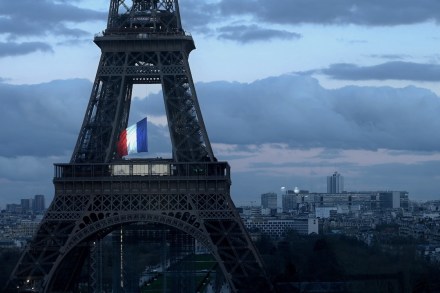
You know that feeling when you haven’t seen someone for several years and when you do, you really notice the changes? Generally it is a melancholy moment: you spot the extra wrinkles, the added pounds. Occasionally it can be positive: gym-toned physique, amusing new green-and-orange hair. Lots of us had these moments as we emerged, blinking and bewildered, from the bunker of Covid. I’ve just had this same experience, but with a city. Paris. The French capital is a place that I know well. I must have visited a dozen times over the decades. I’ve seen the Louvre Pyramid go up, I’ve seen Notre-Dame go down in flames (on TV, in a horrified airport in Vegas). But I have not been to Paris since before the pandemic, so I was keen to check out how the old girl was doing.

Why we love hideous food

I’m sitting on a stone terrace in the winsome south Breton port of Sainte Marine, which oversees France’s prettiest river (the Odet), and I’m excitedly tucking into a dozen gleaming Morbihan oysters. I am doing this partly because I am writing about travel in Brittany and oysters are very much part of the package here – you come to Brittany, you must consume oysters (also cake, cider, biscuits, tinned sardines and chunky buckwheat crepes). But I’m also eating oysters because I really love oysters. The idea is bad, the texture is worse – slimy, crunchy feathers and bones At this point I imagine a reasonable percentage of Spectator readers will be wincing. Because oysters are a divisive issue.

Why is Latin America so violent?

As locations go, they don’t get more humdrum than the address ‘Carrera 79B, #45D/94’. It is so anonymous it sounds encrypted. Nor, in reality, does it look like anything special: a flat roof, next to a shuttered language school, above a wall of graffiti, in a lower middle-class suburb of another Spanish speaking city. But then you notice the razorwire surrounding the nearby boutique. The armed guard outside the local bank. And you remember why this address, in the inner suburbs of Medellin Colombia, is notorious: this is where fugitive cocaine warlord Pablo Escobar was finally shot by cops in 1993 as he tried to flee across that roof.  Native American empires were bizarrely cruel – even before the Europeans arrived Knowing that, everything looks different.

The person who edited this will soon be redundant

Whenever I write about AI on The Spectator (which is a lot) I always get comments like ‘Yawn. Wake me up when AI actually does something’. And, to a point, these are fair comments. For all its remarkable feats, its photos of Shakespeare with weird fingers, its videos of dogs typing in spacesuits, the new wave of AI hasn’t really done something simultaneously concrete and astonishing, something where you can draw breath and say ‘Wow, that is definitely replacing this particular job’. In my experience, these AI chatbots respond better if you are polite, an uncanny fact Well, now I can address that.

Is AI the biggest Brexit benefit?

It’s not easy being a Leaver, right now. For a start, the government that actually delivered Brexit – the present Tory government – is facing a one-sided electoral hammering which will make the Anglo-Zanzibar war of 1896 (duration: 38 minutes) look like a tense, nail-biting score draw. In the same vein, polls consistently show high levels of Bregret and Bremorse, with a hefty majority actively wishing to Rejoin.  If you are reading this and you are in the EU, you might find it trickier In that depressing light – for Brexiteers – let me introduce the ray of sunshine that is ‘Claude’.

William Moore, Sean Thomas, Matt Ridley, Lionel Shriver and Kate Andrews

41 min listen

On this week’s Spectator Out Loud: William Moore questions if the Church of England is about the apologise for Christianity (1:19); Sean Thomas recounts his experience taking ayahuasca in Colombia (8:13); Matt Ridley argues that private landowners make better conservationists (16:40); Lionel Shriver warns against pathological niceness in the debate about immigration (28:37); and, Kate Andrews reviews a play at the Olivier about Nye Bevan (36:57). Presented by Patrick Gibbons.

Will the Red Wall revolt split the right?

48 min listen

On the podcast this week: is Rishi ready for a Red Wall rebellion?  Lee Anderson’s defection to Reform is an indication of the final collapse of the Tories’ 2019 electoral coalition and the new split in the right, writes Katy Balls in her cover story. For the first time in many years the Tories are polling below 25 per cent. Reform is at 15 per cent. The hope in Reform now is that Anderson attracts so much publicity from the right and the left that he will bring the party name recognition and electoral cut-through. Leader of Reform UK Richard Tice joins Katy on the podcast to discuss.

The secret to taking ayahuasca

Antioquia, Colombia If you’ve ever wondered what happened to drug lord Pablo Escobar’s enormous cocaine and occasional execution palace, as featured in the Netflix series Narcos, I can tell you. These days – following the violent death of Escobar in 1993 and the consequent escape of his pet hippos from his private zoo – the estate is now a garish, plasticky, hippo-themed children’s waterpark called Hacienda Nápoles. I have just driven past it. I am deep in the Colombian province of Antioquia.

Now AI is coming for musicians

Do you remember those far off misty days of yore, when shocking, startling, amazing, disquieting revelations from the world of Artificial Intelligence only arrived every year or two, or even longer? It was about, ooh, a fortnight ago: a wistful, innocent time of smiling boy scouts, and honey for tea, and vicars in bicycle clips, and all we had to worry about was this funny new thing called GPT3. For about an hour after making that ditty I had that chorus ‘You can’t even hijack planes’ spinning in my mind Since then, things have, to say the least, accelerated.

Why Cambodia is the best country in the world

Yeah, I know, ridiculous. Cambodia? How can that be the best country in the entire world? For a start, most people can’t place it on a map. This includes close relatives of mine who are studying geography at A Level. They know all about the Marxist topography of urbanism, but Cambodia, err, um, is that near Africa? Also, Cambodia?? Isn’t that the country that suffered a fearsome Maoist genocide within living memory, with a quarter of its population dying by execution, torture, famine and disease, and the rest left so hungry they resorted to eating giant spiders roasted in tomato powder? The landscape is agreeably green, the jungles are often untouched, the islands can be Edenic (but primitive) Well yes, it is.

Are we ready for P(doom)?

It’s difficult to remember a time before climate change – a time when our daily discourse, our newspaper front pages, endless movies and TV documentaries, and Al Gore, Greta Thunberg and Sir David Attenborough (Peace Be Upon Him), were not lecturing us, sternly and constantly, about the threat to our planet from the ‘climate emergency’, the melting of the ice caps, the levelling of the Amazon jungle, the failure of the Gulf Stream, the desertification of Spain, and the complete and total cessation of snowfall in Great Britain, apart from the regular occasions when it snows.  In fact, if you are under 30 you may not even be aware that there was a time when we didn’t vex about Anthropogenic Global Warming.